

Sales pillar
Sales coaching
The sales coaching system that closes the gap between methodology and behaviour. Practice, not slides — AI-powered, manager-amplifying, evidence-led.
Free to start. No credit card.
Or create your account — free to start, no credit card, and your first roleplay is waiting inside.
The failure mode
Why most sales coaching fails
Managers don't have time
The intent is there; the calendar isn't. Coaching becomes the thing that gets cut when the forecast call runs long, which means it's the first thing to disappear when reps need it most.
Coaching is reactive, not designed
Most managers coach whatever happened on the last call — the deal that slipped, the demo that flopped. That may not be the rep's real gap. Without a designed focus (one skill, one rep, this week), coaching scatters across symptoms and never compounds.
Coaching is lecturing
In a typical 1:1, the manager talks for the majority of the time. But skill transfer needs the rep talking and reflecting — explaining what they tried, what they'd change, what they want to test next week. Lecture-led coaching produces note-taking, not behaviour change.
No practice loop
A gap gets identified in the 1:1, the rep is told to "work on it" — and there's no drill, no measurable progress, no evidence at the next 1:1 that anything changed. The rep returns the following week with the same gap, and the manager runs the same conversation. Nothing compounds.
Coaching evaluates instead of develops
When coaching feels like performance review, reps go defensive — they hide weaknesses instead of working on them. Effective coaching is developmental: low-stakes practice, fast feedback, the rep choosing the focus, the manager extending. Evaluation belongs in a different conversation.

“We tried something like this before and it didn't work.”
Practice live
Practice sales coaching live with AI
Reading about coaching frameworks isn't doing them. Everboarder's AI buyers let reps practice specific skills in 5-minute sessions between 1:1s — so the manager's coaching time is spent on the conversation, not on running roleplay sessions they don't have time for.
Contextual Realism (SPCM) means the AI buyer matches the shape of the rep's real calls — same persona, same channel, same source. The same rubric the manager uses to score the live call is the rubric the AI uses to score the practice, so feedback is rubric-led not opinion-led.
Coach without a slot
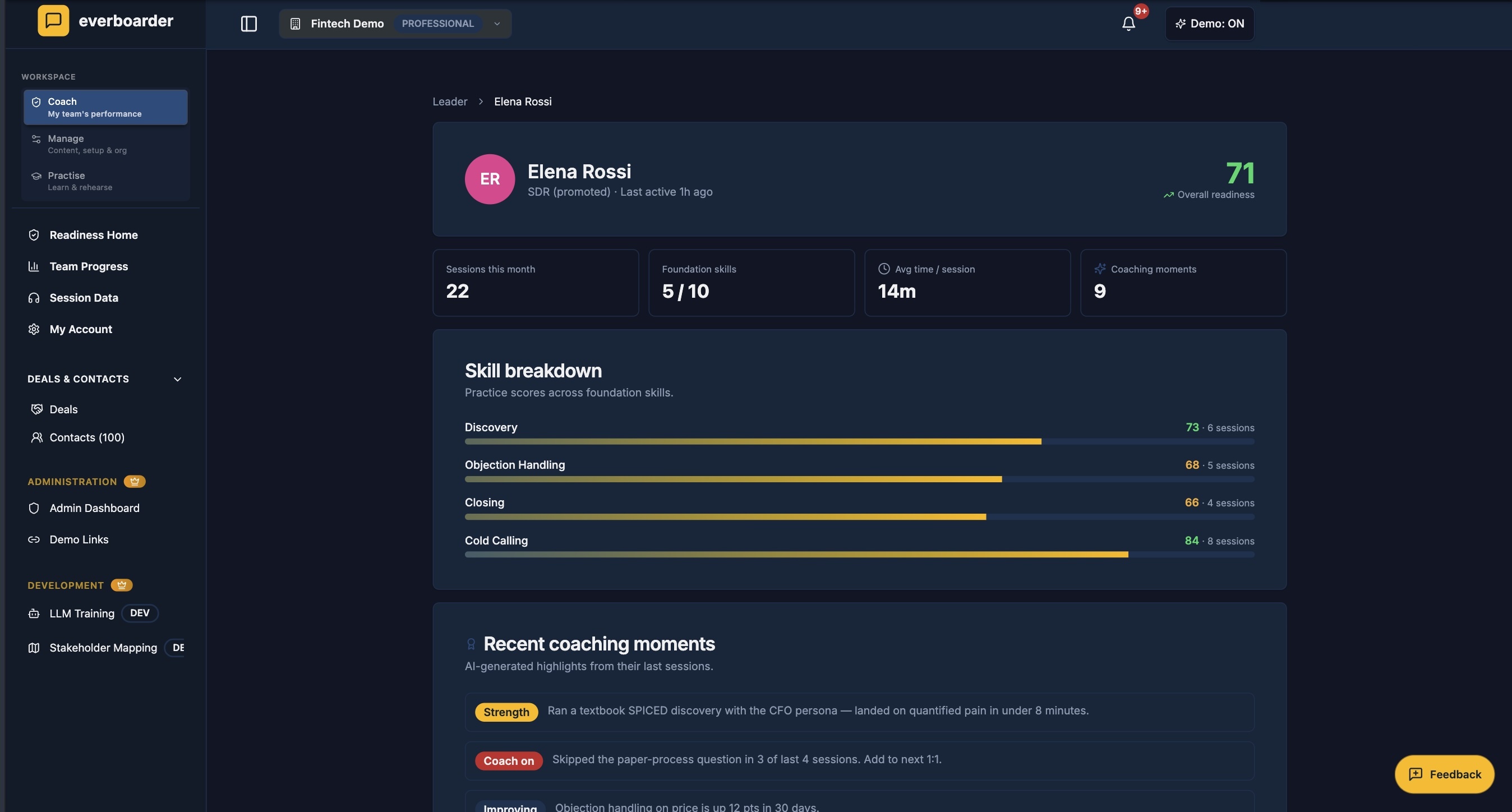
Coaching moments the manager didn't have to book.
AI coaching tagged Strength, Coach on, and Improving — generated from the rep's own practice reps, without a calendar invite. The page argues coaching should be systematic rather than a slot. This is that argument, shown.
- Per-skill moments surfaced automatically, not hunted for.
- The pattern is visible before the 1:1, so the 1:1 can act on it.
- The rubric the manager uses is the rubric the AI uses.
How everboarder helps
How Everboarder approaches sales coaching
Practice-based, not content-based
Every coaching session pairs with practice between sessions. The rep practices a specific skill against an AI buyer 5–10 times before the next 1:1. The manager sees the practice data and coaches the pattern, not just the symptom.
Contextual Realism (SPCM)
AI buyers vary by source, channel, and persona — so a skeptical CFO on a cold call doesn't behave like the same CFO on a warm referral. Practice transfers to live calls because the practice matches the real conversation shape.
Methodology-flexible
MEDDIC, MEDDPICC, BANT, SPIN, SPICED, Challenger — coaching scorecards and qualification gates adapt to the methodology your team actually runs. No rebuilding the rubric every time the team's framework shifts.
Real-time coaching during practice
Feedback arrives during the practice call, not three days later in a 1:1. The rep hears "you skipped Impact — try it again" while the muscle memory is still forming, instead of repeating the bad habit 40 times before the next coaching slot.
Manager-amplifying
Automates scoring, drill assignment, and progress tracking — so the manager's 1:1 time is spent on the conversation, not on writing the rubric and chasing rep practice logs. One manager can extend coaching across the full team without dropping the bar.
Free Solo for individuals, scalable for teams
Reps can start practicing on their own today. Teams add manager dashboards, methodology customisation, coaching-cadence reporting, and CRM integration when they're ready to roll the programme up.
Coach from evidence
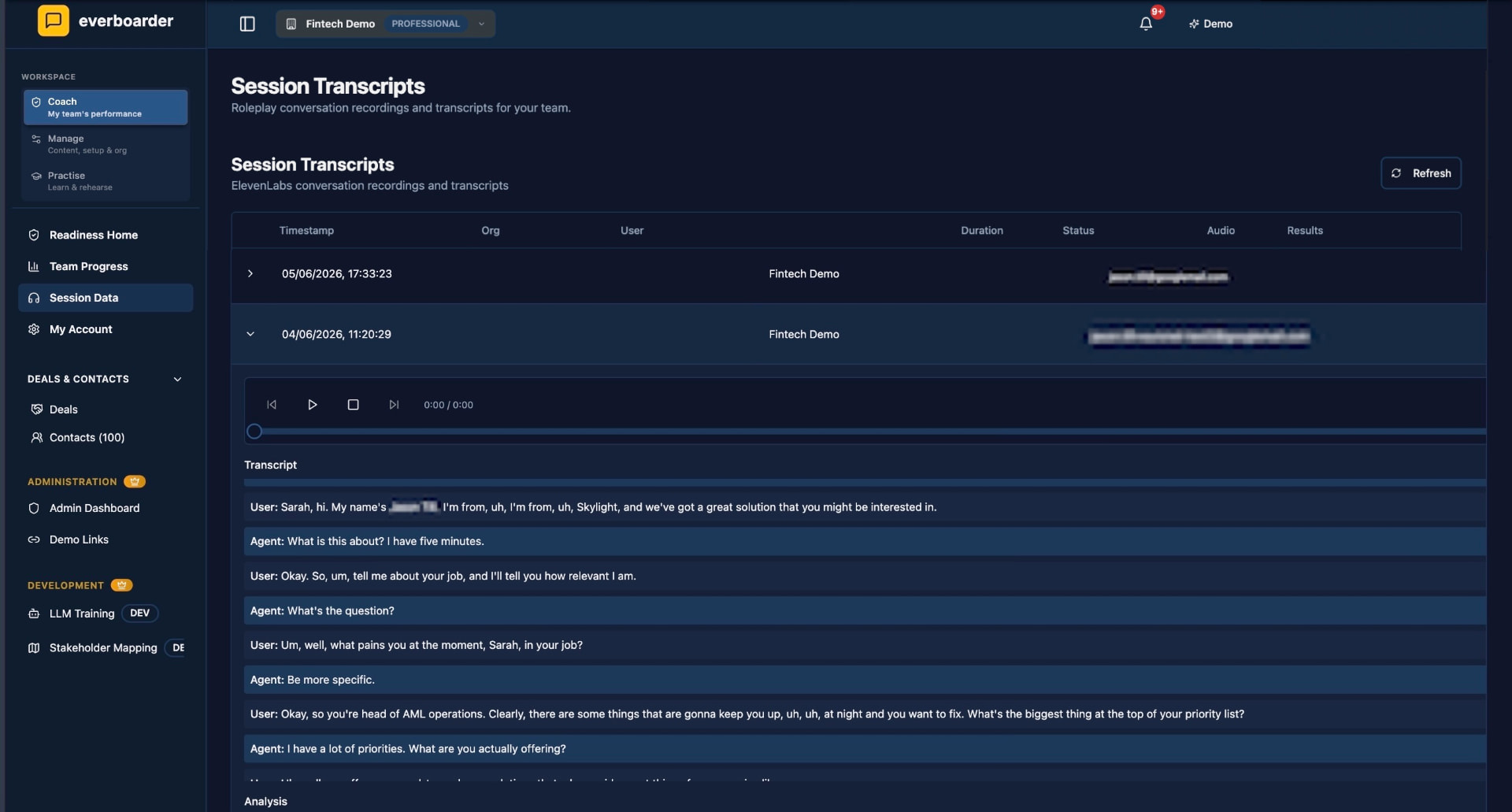
Coach from the transcript, not the recollection.
Every practice session records, transcribes, and analyses the call. A manager coaching from a transcript is coaching from evidence — the specific moment, the exact wording — instead of coaching from the rep's post-hoc summary of what they think happened.
- Full recording plus searchable transcript per session.
- The moment the rep skipped Impact is a timestamp, not a hunch.
- Coaching feedback references the exact line, not the general theme.
Key features for you
Sales coaching templates & resources
Every template pairs with an AI buyer to practice the skill it describes. Coming-soon items ship over the following weeks of Phase 2.
Sales coaching plan template
A weekly 1:1 sales coaching template — agenda, scorecard, action items — that turns coaching from a status update into measurable skill development.
30/60/90 day sales plan
A structured 30/60/90 day sales plan with Learn / Contribute / Lead phases, certification milestones at each gate, and AI practice tied to each phase.
Sales onboarding plan template
Ramp new hires to their first booked meeting in weeks, not months, with a guided practice path tied to the certification gates above.
Sales qualification scorecard
A scorecard rubric for qualifying deals against the team's chosen methodology, surfacing the conversation each letter requires.
Sales playbook template
A modular sales playbook template — personas, plays, objection responses, methodology overlay — built to evolve with the motion.
AI sales coach
Instant, consistent feedback on every practice call — real-time nudges and a five-dimension scorecard that assigns the next drill.
Practice live with AI
Practice the calls before you make them. Adaptive AI buyers tuned to your methodology, with real-time coaching during the practice.
The output
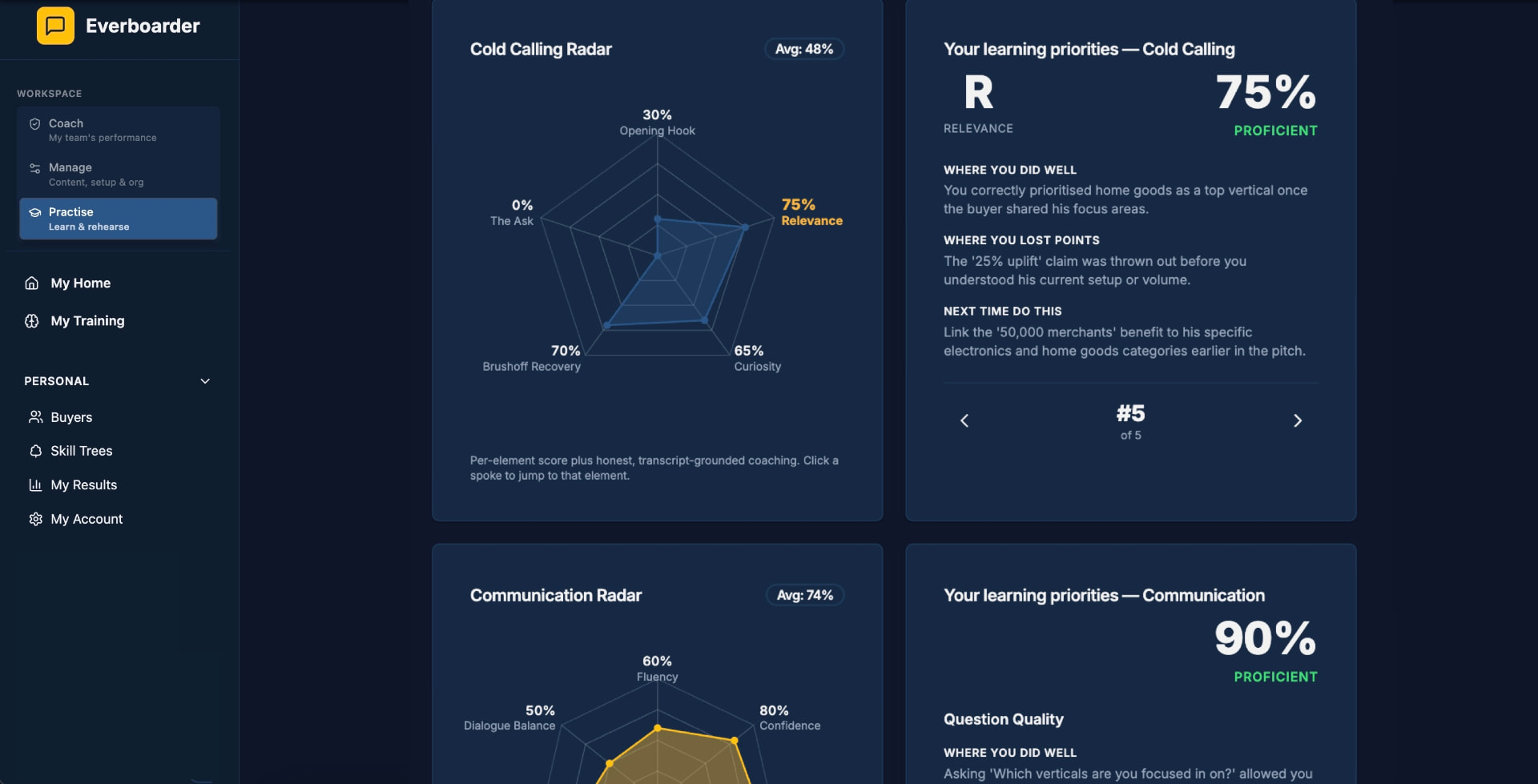
Coaching that names the moment, not the theme.
Every session ends with per-element scoring and coaching notes grounded in the transcript. The common objection to AI coaching is that it produces generic advice; this shows the opposite — specific, anchored, and paired with the next drill.
- Radar across the rubric's elements, so the pattern is visible at a glance.
- Coaching notes anchored to the exact line — no theme-level hand-waving.
- Next drill assigned automatically to close the gap before the next 1:1.
Sales teams at these companies practice with Everboarder











Methodology fit
Coach against the methodology you already run
Coaching scorecards mirror the methodology's letters, so the feedback the rep hears from coaching maps onto the qualification framework the team runs every day.
Your stack
Fits your sales stack
Integrations with your CRM, conversation intelligence platform (call recording, transcript analysis), sales engagement, learning management, and SSO providers are on the roadmap. We'll list specific vendors here as each integration ships — we don't claim integrations we haven't built.
Security: our Trust Centre sets out how we protect data and who processes it.
See coaching at team scale
A 15-minute team demo covers manager dashboards, methodology adoption rollup, coaching cadence reporting, and the practice library reps drill against between 1:1s.
Free to start. No credit card.
Frequently asked questions
Make coaching the system, not the slot
Coaching at scale, manager-amplifying, methodology-aligned. Free templates, free practice, evidence-led 1:1s.
Free for individuals. Team plans add manager dashboards, methodology customisation, and CRM integration.