

Framework
SPICED
The diagnostic framework from Winning by Design — Situation, Pain, Impact, Critical Event, Decision. Built for recurring-revenue SaaS. Free scorecard and live AI practice.
Free to start. No credit card.
Or create your account — free to start, no credit card, and your first roleplay is waiting inside.
The framework
What is SPICED?
SPICED is a five-component diagnostic framework from Winning by Design for needs-based selling in recurring-revenue SaaS — Situation, Pain, Impact, Critical Event, and Decision. The acronym is six letters but the framework is five components: Critical Event is represented by C and E together.
Unlike MEDDIC or BANT, SPICED explicitly spans the post-sale customer-success motion — net expansion, renewal, value realisation. It is built for businesses where the contract is the start of the relationship, not the end of the sale. That makes it the modern fit for subscription SaaS, where lifetime value depends on whether discovery surfaced the Pain and Impact that the customer-success team will need to deliver against.
SPICED is methodology-flexible — many teams run MEDDIC or MEDDPICC for qualification rigour and layer SPICED in as the discovery framework on top. The components don't compete; they overlap and reinforce each other. SPICED's strength is discovery depth; its weakness, compared to MEDDPICC, is procurement-process structure. Match the framework to the shape of the deal.
Component by component
SPICED component by component
Each component is a discovery gate. Below: what it means, a concrete example, and the most common way reps get it wrong.
Situation
The customer's broader system — environment, constraints, priorities, and the trigger that made change relevant now. Not company demographics; the operational reality the rep is selling into.
A 200-person SaaS company finishing a Series B raise, with a new VP of Finance, an audit cycle commitment, and a 12-month runway to operational maturity. The trigger is the audit commitment plus the new VP — both name a near-term need for the system.
Reps treat Situation as firmographics — "200 employees, Series B SaaS" — and stop there. Real Situation surfaces the operational pressure and the change trigger; without them, the rest of the framework runs against an empty room.
Pain
The specific friction, inefficiency, or risk the Situation is producing — observable, concrete, in the prospect's own language. Not a theme; a sharp problem with a name.
"Month-end reconciliation takes the finance team 14 days, blocks the monthly close, and forced 6 weekends of overtime per analyst last year. Audit flagged it as a control weakness in the last cycle."
Reps accept vague Pain ("we want to be more efficient," "the team is stretched") because pushing for specificity feels intrusive. Vague Pain produces vague Impact, and vague Impact loses to status quo every time.
Impact
The quantified business consequence of the Pain if nothing changes — tied to a metric the economic buyer owns and tracks. Dollars at risk, hours lost, customers churned, deals slipped.
"At current reconciliation lag, $X of accrued revenue is mis-reported each quarter, audit risk costs the company a $Y remediation budget annually, and the team's turnover risk in finance ops is the executive concern that put this project on the CFO's quarterly board commitments."
Reps name the Pain but never quantify the Impact — usually because the Impact conversation requires asking the customer to do arithmetic in front of you. Without Impact, the prospect can rationally choose status quo; with Impact, they can't.
Critical Event
The external deadline or trigger that converts "someday" into "by date X" — a board commitment, contract renewal, fiscal year end, product launch, audit cycle, executive transition. The two letters C+E together represent this single component.
"The CFO committed at the last board meeting to close the reconciliation gap by end of Q3. A new system must be live, integrated, and producing clean month-end numbers by then. Slip past Q3 and the commitment is missed in front of the board."
Reps invent Critical Events out of urgency they don't have — "end-of-quarter discount expires Friday" — instead of finding the prospect's real one. A fake Critical Event creates short-term pressure and long-term trust damage; the real one moves the deal without either.
Decision
How the buyer decides — process, stakeholders, criteria, timeline. Overlaps MEDDIC's Decision Process and Decision Criteria, plus the Economic Buyer dimension. The mechanics of the choice, in writing.
"Three vendors in active evaluation. The CRO and CFO co-decide. Decision criteria are: depth of CRM integration, sub-200ms latency, audit log retention, and 6-month payback. Procurement and security review run in parallel in week 4. Final sign-off targeted for the end of the month."
Reps treat Decision as a single signature — usually the Champion's. The actual Decision is a multi-stakeholder process with criteria the rep hasn't surfaced. Missing the Decision shape is the late-stage equivalent of missing the Critical Event: the deal stalls because the process the rep mapped doesn't match the process the buyer's running.
Selling above $100K with formal procurement? SPICED's strength is discovery; MEDDPICC adds Paper Process and Competition for enterprise procurement-heavy deals. See MEDDPICC →
Reading the components is not the same as running them. Practice SPICED against an AI buyer with a framework-specific scorecard.
Practice SPICED with AIWorked example
Worked example: a Series-B SaaS deal qualified with SPICED
The deal. Acme, a Series-B SaaS company selling a finance-ops product, has an $80K ARR opportunity at FinanceCo — a 5,000-employee financial services firm. The rep, Priya, is qualifying with SPICED across a ~90-day cycle. The buyer is evaluating Acme alongside other vendors and the status-quo / build-in-house option.
Situation. FinanceCo finished a Series B raise eight months ago, hired a new VP of Finance Operations in Q1, and committed at the last board meeting to close a known control weakness in month-end reconciliation by end of Q3. The new VP plus the audit cycle plus the board commitment are the change triggers — three signals, not one.
Pain. Month-end reconciliation takes the finance team 14 days, blocks the monthly close, and forced 6 weekends of overtime per analyst last year. The team's turnover risk is real; audit flagged the lag as a control weakness in the last cycle. Sharp, named, observable.
Impact — the load-bearing letter. The VP can defend the project to the CFO with a number the CFO already tracks. Without that number, the project sits behind three other Q3 initiatives. With it, the Q3 board commitment becomes the gating decision.
Critical Event. The CFO's Q3 board commitment is the Critical Event — a date the prospect named, attached to a public stakeholder, with a measurable outcome. A new system must be live, integrated, and producing clean month-end numbers by end of Q3. Slip past Q3 and the commitment is missed in front of the board.
Decision. Three vendors active. CRO and CFO co-decide. Criteria, in writing: CRM integration depth, sub-200ms latency, audit log retention, 6-month payback. Procurement and security review run in parallel in week 4. Final sign-off targeted by end-of-month, then implementation against the Q3 deadline.
The two lessons. First, Pain and Impact are two different conversations — Pain earned the meeting; Impact earned the budget. Second, Critical Event was the prospect's, not the rep's — Priya didn't manufacture urgency, she surfaced the board commitment the CFO had already made.
Outcome.
SPICED as a mode
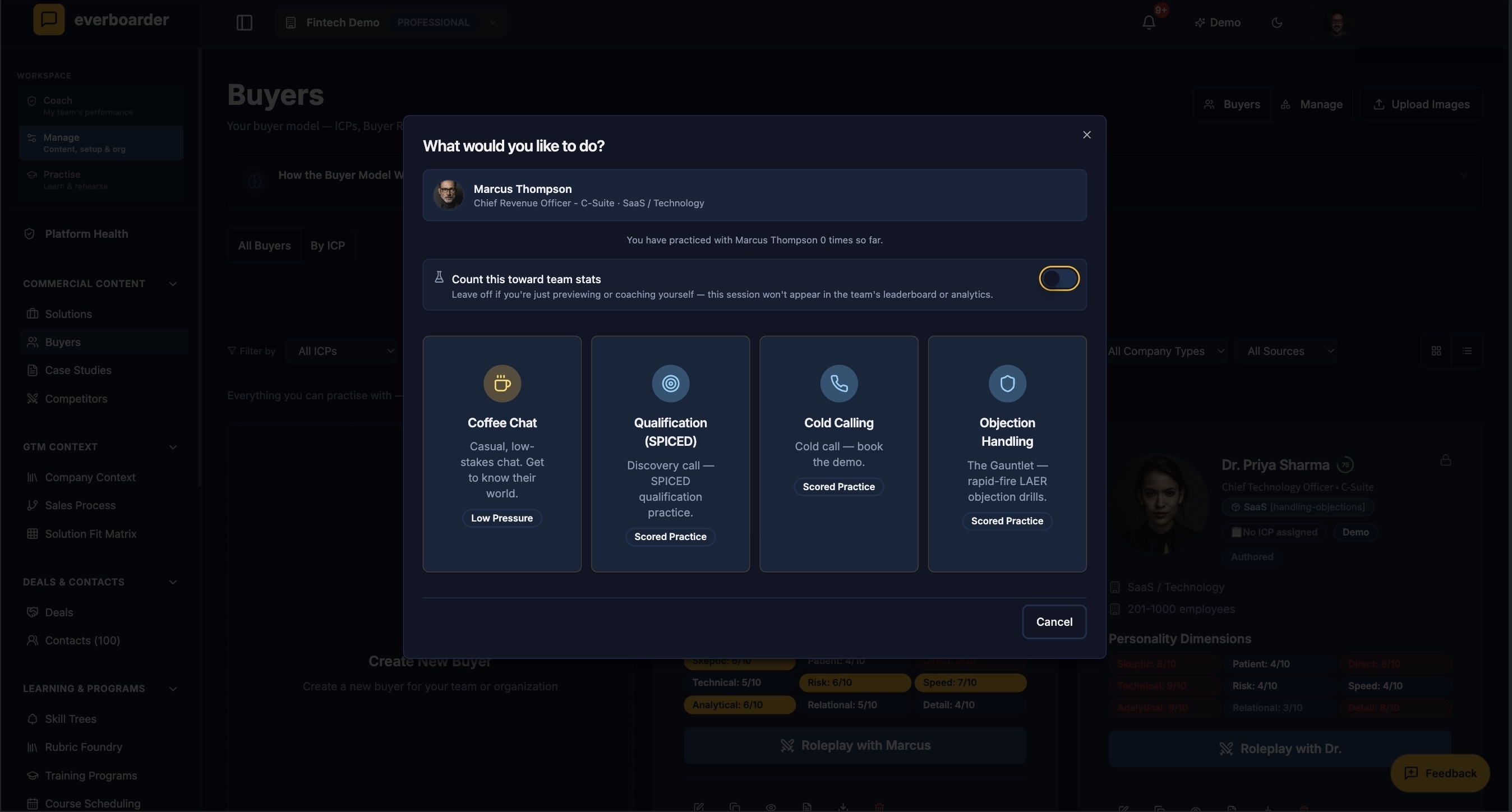
SPICED isn't a tag — it's a scored practice mode.
Pick SPICED at the mode picker and the whole session changes shape: an AI buyer that expects diagnostic questions, a scorecard graded on Impact quantification and Critical Event surfacing, coaching that speaks in the five components. Not a CRM field. A rubric.
- SPICED as a first-class mode alongside qualification, discovery and drill.
- The AI buyer resists Impact until the rep asks in numbers the CFO would accept.
- Free tier — pick the format and start; no manager needed to seed the scenario.
Pitfalls
Five common SPICED mistakes
Generic Situation discovery
Reps conflate Situation with company demographics — headcount, funding stage, vertical — and skip the operational reality. Real Situation surfaces what's actually happening day-to-day, the constraints the prospect is operating under, and the trigger that made change relevant now. Without that layer, Pain and Impact float free.
Confusing Pain with Impact
Pain is the observable friction ("reconciliation takes 14 days"). Impact is the quantified business consequence ("costs $X in misreported accruals, $Y in audit remediation, plus team turnover risk"). Reps frequently name a Pain, get nods, and skip Impact — leaving status quo as the rational choice. The two letters are not interchangeable.
No Critical Event
If there's no real external deadline forcing a decision by a specific date, the deal isn't qualified — period. The most expensive SPICED mistake is inventing Critical Events out of pipeline pressure ("end of quarter," "my forecast") rather than finding the prospect's real one. Without C·E, the deal slips, every cycle, forever.
Treating Decision as a late-stage concern
Reps push Decision-mapping to week 8 because it feels uncomfortable to ask in week 2 — and then discover at week 11 that the decision criteria they assumed are wrong, the decision-maker is someone they haven't met, or procurement is going to add 6 weeks they didn't plan for. Decision belongs in early discovery, not in late-stage close planning.
Skipping the post-sale/CS integration
SPICED is one of the few qualification frameworks that explicitly spans the post-sale customer-success motion — net expansion, renewal risk, value realisation. Reps trained on MEDDIC or BANT instinctively close the framework at sign-off and hand off cold. SPICED's strength in recurring-revenue motions evaporates if the framework stops at the contract.
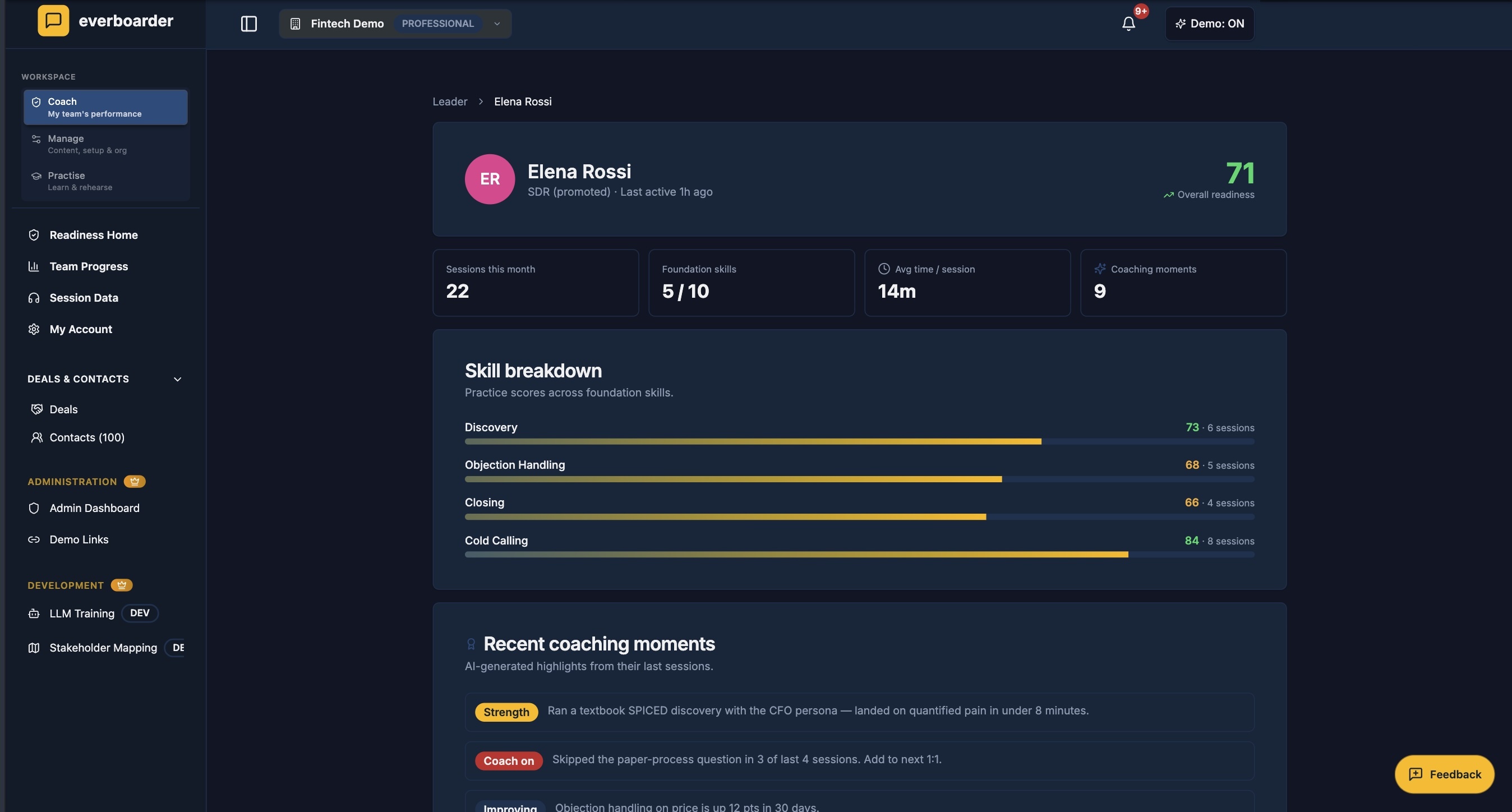
Coaching in SPICED's language
"Ran a textbook SPICED discovery — landed on quantified Impact in 8 minutes."
Every session ends with coaching tagged to the five components. Not "good discovery" — Situation strong, Pain sharp, Impact quantified, Critical Event surfaced, Decision mapped. The framework surfaces in the feedback the rep reads, so behaviour changes on the next rep, not next quarter.
- Per-component coaching moments tagged strength, coach-on, improving.
- Rep-level readiness curve rolls week over week to managers.
- Feedback vocabulary is SPICED, end to end — no generic sales platitudes.

Practice live
Practice SPICED live with AI
SPICED adoption fails for the same reason every methodology rollout fails: there is no practice gap between the training workshop and the live call. Reps learn the five components in a Tuesday workshop and never rehearse them before Wednesday's discovery call. The framework stays in slides; the behaviour never changes.
Everboarder closes that gap with short, repeated practice against a SPICED-tuned AI buyer. Quantify Impact under pressure. Surface the Critical Event the prospect won't volunteer. Map Decision early when the conversation feels premature. The methodology-specific scorecard scores each component against the conversation — not against CRM field completion — and real-time coaching flags missed components the moment the rep moves past them, while the muscle memory is still forming.
For teams, manager dashboards roll up SPICED adoption — book a demo to see it.
Practice SPICED, don't just read about it
Reading the five components is not the same as running them on call 14 of the week. Practice against a SPICED-tuned AI buyer; layer the framework into your motion.
Free to start. No credit card.
When to use it
When to use SPICED vs alternative frameworks
Match the framework to the deal shape. SPICED is right-sized for SaaS / subscription motions where discovery quality drives close rate and net expansion drives lifetime value.
| Framework | Use it when |
|---|---|
| SPICED | Recurring-revenue SaaS where discovery quality drives close rate; net expansion and customer-success integration matter as much as the initial close. |
| MEDDIC | $50K–$500K enterprise deals, 3–5 stakeholders, 3–9 month cycles, no procurement-heavy buying. Pairs with SPICED as a qualification overlay. |
| MEDDPICC | Enterprise above $100K ARR with formal procurement, security review, legal redlines, competitive RFPs. Procurement structure SPICED doesn't try to cover. |
| BANT | Transactional inbound triage, short cycles, speed beats rigour. Budget / Authority / Need / Timeline as a quick gate. |
| SPIN Selling | Discovery-heavy sales where the prospect doesn't yet know they have the problem. Pairs well with SPICED as a question-design overlay. |
| Solution Selling | Pain-chain frameworks for consultative motions — diagnose before prescribing. Strong in services-led sales. |
Frequently asked questions
Run SPICED for real
Five components are easy to read and hard to run. Get the practice and the AI buyer that turn methodology into behaviour.
Free to start. No credit card.