

Framework
MEDDIC
The B2B sales qualification framework created at PTC in 1996. Used by 73% of SaaS companies selling above $100K ARR — according to MEDDIC Academy. Free MEDDIC checklist template and AI practice.
Free to start. No credit card.
Or create your account — free to start, no credit card, and your first roleplay is waiting inside.
The framework
What is MEDDIC?
MEDDIC is a six-letter B2B sales qualification framework — Metrics, Economic Buyer, Decision Criteria, Decision Process, Identify Pain, Champion. Each letter is a gate the deal has to pass before it advances. The framework gives reps a structured way to qualify complex, multi-stakeholder deals between $50K and $500K with cycles of 3–9 months, where the buyer is sophisticated but procurement is not the bottleneck.
MEDDIC was developed at PTC in the early 1990s, where it is credited with helping grow the company from roughly $300M to $1B in revenue. According to MEDDIC Academy, 73% of SaaS companies selling above $100K ARR now run MEDDIC or a variant — at enterprise scale, that variant is usually MEDDPICC, which adds Paper Process and Competition.
The framework is methodology-flexible but rigour-strict. Skip a letter and the deal slips — usually at week 11, when the unconfirmed Economic Buyer or untested Champion finally surfaces and quietly kills the forecast.
Letter by letter
MEDDIC letter by letter
Each letter is a qualification gate. Below: what it means, a concrete example, and the most common way reps get it wrong.
Metrics
The quantified business outcome the prospect expects from solving this problem. Dollars saved, hours reclaimed, conversion lifted — a number, not a sentiment.
"Cut reconciliation time from 14 days to 5" or "reduce ramp time from 9 months to 4." Metrics anchor the ROI story you'll need at the budget conversation.
Reps accept "improve efficiency" or "modernise the stack" as a metric. Those are themes, not metrics. Without a number, there's nothing to defend when the EB asks why now.
Economic Buyer
The single person with the discretionary authority and budget to say yes — independent of consensus, committee, or executive sponsor sign-off.
At a 200-person SaaS company, the EB for a $80K tool is usually the VP of the business unit. At enterprise, it may be a divisional CFO. The EB is rarely the person you've been talking to.
Reps confirm the Champion as the Economic Buyer and skip the meeting. The deal then dies in week 11 because the actual EB sees the proposal for the first time and has different priorities. Missing the EB early is the most expensive MEDDIC mistake.
Decision Criteria
The explicit list of features, capabilities, integrations, and constraints the prospect will evaluate vendors against — in writing where possible.
"Must integrate with Salesforce, SSO via Okta, SOC 2 Type II, sub-200ms latency, audit log retention 7 years." The criteria are the scorecard you'll be measured against.
Reps assume criteria from a demo conversation. Real criteria are set by the technical buyer, often after the demo, and frequently include items the rep never heard about.
Decision Process
The sequence of steps, approvals, and gates the deal must clear — from technical evaluation through final sign-off — with names and dates against each step.
"Tech eval (2 weeks, led by Priya) → security review (1 week, InfoSec) → CFO sign-off (1 week) → DocuSign." Named owners against each step.
Reps get "we'll get back to you next week" and write it down as the Decision Process. The real process has 4–6 steps the rep hasn't surfaced; the deal slips because no one mapped them in advance.
Identify Pain
The specific, named, quantified pain that motivates the prospect to act now rather than next year. Not "efficiency," not "growth" — a sharp problem with a cost.
"Reconciliation takes the finance team 14 days a month, blocking the monthly close and forcing 6 weekends of overtime per analyst per year. Audit flagged it last cycle." Named, quantified, with a deadline.
Reps accept generic pain ("we want to be more efficient") and lose to status quo. Without an identified, costed pain, there's no urgency — and "do nothing" beats "buy yours" by a wide margin.
Champion
An internal advocate with influence over the Economic Buyer, who actively sells your solution on your behalf when you're not in the room. Tested by asking them to do something difficult.
The Champion organises the demo with the EB, shares your one-pager in the leadership team meeting, and tells you which competitor's pricing came in lower. They have skin in your game.
Reps mistake an enthusiastic user for a Champion. A user who likes the demo is a Coach, not a Champion. The Champion test: "will they introduce me to the EB this week, and what will they say?" If the answer is vague, they aren't your Champion.
Need Paper Process and Competition tracking? Once deals run above $100K with formal procurement and competitive RFPs, the six MEDDIC letters need two more. See MEDDPICC →
Reading the letters is not the same as running them. Practise MEDDIC against an AI buyer with a framework-specific scorecard.
Practise MEDDIC with AIWorked example
Worked example: a Series-B SaaS deal, qualified end-to-end
The deal. Acme, a Series-B SaaS company selling a finance-ops product, has an $80K ARR opportunity at FinanceCo — a 5,000-employee financial services firm. The rep, Priya, is on her fourth call with the prospect. The deal closes 76 days after first contact.
Metrics. The Director of Finance Operations names the metric on call two: reduce month-end reconciliation from 14 days to 5, saving the finance team 6 weekends per analyst per year. Quantified, named, owned.
Economic Buyer — the load-bearing letter. Priya confirms on call three that the EB is the CFO, not the Director of Finance Ops she has been talking to. She asks for and gets a 20-minute meeting with the CFO in week 5. Most MEDDIC deals die because the rep never gets here. Priya's deal didn't.
Decision Criteria. In writing, from the technical buyer: Salesforce integration, SSO via Okta, SOC 2 Type II, sub-200ms latency, 7-year audit log retention. Priya gets the list, confirms Acme meets each criterion, and documents it.
Decision Process. Mapped in week 3: tech eval (2 weeks, led by Priya at FinanceCo) → security review (1 week, InfoSec) → CFO sign-off (1 week) → DocuSign. Named owners against each step. No surprises in the back half of the cycle because every step was on the timeline by week 3.
Identify Pain. The audit cycle had flagged reconciliation lag as a control weakness. The CFO had a quarterly board commitment to close it. Doing nothing was the most expensive option — which meant status quo could not win.
Champion — and the Champion test. The Director of Finance Ops introduced Priya to the CFO, shared the Acme one-pager in her leadership team meeting, and warned Priya that a competitor's pricing had come in 12% lower. Priya ran the Champion test in week 2: "would you introduce me to the CFO this week, and what will you say?" The Director said yes and previewed the message. That was the moment Priya knew she had a Champion, not a Coach.
The two lessons. First, the Economic Buyer was confirmed in week 3, not week 9. Second, the Champion was tested, not assumed. Those two letters are where most MEDDIC deals are won or lost.
Outcome. Deal closed in 76 days. Roughly the cycle length the team forecast at qualification, because every letter had been surfaced before week 4.
Ready for MEDDPICC?
If your deals run above $100K with formal procurement, add Paper Process and Competition — see the MEDDPICC guide.
Metrics, made visible
Pain and outcomes tagged MEDDIC — inside the buyer, before the call.
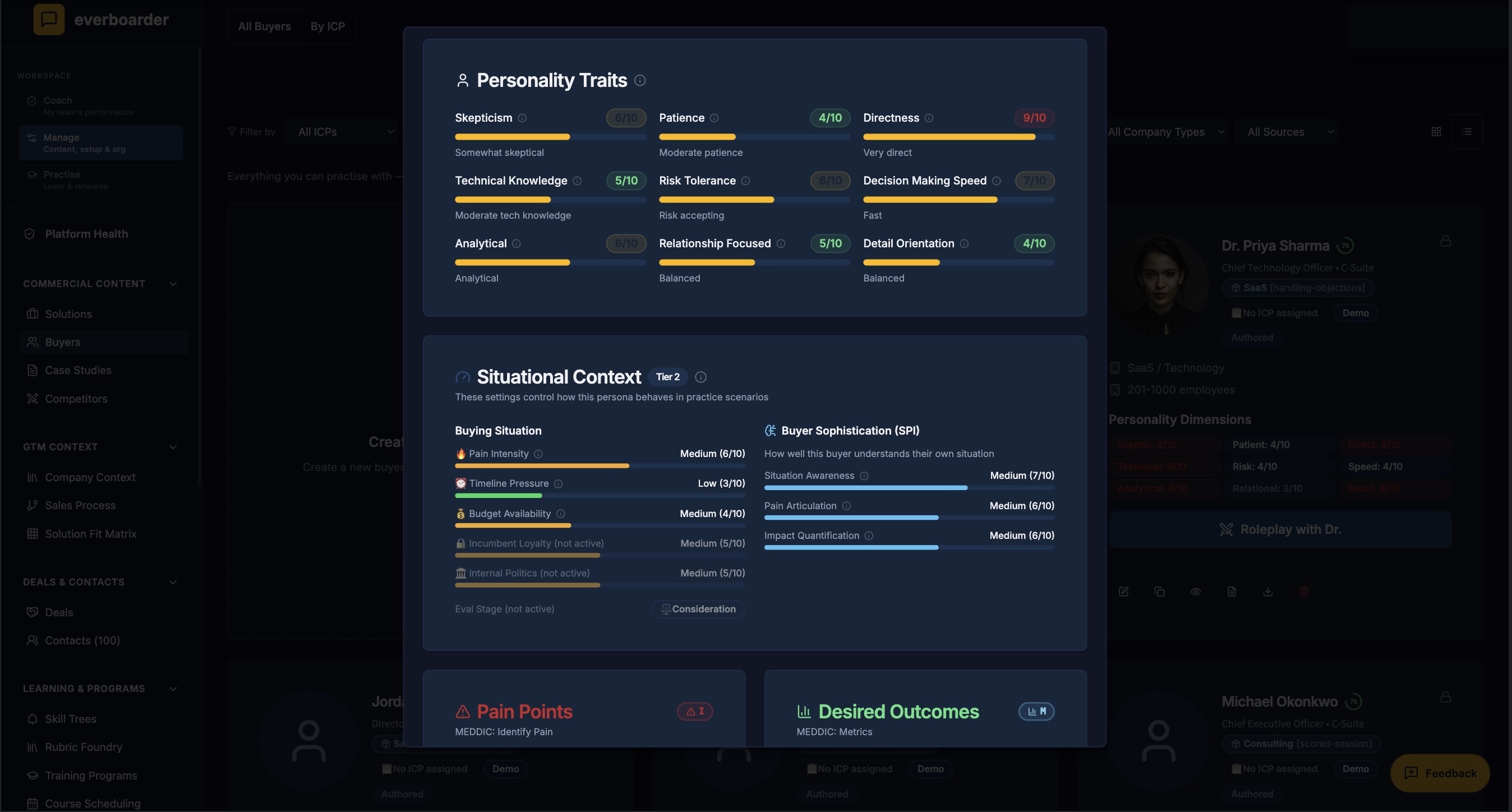
Every AI buyer carries MEDDIC-tagged Pain Points and Desired Outcomes on the dials, so reps read the letters on the model they're about to sell to. Metrics doesn't stay an abstract letter on a slide — it's the row the buyer will push back on the moment it isn't sharp enough.
- Personality and situational dials with MEDDIC tags on Pain and Desired Outcomes.
- Buyers who withhold Metrics until the rep asks in the buyer's own units.
- Same dials feed the scorecard — read the letter, run the letter, get scored on the letter.

“We need to see a clear ROI model before we can justify the spend.”
Practise live
Practise MEDDIC live with AI
MEDDIC adoption fails for the same reason every methodology rollout fails: there is no practice gap between the training workshop and the live call. Reps learn the six letters in a Tuesday session and never rehearse them before Wednesday's qualification call. The framework stays in slides; the behaviour never changes.
Everboarder closes that gap with short, repeated practice against an AI buyer tuned to enterprise qualification. Resist the Economic Buyer probe the way a real CFO would. Withhold Decision Criteria until pressed. Test the Champion with a real ask. The methodology-specific scorecard scores each letter against the conversation — not against CRM field completion — and real-time coaching flags missed letters the moment the rep moves past them, while the muscle memory is still forming.
For teams, manager dashboards roll up methodology adoption — book a demo to see it.
Pitfalls
Five common MEDDIC mistakes
Treating MEDDIC as a CRM compliance exercise
Reps fill the six fields after the call to keep the forecast clean, not before the call to actually qualify. The framework only works as a conversation guide. When MEDDIC becomes a data-entry chore, the qualifying questions never get asked and the deal slips at week 11.
Missing the Economic Buyer until it's too late
The single most expensive MEDDIC mistake. Reps confirm the Champion as the EB, skip the EB meeting, and discover in week 11 that the actual decision-maker has different priorities. The Champion test ("will you introduce me to the EB this week?") surfaces this gap in week 2 instead of week 11.
Confirming the Champion without testing them
An enthusiastic user is a Coach, not a Champion. The test is whether they'll take political risk on your behalf — introduce you to the Economic Buyer, share your one-pager in their leadership team, tell you their CFO's actual objection. If they won't do something difficult for you, they aren't your Champion.
Accepting generic pain and losing to status quo
"We want to be more efficient" is not pain. Without a named, quantified, time-bound pain, status quo wins — and status quo requires zero budget approval. The Identify Pain letter has to be sharp enough that doing nothing is the more expensive option, or the deal disqualifies itself.
Using MEDDIC when MEDDPICC is the right tool
MEDDIC is right-sized for $50K–$500K enterprise deals with 3–9 month cycles and no procurement-heavy buying. Once deals run above $100K with formal procurement, security questionnaires, and competitive RFPs, MEDDPICC's Paper Process and Competition letters earn their keep. Don't bolt those gates onto MEDDIC implicitly — switch frameworks.
Practise MEDDIC, don't just read about it
Reading the six letters is not the same as running them on call 14 of the week. Practise against an AI buyer; get the checklist; ship the framework into your motion.
Free to start. No credit card.
When to use it
When to use MEDDIC vs alternative frameworks
Match the framework to the deal shape. MEDDIC is right-sized for mid-market complex deals; enterprise procurement-heavy motions need MEDDPICC.
| Framework | Use it when |
|---|---|
| MEDDIC | $50K–$500K enterprise deals, 3–5 stakeholders, 3–9 month cycles, no procurement-heavy buying. The original six-letter framework. |
| MEDDPICC | Enterprise deals above $100K ARR, 5+ stakeholders, 90+ day cycles, formal procurement, security review, legal redlines, competitive evaluation. |
| BANT | Transactional B2B, inbound triage, short cycles where speed matters more than rigour. Budget / Authority / Need / Timeline as a quick gate. |
| SPIN Selling | Discovery-heavy sales where the prospect doesn't yet know they have the problem. Pairs well with MEDDIC as a discovery-stage overlay. |
| SPICED | Subscription motions where deal-cycle compression and net expansion drive the economics. Winning by Design's framework, tighter than MEDDIC for SaaS. |
| Solution Selling | Pain-chain frameworks for consultative motions — diagnose before prescribing. Strong in services-led sales; weaker when procurement is the bottleneck. |
Frequently asked questions
Run MEDDIC for real
The six letters are easy to read and hard to run. Get the practice and the checklist that turn methodology into behaviour.
Free to start. No credit card.