
PRACTICE
Live against the digital twin
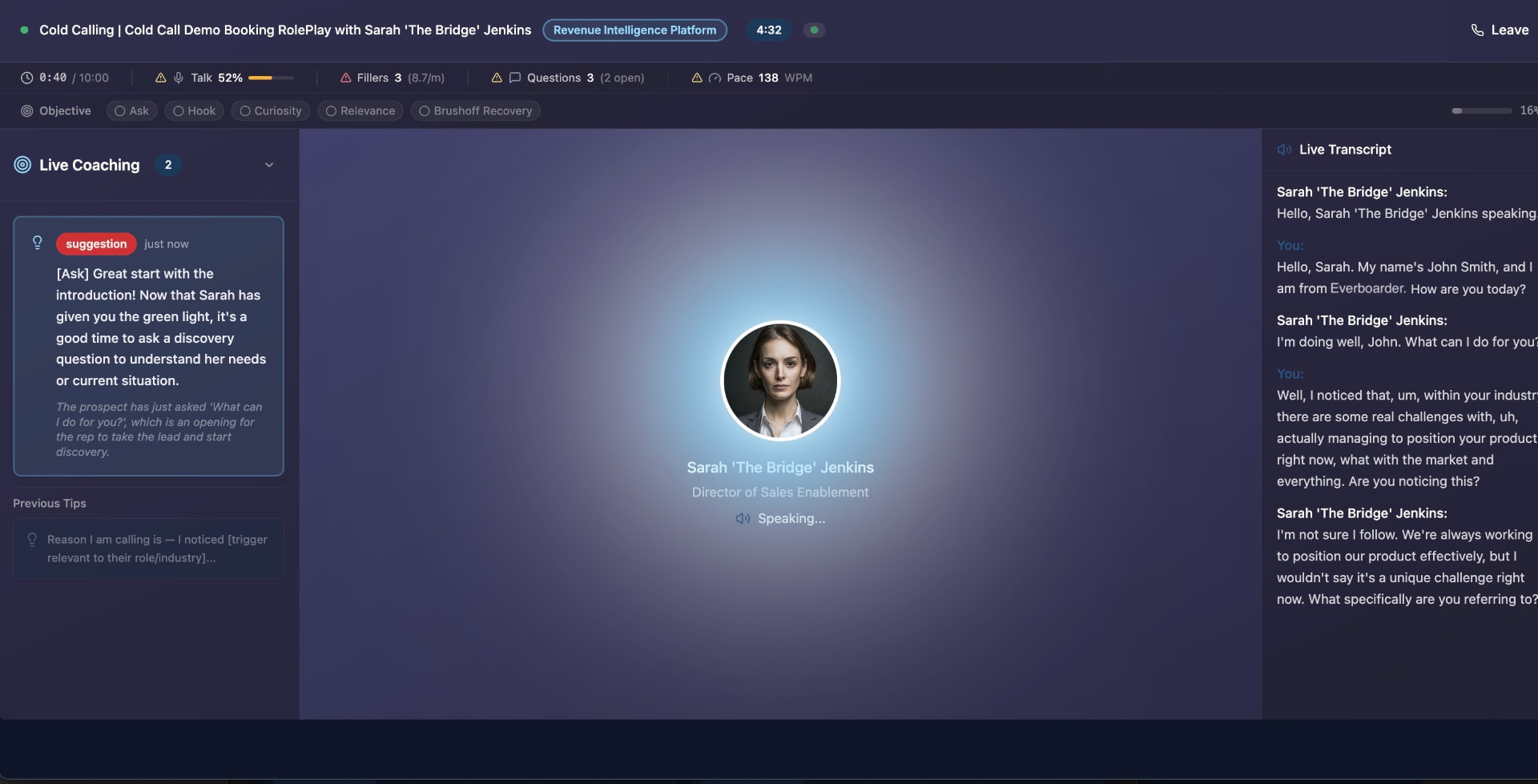
The subhead promises live AI sales practice against a digital twin of your buyer. This is that: voice or text, meters running, buyer withholding until the follow-up earns it.

For sales leaders
Live AI sales practice against a digital twin of your buyer — scored, spaced, and measured.
Free to start. No credit card.
Everboarder turns training into reps. Every session is scored, what a rep gets wrong sets what they practice next, and you see readiness before the quarter starts.
The problem
Months to ramp a new AE to full productivity
Source: The Bridge Group, 2026 AE Models, Motions & Metrics (158 B2B companies)
They are not inexperienced. Reps arrive with nearly four years of selling behind them and still take half a year to reach full productivity. At a median AE quota of $960K, every month of that ramp is roughly $80K of capacity that builds instead of produces.
Then you launch something. New product, new positioning, new competitor, new objection — and the deck goes round again. The team that took six months to get good at selling the last thing is now a beginner at selling this one.
Ramp isn't a one-time onboarding cost. It's a recurring tax on every change you make to what you sell.









“We already run a QBR and a coaching cadence. Why would this move the needle?”
Why it works
Two things the learning research is clear about — performing beats watching, and spacing beats cramming. A launch-day workshop is the worst shape available.
Adesope, Trevisan and Sundararajan (2017) reviewed the evidence on practice testing in Review of Educational Research. Practice testing outperformed restudying — and every other comparison condition they measured.
That is the whole problem with the slide deck. A rep who watches a presentation has been exposed to the material. A rep who has been asked to perform it has retrieved it, and retrieval is what builds the memory you can use under pressure on a live call.
Ask any sales leader how much of last quarter's training they think landed. The honest answer is the reason this page exists.
Cepeda, Pashler, Vul, Wixted and Rohrer (2006) synthesised 839 assessments across 317 experiments in Psychological Bulletin. The finding is consistent: practice distributed over time beats the same amount of practice crammed into one sitting.
A launch-day workshop is, structurally, the worst-shaped intervention the science describes. Everything delivered at once, at the point of least context, to people who will not touch it again until they are in front of a buyer.
A note on a statistic you have probably been quoted. You may have seen "87% of sales training is forgotten within a month." There is no primary source for it — the citation trail runs through vendor blogs and stops. We are not going to use it. The two findings above are real, peer-reviewed, and say something more useful anyway.
Build
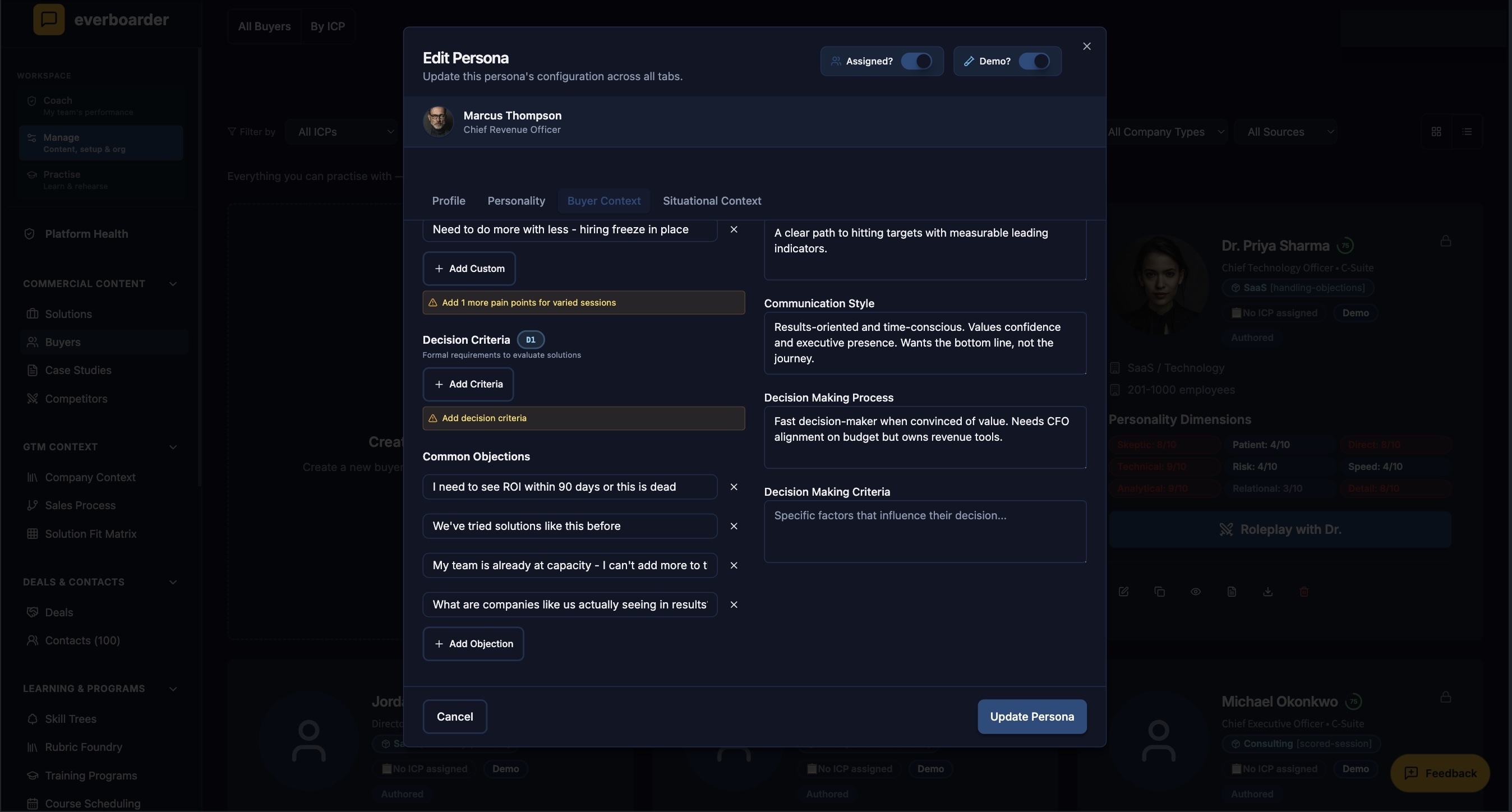
Build has to look like construction, not upload. The tabbed persona builder assembles the twin from your positioning, objections and competitive plays — and flags the gaps enablement didn't notice yet.
How everboarder trains
Your methodology, your product, your competitive landscape and your CRM context become a digital twin of your ICP. When you launch something, you update the twin — not a fifty-slide deck and three weeks of enablement calendar.
Reps run real sales conversations against that buyer, in voice or text, on their own time. As many times as it takes. The rep who needs eleven attempts gets eleven attempts, and nobody has to watch them take ten of them.
Every session is scored across sales technique and communication skill against the MEDDIC, MEDDPICC, SPICED, SPIN or Solution Selling framework you run. What a rep gets wrong sets what they practice next, spaced over weeks rather than delivered once — which is what coaching research says actually works. It happens without booking your managers' calendars.
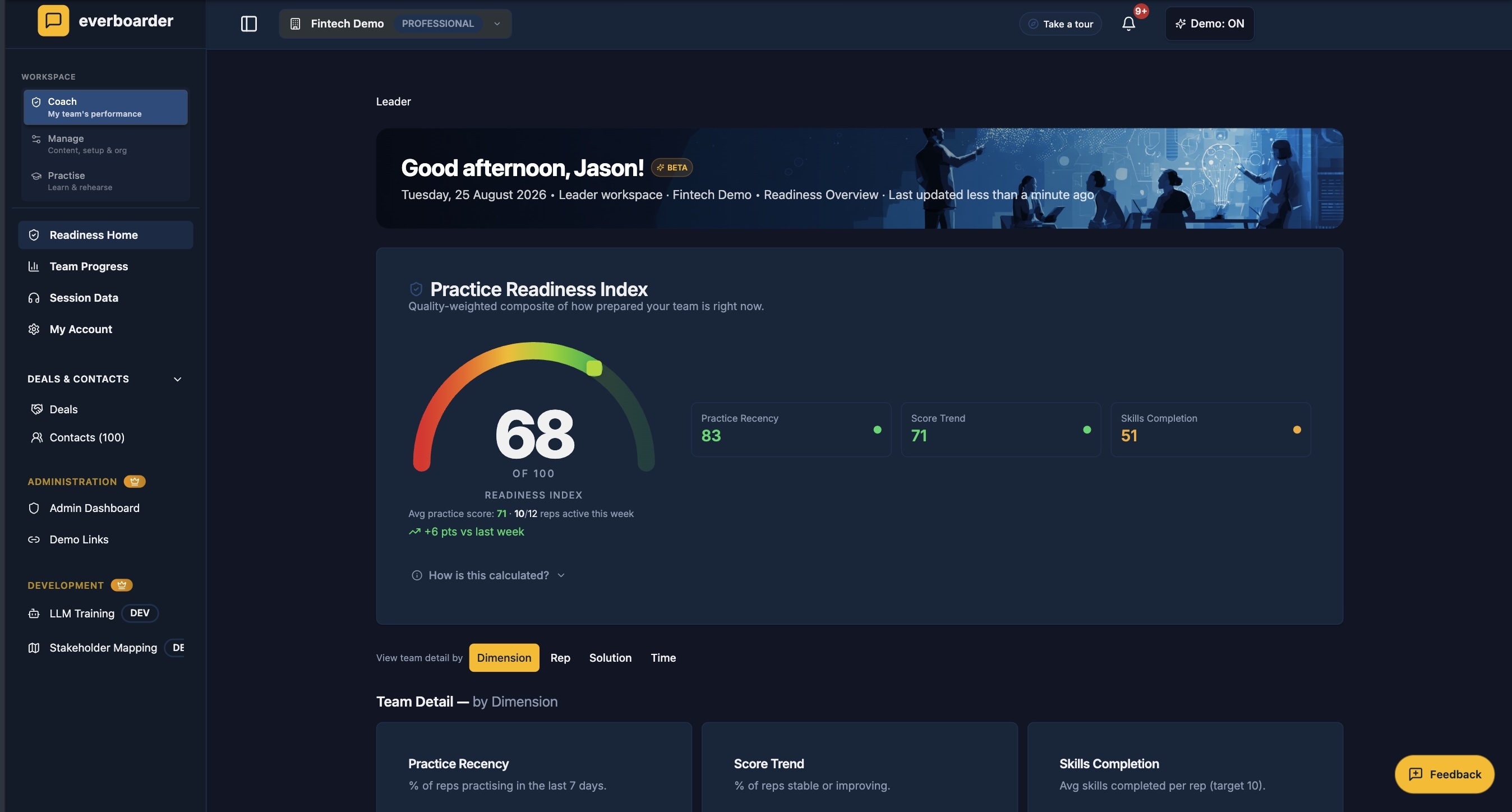
Readiness scored by rep, by team and by skill. You know who can sell the new product before you put them in front of a buyer, not after the forecast tells you they couldn't.
In the session
The two halves of the loop that turn a slide into a rep. Reps perform the conversation, then get told exactly what to fix — with the next drill loaded before they close the tab.
The subhead promises live AI sales practice against a digital twin of your buyer. This is that: voice or text, meters running, buyer withholding until the follow-up earns it.
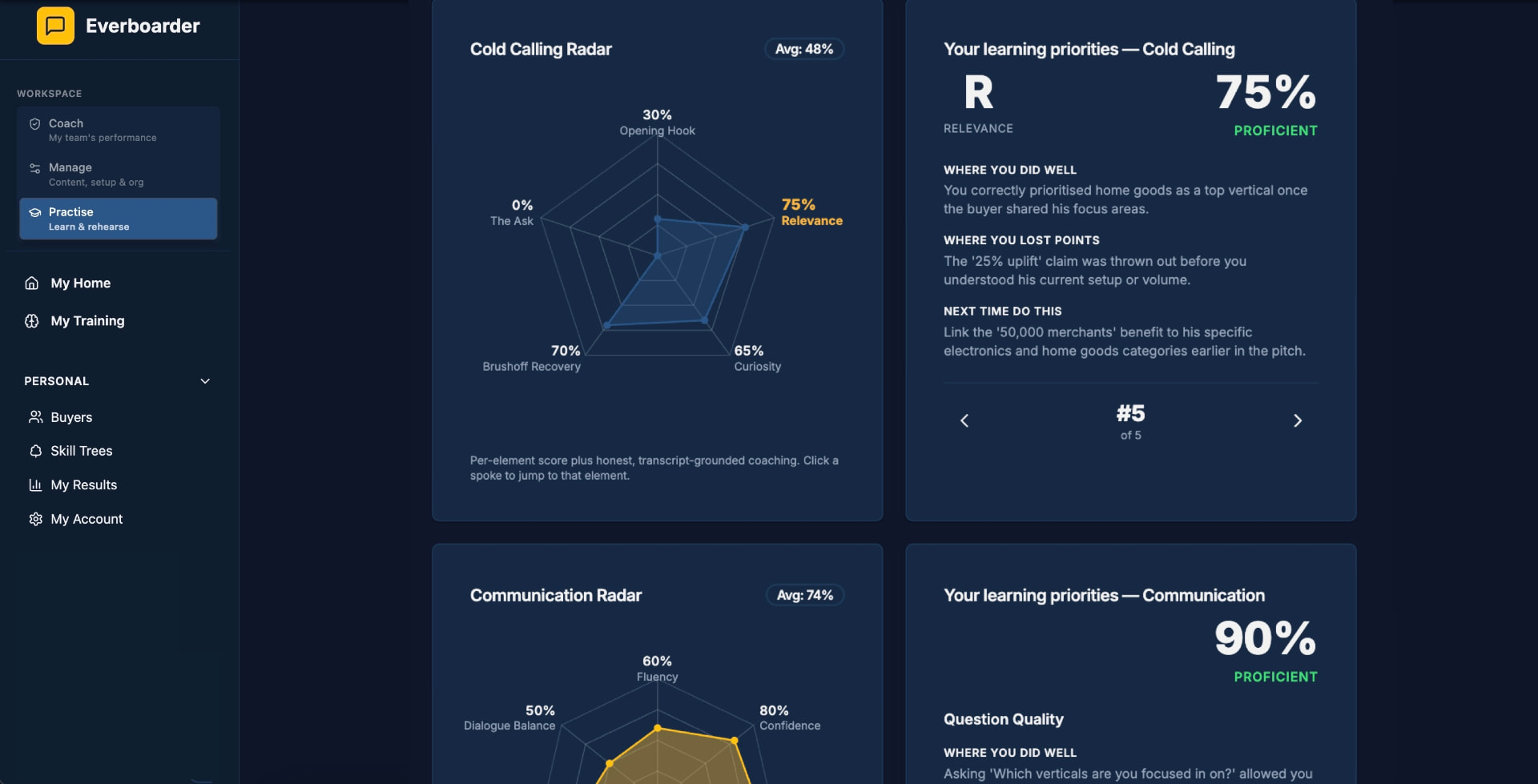
Tested beats taught needs a test with a result. Per-element scoring plus what to fix — and the next drill assigned automatically, so the rep doesn't have to pick.
What changes
A new hire reaches their first real call having already run it fifty times against your buyer. The first conversation with a live prospect stops being the first conversation they've had.
Update the digital twin and the whole team re-ramps on the new product in days — no offsite, no field pulled out of territory, no waiting for the enablement calendar to have a gap.
This is the one leaders feel and rarely name. Reps default to the pitch they have already won with, because that pitch is safe and the new one isn't. Practice is how the new product becomes the safe one. Otherwise your launch competes with your rep's muscle memory, and muscle memory wins.
Every rep gets specific coaching on every session. Your managers stop spending their week delivering the same feedback to twelve people and spend it on the two who need a human.
Verify · team
The verification step at team level, in one index — which is what you're actually purchasing. See who can sell the new product before you put them in front of a buyer, not after the forecast tells you they couldn't.
Where it fits
Your methodology, your playbook, your enablement team and your kickoff all stay. Everboarder is the layer underneath that turns the content into reps — the part that has always been left to chance because nobody had the hours to run roleplay with forty people.
| How training usually gets delivered | Slide deck / kickoff | LMS course + quiz | Manager roleplay | Everboarder |
|---|---|---|---|---|
| Rep performs the actual task | No | No | Yes | Yes |
| Every rep gets the same rep count | No | Yes | No | Yes |
| Spaced over time | No | Partly | Rarely | Yes |
| Adapts to individual weakness | No | No | Yes | Yes |
| Costs manager hours | Some | No | Heavily | No |
| Readiness measurable per rep | No | Quiz score only | Subjective | Yes |
| Survives a product launch | Rebuild | Rebuild | Rebuild | Update the twin |
Verify · rep
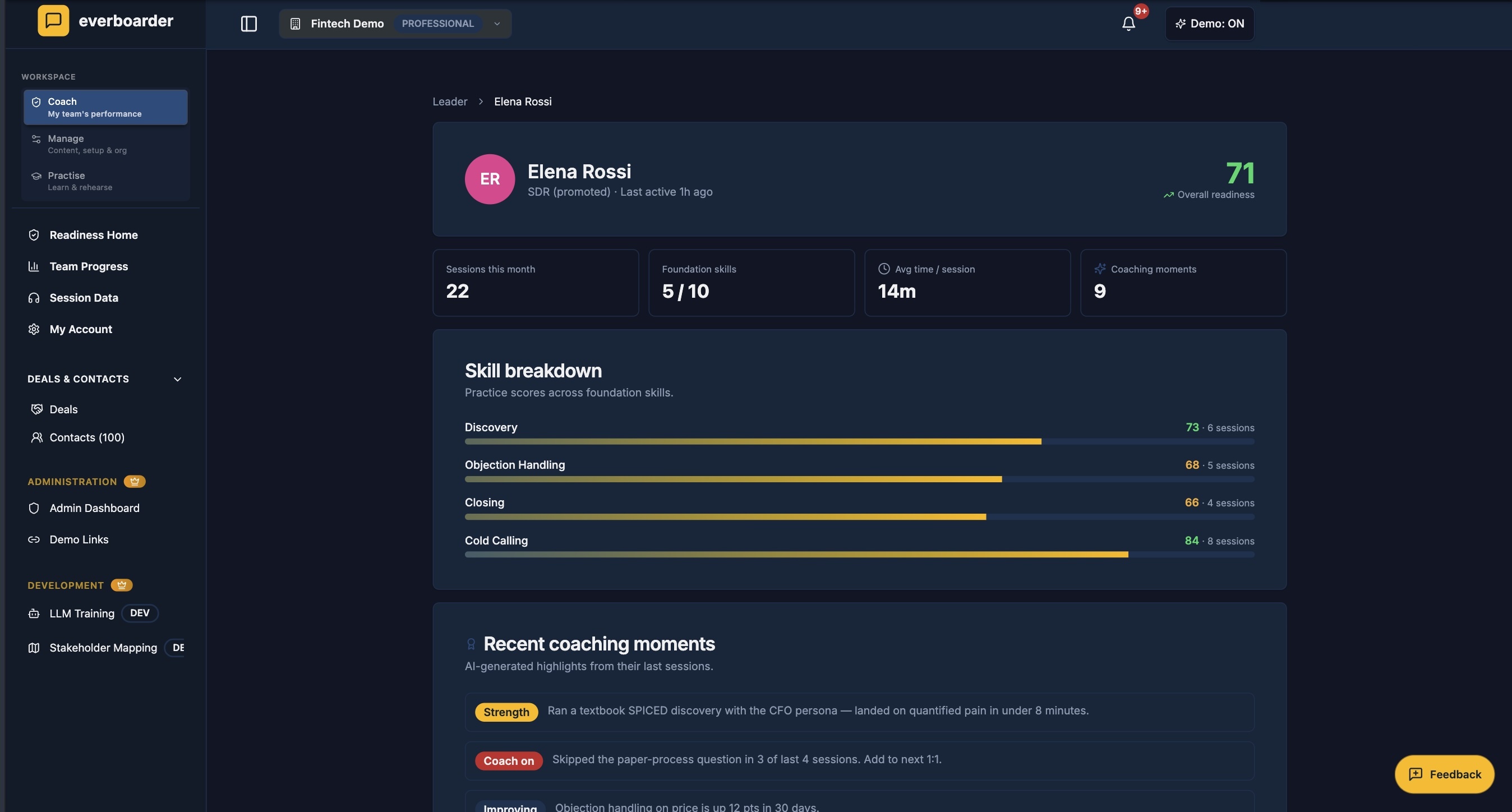
Ramp is the cost. This is ramp being measured. Per-rep skill progression across the elements the methodology scores, with AI coaching moments tagged Strength, Coach on, or Improving so managers know exactly where to spend the hour.
One system
The digital twin that screens a candidate is the same one they train against once hired, and the same one the whole team practices against when you launch. Their screening record becomes their sales onboarding baseline; their 30-60-90 day plan scores become their coaching plan.
Most orgs buy those as three tools and wonder why nothing connects.
Objections answered
"We already have an LMS and a methodology." Keep both. Neither one makes a rep able to run the call — an LMS tracks that content was delivered, and a methodology tells a rep what good looks like. This is the repetition layer underneath: the part that has always been left to whoever had time to run roleplay.
"Our reps will hate it." Reps hate roleplay in front of their manager and their peers, which is the version most of them have experienced. Practicing privately, failing privately, and being able to run the same call eleven times without anyone watching the first ten is a different proposition — and it is the one reps actually ask for.
"We can't rebuild this every launch." You don't. You update the digital twin — the new positioning, the new objections, the competitive responses — and everything downstream re-points at it. That is the whole architectural argument: the content is the buyer, not the deck.
"How do I know it transfers to real calls?" You don't take it on faith — you look at the readiness scores before the quarter and the pipeline after it. The learning research in the insight section is why the mechanism works; your own numbers are what should decide whether it worked here.
See it live
Book a 30-minute walkthrough. We'll build a digital twin of one of your buyer personas, load a product you're launching, and run a live practice session through it on the call.