
Sales coaching plan template
A weekly 1:1 sales coaching template — agenda, scorecard, action items — that turns coaching from a status update into measurable skill development, backed by practice data.
Free to start. No credit card.
Or create your account — free to start, no credit card, and your first roleplay is waiting inside.
WHAT YOU GET
What's in this template
Structured weekly 1:1 — agenda, scorecard, action items
Every 1:1 follows the same shape: pre-brief, 30-minute structured conversation, scorecard against the methodology rubric, action items tied to practice. The structure protects the time when the manager's calendar is under pressure.
Pre-call brief from the rep's practice + live-call data
The rep arrives at the 1:1 with practice scorecard data and a named live call to discuss. The manager arrives with the same data already loaded. Both sides start the conversation calibrated; no time wasted on "what did you work on this week?"
AI-surfaced focus areas
The rep's practice data and live-call patterns surface the focus area for the week — "objection handling on pricing," "qualification depth on Critical Event" — instead of the manager guessing. Coaching focus matches the rep's actual gap, not the most recent symptom.
~70/30 rep-talk ratio
Coaching is the rep talking, the manager extending. The scorecard moves the talk-time ratio toward the rep — they explain what they tried, what they'd change, what they want to test. Manager-led monologues don't produce skill transfer; rep-led reflection does.
Manager dashboard rolls up coaching consistency
For teams, the dashboard shows which reps were coached this week, which skills were focused, where rubric scores are trending, and which coaching commitments slipped. Coaching consistency becomes visible, not a private manager metric.
Backed by practice data, not just call recordings
Recording-only coaching reviews the past; practice-data coaching changes the future. The template assumes both, and surfaces the practice signal the manager would otherwise miss.
TEMPLATE PREVIEW
Preview the template
Four building blocks of the weekly coaching 1:1. Practice with AI to see the full editable rubric.
Template preview
Sales Coaching Plan
Weekly 1:1 agenda (30 min)
- 5 min check-in
- 15 min coaching focus (one skill)
- 5 min deal review
- 5 min action items
Coaching focus selector
- Surface this week's theme from practice data + live-call patterns
- One skill at a time — not whatever happened on the last call
Scorecard rubric (1–5)
- Opener delivery
- Discovery rhythm
- Objection handling
- Qualification depth
- Closing
Practice with AI to unlock the full template
Practice to unlock the full templateAction items
- SMART actions tied to a specific Everboarder practice scenario
- Completion date + next-1:1 evidence
HOW IT WORKS
How to run a coaching 1:1
Five steps the manager and rep both follow. The structure protects the time and the evidence.
Pre-1:1 brief (rep-prepared, 5 minutes)
Before the meeting, the rep submits a one-screen brief: which skill they focused on this week, what their practice data shows, the live call they want to discuss, and what they want help with. Pre-work makes the 1:1 a coaching conversation instead of a status update.
Weekly 1:1 (30 minutes, structured)
Five-minute check-in. Fifteen minutes on a single coaching focus (one skill, surfaced from the pre-brief). Five-minute deal review on one named deal. Five-minute action items the rep commits to before the next session.
Score against the rubric (1–5)
Score the focus skill against the methodology-aligned rubric — opener delivery, discovery rhythm, objection handling, qualification depth, closing. The same rubric the rep used in practice this week, so the conversation is calibrated.
Set practice scenarios for next week
SMART action items tied to specific Everboarder practice scenarios — drill the opener variant the rep struggled with, run two SPICED qualification reps, practice one objection sequence. Completion date plus the evidence the rep brings to the next 1:1.
Review evidence at the next 1:1
The next session opens with the practice data and the live call where the skill was applied. Behaviour change is visible (or not) — and the coaching focus for the new week is set from the evidence, not from whatever happened on the most recent call.
WHY IT FAILS
Why most coaching plans fail
Coaching is reactive, not designed
Most 1:1s coach whatever happened on the last call. That may not be the rep's real gap. Without a designed focus (one skill, one rep, this week, chosen from practice + live data), coaching scatters across symptoms and never compounds.
Coaching is lecture-led
In a typical 1:1, the manager talks for the majority of the time. But skill transfer needs the rep talking and reflecting. The scorecard and pre-brief move the talk-time ratio; lecture-led 1:1s produce note-taking, not behaviour change.
No practice loop between sessions
A gap gets identified in the 1:1, the rep is told to "work on it," and there's no drill, no measurable progress, no evidence at the next 1:1 that anything changed. The rep returns next week with the same gap, the manager runs the same conversation, nothing compounds.
Coaching evaluates instead of develops
When coaching feels like performance review, reps go defensive — they hide weaknesses instead of working on them. Effective coaching is developmental: low-stakes practice, fast feedback, the rep choosing the focus, the manager extending. Evaluation belongs in a different conversation.

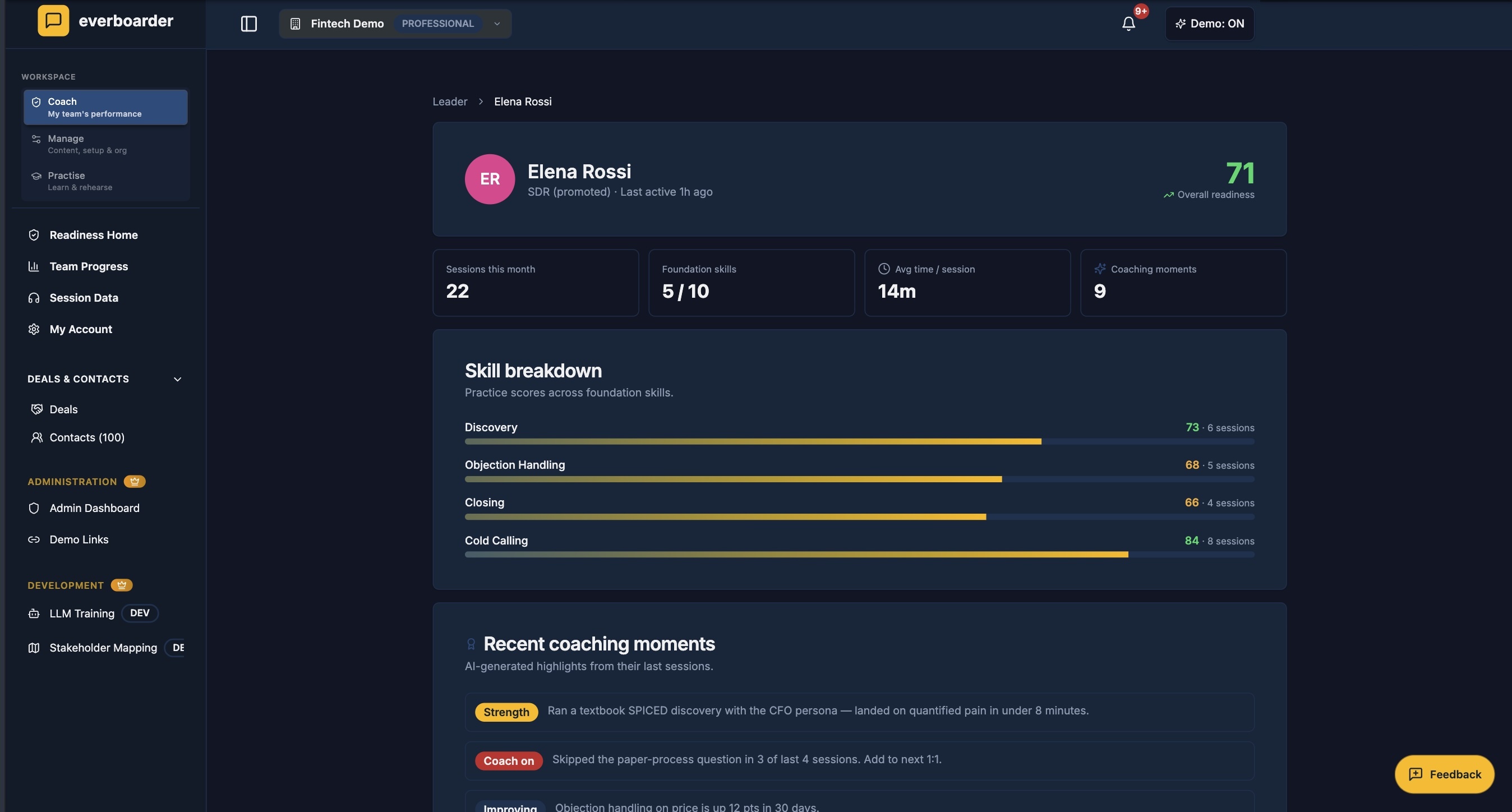
1:1 with an agenda
The rep readiness profile gives the coaching plan a real agenda.
Weekly 1:1s die when the manager arrives without evidence. The rep readiness profile surfaces AI coaching moments across the week — tagged Strength, Coach on, Improving — so the agenda comes from actual behaviour, not the manager's memory of yesterday's shadowed call.
- Per-skill coaching moments already tagged before the 1:1 starts.
- The manager coaches on the pattern, not the last thing they saw.
- Systematic — the coaching happens whether or not the calendar slot survives.
METHODOLOGY FIT
Coach against the methodology you already run
The scorecard rubric mirrors the methodology's letters, so coaching feedback maps onto the qualification framework the team runs every day.
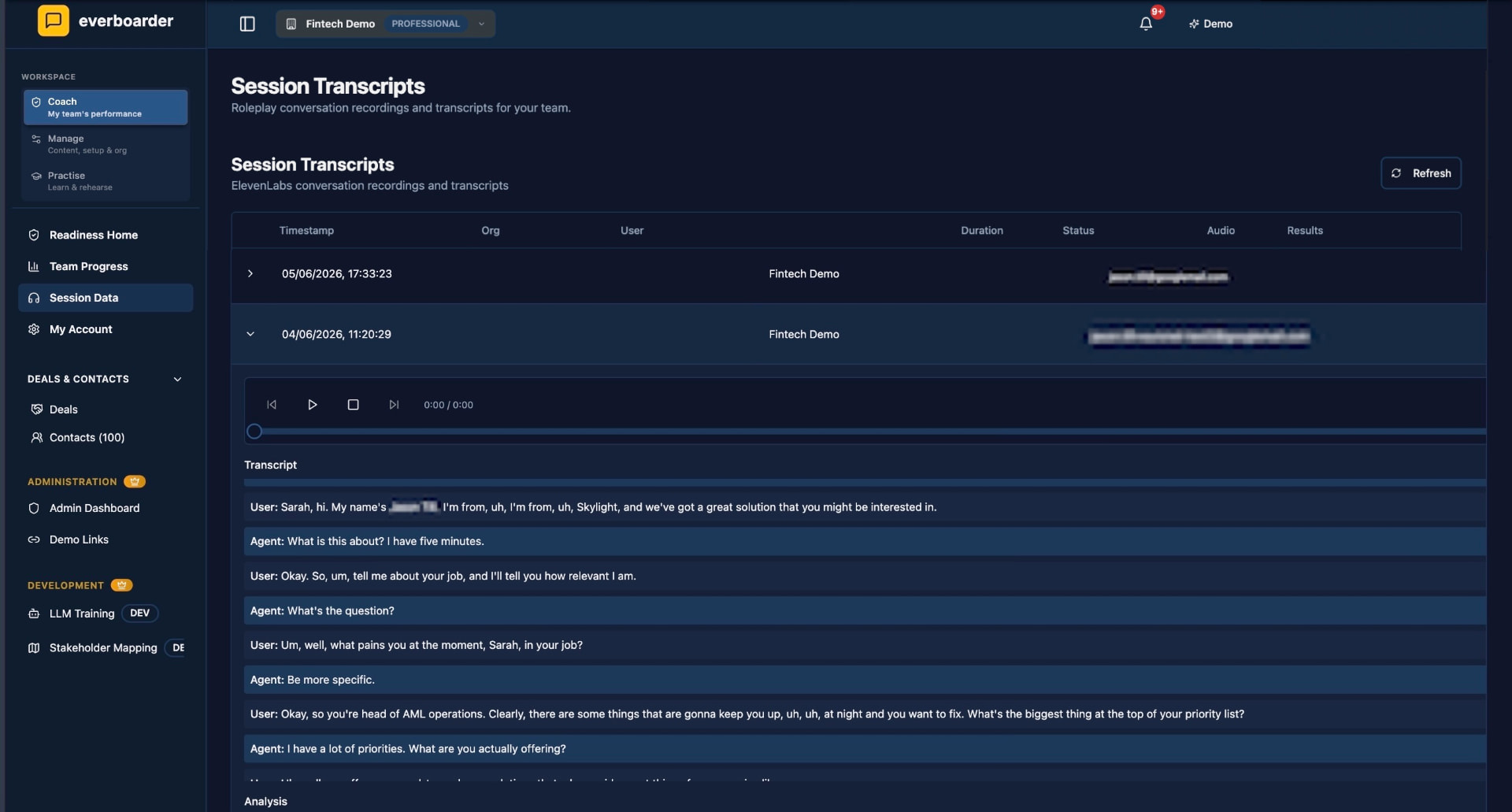
Coach from evidence
Every session leaves a session recording and transcript — coach from what happened, not what you remember.
A coaching moment lands when the rep can see the exact line that lost the deal. Session recording, transcript, and analysis sit in one place — the manager quotes the transcript in the 1:1, and the rep can play the moment back after the call. That's the difference between coaching and status updates.
- Full transcript with the analysis attached.
- Coach from the line, not the recollection.
- The rep can replay the exact moment after the 1:1.
RELATED TEMPLATES
Related templates
30/60/90 day sales plan template
The rep-side companion: a structured 90-day ramp plan with practice targets and certification gates at each phase boundary.
Sales onboarding plan template
A deeper onboarding plan with role-specific paths for SDR / AE / enterprise reps — the bridge between ramp and steady-state coaching.
Sales playbook template
Modular playbook covering personas, plays, objection responses, and methodology overlay — the system the coaching rubric scores against.
For the full system around this template, see Sales Coaching →
Customer outcome
Frequently asked questions
Make every 1:1 a coaching session
Free to use. The team plan adds manager dashboards, coaching-consistency rollups, and methodology-aligned rubric customisation.
Free to start. No credit card.