

For law firms
Law firm business development has a repetitions problem.
Your lawyers rehearse every high-stakes conversation, except the one that wins the work. Everboarder gives associates, partners and pitch teams a private place to practise pitches, panel reviews, cross-selling and fee conversations, against AI versions of the clients they're trying to win.
A conversation with your BD or L&D lead, not a generic demo.
The basics
What is law firm business development?
Law firm business development is everything a firm does to win and grow client work. That covers building relationships with in-house legal teams and referrers, pitching for new instructions and panel places, cross-selling other practices to existing clients, and running key-client programmes.
What makes it different from business development almost anywhere else is who does it. In a partnership, the people who do the legal work are the people who have to win it. Partners and associates carry the client conversations. The BD team supports them with research, pitch documents, events and client listening.
Firms usually develop those skills in four ways:
Workshops and training days
Networking, pitching and client-care sessions, often run by an external trainer once or twice a year.
Business development coaching
One-to-one coaching for partners and senior associates, usually built around a personal BD plan.
Associate and partnership programmes
Structured development tracks that culminate in a business case for partnership.
Key-client and cross-selling programmes
Client teams, account plans and client-listening interviews for the firm's most important relationships.
All four build knowledge and plans. None of them gives a lawyer repeated, safe practice at the conversations themselves. That's the gap the rest of this page is about.
In short
Everboarder for law firms is a private rehearsal environment where lawyers practise the conversations that win work: pitches, panel reviews, cross-selling introductions and fee discussions. They practise against AI versions of the clients they're trying to win, with scored feedback for the lawyer and firm-wide readiness reporting for business development and L&D.
The uncomfortable bit
Your lawyers don't have a knowledge gap. They have a repetitions gap.
No firm would send an associate to cross-examine a witness without preparation. Nobody walks into a negotiation without having run the positions. Rehearsal is how the profession manages risk in every conversation that matters.
Then the conversation that decides whether there is any work to do at all gets a two-hour workshop and a pitch document. The firm has invested in BD training, a CRM, a pitch team and a key-client programme. Partners still describe business development as something you “pick up”.
They pick it up the slow way, by getting it wrong in front of real clients. A senior associate may have had only a handful of genuine client-development conversations before the partnership committee asks for a business case.
What firms rehearse
- ✓Advocacy — moots, mock trials, cross-examination practice
- ✓Witness evidence — preparation sessions before every hearing
- ✓Negotiations — dry runs of the positions and the fallbacks
- ✓Completion meetings — checklists, run-throughs, sign-offs
What wins the work, unrehearsed
- ✕The pitch Q&A — usually one run-through, often in the taxi
- ✕The first conversation with a new General Counsel
- ✕Introducing a colleague's practice to your client
- ✕Telling a client the fee estimate has moved
Why BD programmes stall
Four things firms tell themselves about business development
“Business development is about relationships. You can't train it.” Relationships are built one conversation at a time, and a conversation is a skill. The partners who seem to have a natural gift for it have usually had hundreds more of those conversations than the associate who is now expected to build a practice. Talent isn't the difference. Repetitions are.
“We covered that in the BD workshop.” Then your lawyers know what good looks like. Knowing it isn't the same as being able to do it under pressure, in front of a sceptical client. The learning research is unambiguous that practising beats re-reading and re-hearing. A workshop is the re-hearing. Ask what happened in week two. (Practice testing meta-analysis: Adesope, Trevisan & Sundararajan (2017); more on the evidence in practice-based training.)
“Our lawyers can role-play with each other.” In theory. In practice, a senior associate won't experiment in front of the partner who will vote on their promotion, and partners don't role-play at all. Group role-play in a law firm becomes a performance, not practice. Real rehearsal needs somewhere private to get it wrong.
“The pitch team has it covered.” The pitch team has the document covered. The tender response gets three weeks of drafting. The thirty minutes in the room, which is usually where the panel decides, gets a read-through. The answer to “why should we move from our current firm?” shouldn't be heard out loud for the first time by the client.
Where it matters
The five conversations worth rehearsing
This isn't sales training, and your clients don't want to be sold to. It is practice at the curiosity, commercial judgement and clear next step that clients say they want from their lawyers.
Panel reviews and competitive pitches
Rehearse against each member of the panel in turn: the GC who is loyal to the incumbent, the procurement lead who wants a lower rate, the business sponsor who wants to know you understand the deal. Do it as many times as you need before the day.
Associate to partner
A partnership business case rests on conversations most associates have barely had. Give your senior associates the reps: the first meeting with a GC, the follow-up that turns a matter into a relationship, the ask for the next instruction.
Cross-selling and key clients
Practise introducing a colleague's practice so it sounds like help rather than a pitch. Cross-selling strategies rarely fail in the strategy. They fail when a partner doesn't risk the conversation.
Lateral partner integration
A lateral partner knows their own clients and none of their new firm's capabilities. Rehearse telling the firm's story to their existing clients before the first introduction, not during it.
Fee and scope conversations
Estimates move, scope creeps and clients push back on rates. These are the conversations lawyers avoid longest and handle worst. Practise them before they cost you a write-off or a client.
Your clients, not a sales scenario
Who your lawyers rehearse against
Every client persona is built for your firm: your sectors, your target clients, and the rival firm they already instruct.
| The client | The conversation they test you on |
|---|---|
| General Counsel at a corporate client | “We're happy with our current panel firm. Why should we move?” |
| Head of Legal Operations / legal procurement | Rates, alternative fee arrangements, value reporting and panel KPIs. |
| CFO or CEO of an owner-managed business | “Can't this be done for less?” The fee estimate, the scope, the risk. |
| Private equity deal partner | Speed, commerciality, and “what's your actual view on this deal?” |
| In-house lawyer who instructs day to day | Responsiveness, and a natural opening to introduce another practice. |
Realistic resistance
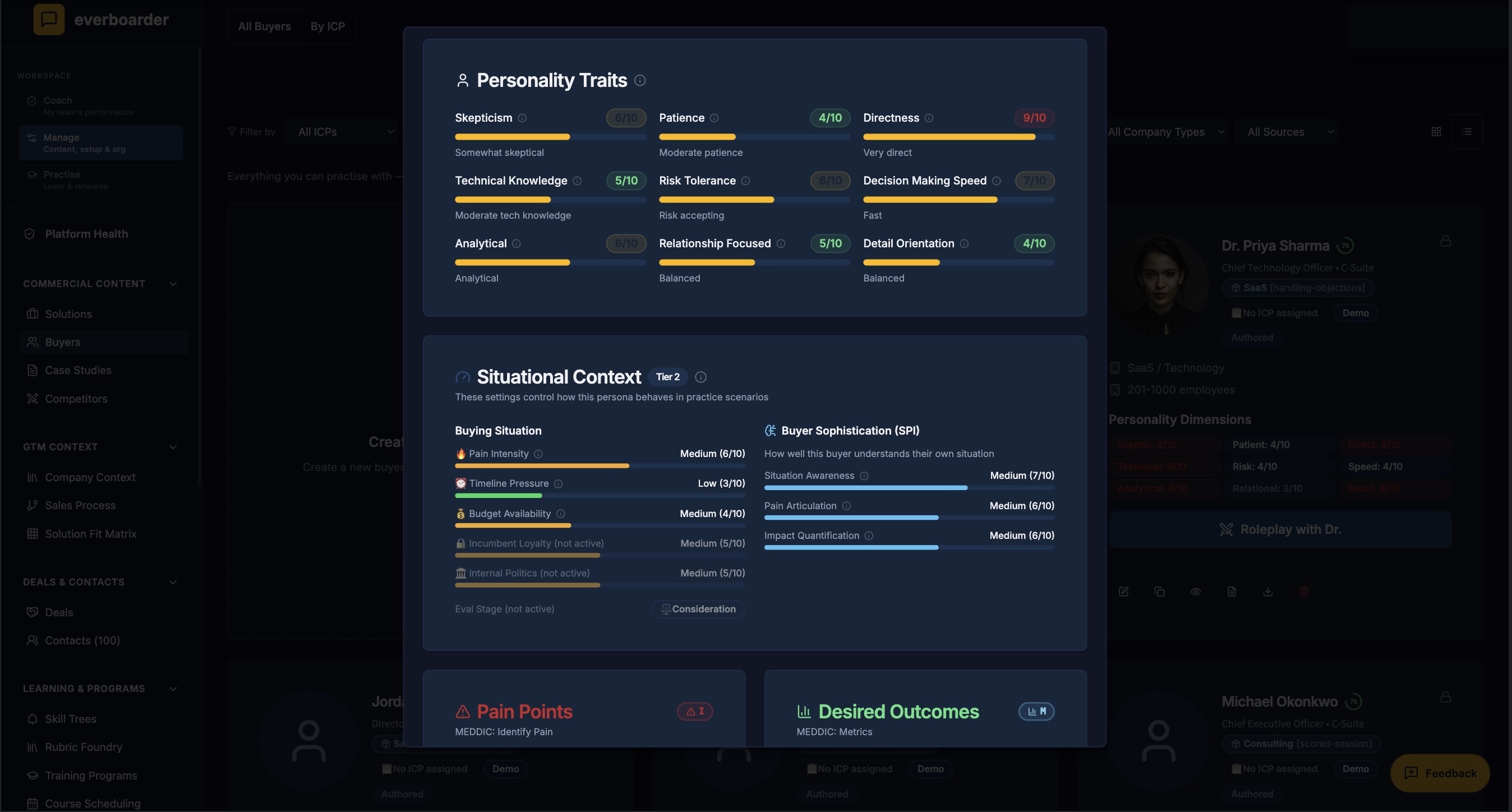
The client pushes back the way real clients do.
A GC who is happy with the incumbent firm doesn't make it easy. Each client persona is tuned on the dimensions that decide legal pitches, so your lawyers practise against the resistance they'll actually meet.
- Incumbent loyalty: how attached the client is to the firm they already use.
- Internal politics: the GC who wants you and the procurement lead who wants a lower rate.
- Scepticism, budget pressure and timeline: dialled up for the pitch that matters.
How an engagement works
Scoped with your firm, not switched on from a sign-up page
1. A private briefing
A conversation with your Head of BD or L&D lead, not a generic product demo. We agree which conversations matter most to your firm this year: a panel review on the horizon, a partnership cohort or a cross-selling push.
2. We build your clients
We build AI versions of the people your lawyers need to win over. That means a General Counsel in your target sector, a legal procurement lead or the CFO of an owner-managed business. Each is built from public information and the briefing you choose to give, with the incumbent firm loaded in. Scoring is calibrated to your own client-development framework.
3. A pilot with one group
One practice group, associate cohort or live pitch team. Lawyers rehearse privately, by voice or text, in sessions that take minutes rather than an afternoon. Each session ends with specific feedback on what to change.
4. A readout for the committee
Readiness by lawyer, cohort and practice group, so your BD investment shows up as changed behaviour rather than attendance. You decide what to roll out next from evidence, not anecdote.
And when a live pitch lands, your BD team briefs us on the client. The pitch team rehearses against that panel, member by member, before they're in the room.
Privacy and confidentiality
Private for the lawyer. Safe for the firm.
Nobody watches you get it wrong
Lawyers rehearse alone, on their own time, as often as they like. That is the whole point. BD and L&D see readiness scores and trends across cohorts and practice groups, not an audience for every attempt.
No client-confidential information needed
Personas are built from public information and the briefing you choose to give. No matter files and no privileged material. A DPA aligned to UK and EU GDPR is available. We don't yet hold our own SOC 2. We run on independently certified subprocessors and will complete your security questionnaire. Read our Trust Centre.
Who it's for
Built for the people accountable for winning work
Heads of business development
You need evidence that your programme changes behaviour between workshops.
L&D and talent leaders
You own the associate-to-partner pipeline and the business cases it depends on.
Managing partners and practice heads
You carry the panel positions, the cross-practice revenue and the succession risk.
Pitch teams
You have a panel date and a room you'd like to have rehearsed.
Private briefing
Bring us your next pitch.
Tell us about a panel review, partnership cohort or cross-selling push on your horizon. We'll show you what it looks like when your lawyers have rehearsed it before the client hears it.
Arrange a private briefingWe reply within one business day.
Frequently asked questions
Not a law firm? See Everboarder for professional services firms.