
Sales qualification scorecard template
A methodology-agnostic qualification scorecard — score every deal against your team's framework, tighten the forecast, and practise qualification against an AI buyer in a multi-stakeholder deal.
Free to start. No credit card.
Or create your account — free to start, no credit card, and your first roleplay is waiting inside.
For managers: pipeline dashboard, forecast tightening, qualification scores by rep, stage, and methodology.
What you get
What's in this template
Pipeline dashboard for managers
Scores roll up to a manager view — every deal, every rep, every stage. See at a glance which deals have a Consensus gap, which reps are strong on Pain but weak on Process, which stage of the funnel has the biggest qualification hole. The dashboard is the single view that replaces the Monday forecast call's guesswork.
Forecast tightening
"12+ to forecast Commit" replaces "I've got a good feeling about this one." Reps and managers argue about the missing dimension, not about whether the deal is real. Category-C surprises drop; forecast integrity holds under CRO pressure.
Methodology-agnostic scorecard, methodology-mapped scoring
The five dimensions (Pain / Power / Value-Vision / Process / Consensus) hold across every methodology. The questions behind each dimension come from your framework — MEDDIC's letters, MEDDPICC's Paper Process, SPICED's Impact, SPIN's question sequences. Switch methodologies without rebuilding the scorecard.
AI-surfaces qualification gaps
Missing Pain in a deal? The AI flags it in the practice call before the rep runs it live. Weak Power? The scorecard names the missing stakeholder meeting. The rep doesn't have to notice the gap; the system does. Coaching focus becomes the specific dimension the rep is losing on, not the last deal that slipped.
Syncs to Salesforce and HubSpot custom fields
Scorecard fields map to custom-field structure in Salesforce and HubSpot. Reps score in the flow of work; managers report from the CRM they already run. No parallel system, no double-entry, no "we filled the scorecard in but the CRM shows something different." Single source of truth.
Practise the qualification conversation, not just the fields
Filling in a scorecard is not the same as running the qualification conversation. Reps who ace the checkbox exercise still miss Power on the live call. Practice against a methodology-tuned AI buyer — including multi-stakeholder scenarios — closes that gap so the scorecard reflects real qualification, not just data entry.
Template preview
Preview the scorecard
Five dimensions, 23 questions total, scored 0–3 each. Total 0–15. Stage-gate at 8+ for Proposal, 12+ to forecast Commit.
Template preview
Sales Qualification Scorecard
Pain (5 questions)
- Is the pain defined, quantified, owned?
- Score 0–3
Power (4 questions)
- Is the economic buyer identified and engaged?
- Score 0–3
Value / Vision (4 questions)
- Has the buyer articulated the outcome + measurable value?
- Score 0–3
Practise with AI to unlock the full template
Practise to unlock the full templateProcess (6 questions)
- Decision process, paper process, timeline mapped?
- Score 0–3
Consensus (4 questions)
- Agreement across the buying group?
- Score 0–3
How it works
How to use the scorecard
Five steps the rep and manager both follow. The structure turns qualification from checkbox theatre into an argument about the missing dimension.
Score each deal across five dimensions
Pain, Power, Value / Vision, Process, and Consensus — score 0–3 on each. Total scores from 0–15. Every deal gets a running scorecard the rep and manager both see. Not a one-off qualification exercise — a living view of deal health.
Gate at 8+ for Proposal, 12+ for Commit
A deal moves to the Proposal stage when its scorecard hits 8 out of 15. It's forecasted as Commit at 12+. Anything below the gate stays back — the rep works the missing dimensions before advancing. This is the mechanism that stops "gut feel" forecasts and tightens the pipeline conversation.
Map to whichever methodology the team runs
Each dimension tags to MEDDIC / MEDDPICC / BANT / SPIN / SPICED / Solution Selling equivalents. MEDDIC teams score Pain against "Identify Pain," Power against "Economic Buyer." SPICED teams overlay Impact under Pain. The scorecard is the common language; the methodology fills in the questions behind each dimension.
Practise qualification against a multi-stakeholder AI buyer
The gap between filling in a scorecard and running the qualification conversation live is where forecasts go wrong. Practise against an AI buyer tuned to your methodology, in a scenario with multiple stakeholders — including the veto-risk stakeholder your rep hasn't met yet. Real-time coaching flags the missing dimension while the muscle memory is still forming.
Roll up to a manager pipeline dashboard
Every rep's scorecards across every deal roll up to a manager view — pipeline dashboard, forecast tightening, qualification scores by rep / stage / methodology. The manager coaches the pattern ("you consistently score low on Consensus in enterprise deals") instead of the symptom.
Why it fails
Why most qualification fails
Checkbox-qualified vs genuinely qualified
Reps tick the boxes after the call to keep the forecast clean, not before the call to actually qualify. Six MEDDIC fields marked "complete" doesn't mean the Economic Buyer is confirmed — it means the rep believes they're confirmed, which is a different thing. Scorecards without qualifying conversations behind them are compliance theatre.
The gap between methodology and behaviour
Reps can quote MEDDIC letter-for-letter and still skip Identify Pain on a live discovery call. Knowing the framework and running it are different skills. Certification-by-quiz measures the former; practice-based scoring measures the latter. Only one of those maps to forecast accuracy.
Scorecards without practice close nothing
Adopting a scorecard without practising the conversation behind it just adds admin overhead. The scorecard shape sits in the CRM; the qualifying skill still doesn't transfer to live calls. Practice with AI buyers on multi-stakeholder scenarios is what turns the scorecard from a data-entry chore into a real qualification instrument.
One scorecard per methodology — the wrong solution
Teams that build a MEDDIC scorecard, then a MEDDPICC scorecard when they move upmarket, then a SPICED scorecard when they add a SaaS motion, end up maintaining three parallel systems. A methodology-agnostic scorecard with methodology-mapped scoring survives framework changes. The dimensions hold; the questions behind them evolve.

“What happens if your company goes under? We'd be stuck.”
Score every session
The five dimensions land on the scorecard, session after session.
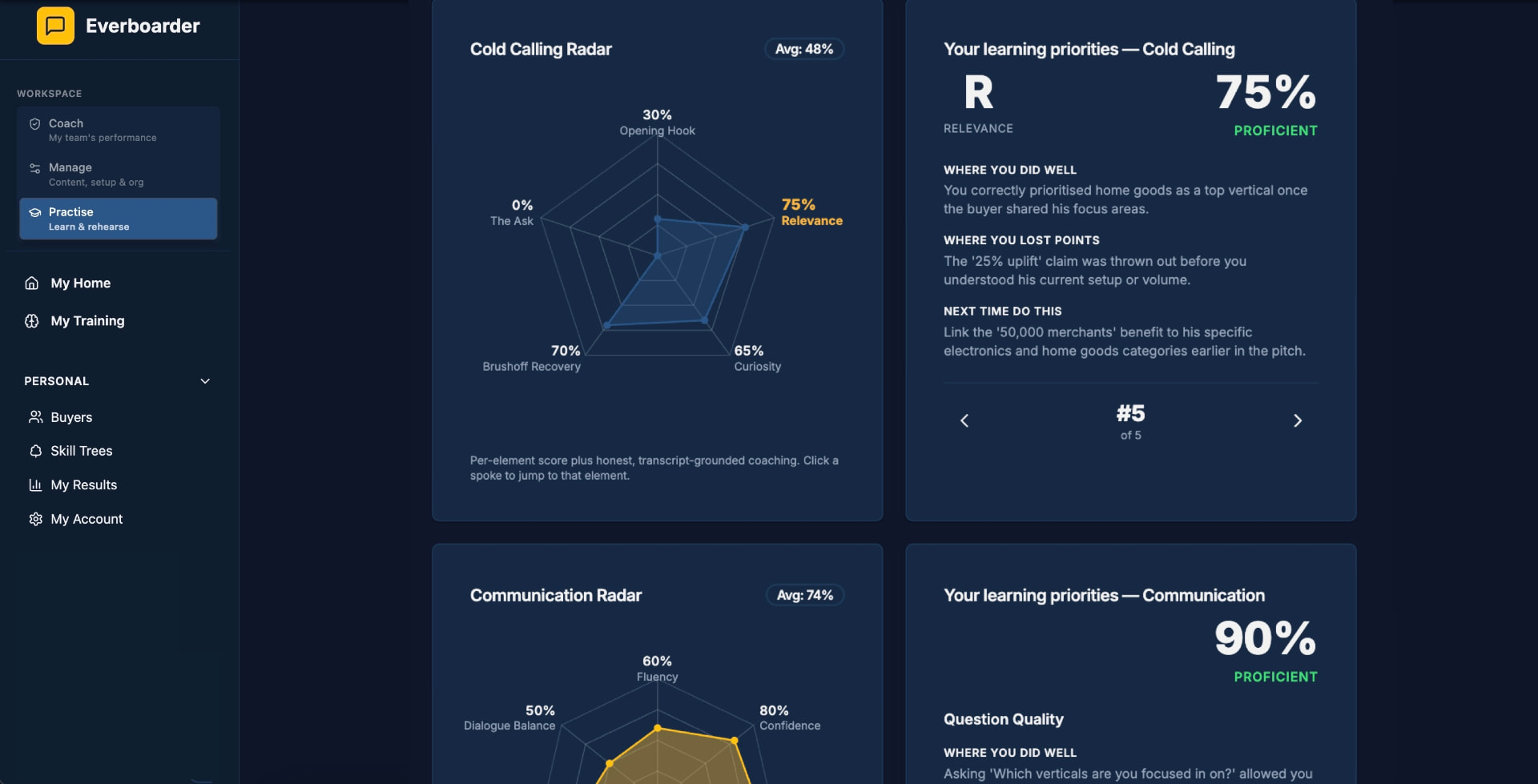
Pain, Power, Value-Vision, Process, Consensus. The same five dimensions the scorecard grades manually show up on the post-call radar after every practice session — with the specific line-level moments the rep did well, lost points on, and should try next time.
- Radar scored against the five dimensions — the same taxonomy your scorecard uses.
- "Where you did well / lost points / next time" — grounded in the transcript.
- One vocabulary from doc to product to deal review.
Methodology fit
Maps to the methodology you already run
The five dimensions hold across every framework. The questions behind each dimension come from your methodology.
Related templates
Related templates
MEDDPICC checklist
The MEDDPICC framework as a checklist — every letter as a qualifying gate, with practice against enterprise-procurement scenarios.
BANT qualification template
The fast qualification filter — Budget, Authority, Need, Timeline — for transactional inbound triage.
Discovery call question template
Layered discovery questions that surface Pain, Power, and timeline without interrogating — the discovery layer the scorecard scores against.
Customer outcome
Frequently asked questions
Tighten the forecast, not the pressure
Score every deal, gate every stage, coach the pattern. Free to use; the team plan adds pipeline dashboards and methodology-mapped rollups.
Free to start. No credit card.