
Sales playbook template
A complete sales playbook scaffold — ICP, messaging, methodology, objection library, tech stack — that your team can practice against, not just read. AI populates each section from your own call data.
Free to start. No credit card.
Or create your account — free to start, no credit card, and your first roleplay is waiting inside.
WHAT YOU GET
What's in this template
Full scaffold — company, ICP, value prop, messaging, methodology, objections, tech stack
Not a slide deck of "what a playbook should include" — a working scaffold your team fills in and practices against. Six sections cover every decision a rep makes in the flow of work: who to prioritise, what to say, which methodology to score against, how to handle pushback.
AI populates from your Gong / Chorus / Salesforce data
The AI reads your actual call data and drafts the sections — winning-deal patterns, top-performer language, common objections, the specific pain the top of the sample surfaces. What ships is not what the seller wishes were true; it's what your best reps already do. The manager edits; the team practices.
Every section is also a practice configuration
The playbook is not just documentation. Objection library → AI-buyer scenarios reps drill. Messaging → opener practice reps rehearse. Methodology → certification gates that fire on live calls. Each section has a paired practice mode, so the playbook is what reps use, not what they file away.
Methodology-flexible (all six)
MEDDIC, MEDDPICC, BANT, SPIN, SPICED, Solution Selling — the methodology section maps onto whichever framework your team runs, with stage-gating and CRM field structure. Change methodology without rebuilding the playbook. The scaffolding holds; the qualifying rubric fits your stack.
Manager-edit + rep-read views
Managers see the edit interface with version history, refresh reminders, and the practice-configuration wiring for each section. Reps see the read-only view with the practice CTAs live. One document, two views, so the playbook is authoritative for both audiences without either fighting over the shape.
Structured playbooks lift win rate
Structured beats unstructured on measured close rate; structured plus practice beats structured alone. The difference is whether the playbook is a Google Doc or a live scaffold the team drills.
TEMPLATE PREVIEW
Preview the playbook scaffold
Six sections covering every decision a rep makes in the flow of work. Practice with AI to see the full scaffold with editable content.
Template preview
Sales Playbook
1. Company + ICP
- Mission, org, exec bios
- 3–5 personas with pains, signals, disqualifiers
2. Product, pricing, process
- Features → value props, packaging logic
- Pipeline stages, exit criteria, conversion benchmarks
3. Messaging library
- Value-prop one-liners, persona decks, demo scripts, follow-up emails
4. Methodology + qualification
- MEDDIC/MEDDPICC/BANT/SPIN/SPICED/Solution Selling with stage-gating + CRM field mapping
Practice with AI to unlock the full template
Practice to unlock the full template5. Objection library
- Top 25 objections with LAER responses
6. Competitive + tech stack + onboarding
- Battle cards; CRM/CI/engagement/dialler; links to 30/60/90 + certification gates
HOW IT WORKS
How to build (and practice) the playbook
Five steps. The last one is the difference between a Google Doc and a working playbook.
Define the playbook shape — who it serves, what it decides
Every section maps to a decision a rep has to make in the flow of work: which persona to prioritise, which value prop to lead with, which objection response applies, which methodology gate to score against. If a section doesn't decide something, it doesn't belong in the playbook.
Populate from your actual call data
The AI reads your Gong / Chorus / Salesforce data — winning-deal patterns, losing-deal excuses, top-performer language, common objections — and drafts the sections. The manager edits; the rep reads and practices. What ships is not what the seller wishes were true; it's what the top of the sample already does.
Layer the methodology, don't replace the playbook with it
MEDDIC / MEDDPICC / BANT / SPIN / SPICED / Solution Selling map onto the playbook's qualification section with stage-gating and CRM field structure. The methodology is one section, not the whole document. Playbooks that collapse into pure methodology stop describing the actual selling motion.
Wire every section to a practice configuration
Objection library section? Every objection becomes an AI-buyer scenario reps drill. Messaging section? The value-prop one-liners become opener practice. Methodology section? Certification gates run the qualifying conversation. The playbook is not just documentation — every page is also a practice target.
Set the refresh cadence — quarterly, not annually
Playbooks decay fastest at the intersection of messaging and objection library — both move with the market and the competitive landscape. Set a quarterly refresh cadence: the manager updates messaging and objections, top-performer patterns get promoted, stale content gets retired. Annual-refresh playbooks are stale by month four.

WHY IT FAILS
Why most sales playbooks fail
Playbooks become 200-page tomes nobody opens
The classic failure mode. A well-meaning enablement lead spends 60 days building the definitive playbook, ships it to the team, and nobody reads it again. Coverage isn't the point — usability is. A 30-page playbook the team actually drills beats a 200-page playbook that lives on the enablement drive.
They're static while the market moves
Objection language shifts with the competitive landscape. Value props shift with the buyer's priorities. Methodology adoption shifts with the leadership hire. A playbook that refreshed "last quarter" is describing a market that no longer exists. Static playbooks are worse than none — they teach reps to run yesterday's play.
Reps read them once and never practice
Reading a playbook is not running one. Reps who read the methodology section still miss Power on the live call; reps who read the objection library still fumble the LAER sequence when the buyer actually pushes back. Skill transfer happens in practice, not on read-through. The playbook has to be a practice target, not a reference document.
One-size-fits-all across roles and segments
An SDR playbook, an AE playbook, and an enterprise-CSM playbook need three different scaffolds — same six sections, different content per section. Playbooks that try to serve every role get watered down until they serve none. Segment the playbook by role and segment; refresh each segment on its own cadence.
ICP as a live scenario
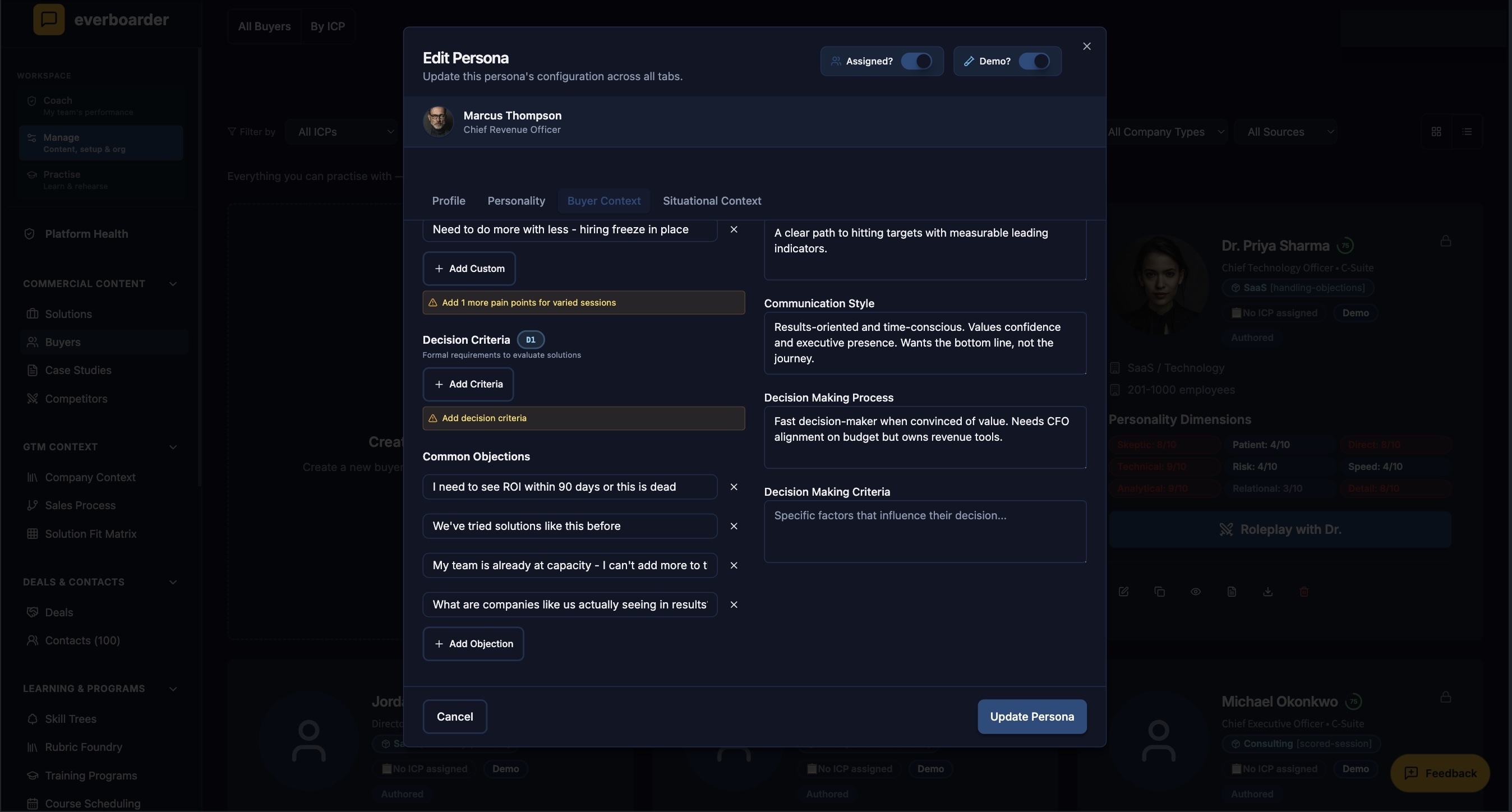
The playbook's ICP shows up as an actual buyer reps can practice against.
A playbook lists the ICP. This turns that list into a live buyer. The persona builder assembles a working scenario from your own collateral — pain, outcomes, objections, stakeholder posture — with completeness prompts so nothing critical to the pitch gets left blank. Enablement content becomes practice, not a PDF.
- Persona built from your own decks, calls, and battlecards.
- Completeness prompts flag missing pain, outcomes, and objections.
- The ICP paragraph becomes a live buyer reps can dial into.
METHODOLOGY FIT
Methodology-flexible — pick yours
The methodology section maps onto whichever framework your team runs, with stage-gating and CRM field structure.
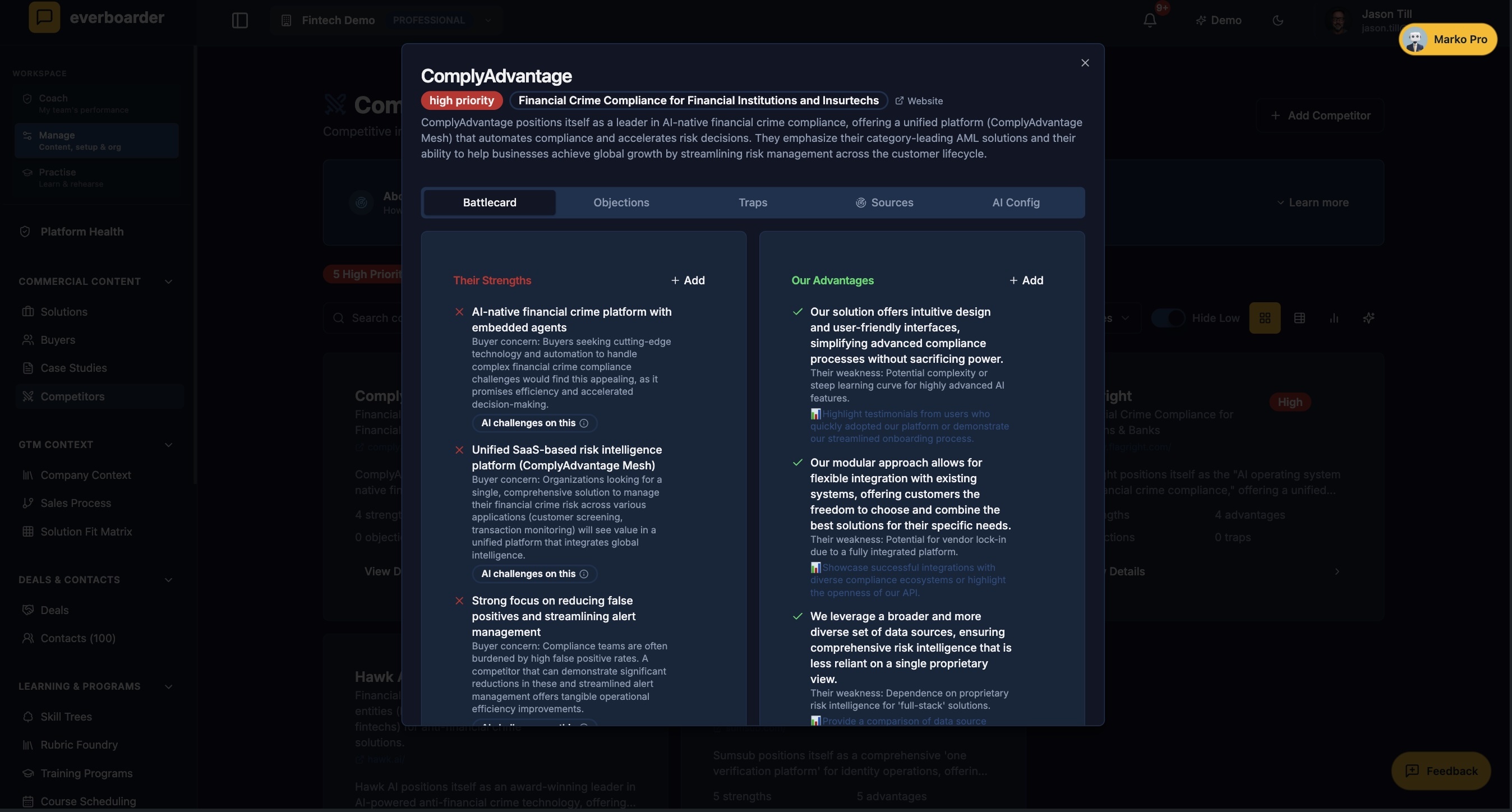
Battlecards that get used
The competitor section becomes a drill, not a laminated card.
Every enablement team has battlecards nobody reads. The battlecard view carries a live "AI challenges on this" button — the rep loads the competitor into a scored practice session and finds out whether the differentiation actually holds up when a buyer pushes back on it.
- One-click load into a live practice against the competitor.
- Reps drill the framing, not just read it.
- The battlecard evolves as the reps' wins and losses come back in.
RELATED TEMPLATES
Related templates
30/60/90 day sales plan template
The rep-side ramp plan — Learn / Contribute / Lead phases with certification milestones tied to AI practice. Sits inside the onboarding programme the playbook wraps.
Sales onboarding plan template
The manager-side onboarding programme — role definitions, competency framework, week-by-week schedule. The playbook is what new hires work against post-ramp.
Sales coaching plan template
The weekly 1:1 coaching template — agenda, scorecard, action items. The playbook is the scaffolding the coaching scorecard scores against.
Battle cards template
The competitive section of the playbook, one card per rival — positioning, expected objections, and AI practice for each.
Solution cards template
The product side of the messaging library — pain solved, ROI and differentiation per solution, ready to pitch against an AI buyer.
Also relevant: Sales enablement pillar.
Customer outcome
Frequently asked questions
Get the playbook your team will actually use
Populated from your data. Practiced, not just read. Free to start; the team plan adds manager-edit + rep-read views and quarterly-refresh automation.
Free to start. No credit card.