

For sales leaders
Watch them sell before you sign them.
Live AI sales practice against a digital twin of your ICP — scored, coached, and retested.
Free to start. No credit card.
Everboarder screens candidates on a real sales call, coaches them on what they got wrong, then retests — so you see not just how good they are, but how fast they get better.
The problem
The problem isn't hiring. It's finding out nine months late.
A resume tells you where a candidate has been. An interview tells you how well they interview. Neither tells you whether they can run your call, against your buyer, using your methodology.
So you find out in month nine. After the ramp spend. After the missed quarter. After the pipeline that never materialized, the manager hours spent trying to coach a rep who was never going to get there, and the termination conversation. Then you start the search again, and the seat sits empty for another quarter.
The mistake isn't hiring. Everyone mis-hires. The mistake is a screening process that can't tell you you've mis-hired until the damage is already priced in.
What one mis-hire costs — roughly 1–2× their on-target earnings
Source: Triangulated across DePaul CSL, SalesFuel, Gallup and SHRM
Of SDRs are let go each year — on top of the 11% who quit
Source: The Bridge Group, 2025 SDR Models, Motions & Metrics (351 B2B companies)
Months from offer to full productivity — ~3 to the first call, ~5.5 more to full output
Run it against your own comp band: four mis-hires a year on a 30-rep team, at 1–2× OTE, is a seven-figure line item most sales orgs never put on a slide.
Sales teams at these companies practice with Everboarder








Why it works
Structured beats subjective. Improvement beats the score.
Two things the hiring research is clear about — structured, real-task assessment predicts performance better than a conversation, and how fast a candidate improves tells you how fast they will ramp.
1. Structured, real-task assessment beats gut feel
The largest recent re-analysis of personnel selection research — Sackett, Zhang, Berry and Lievens (2022), Journal of Applied Psychology — re-ranked what actually predicts on-the-job performance. Structured interviews came out on top at r = .42, ahead of job-knowledge assessment (r = .40), work sample tests (r = .33) and cognitive ability (r = .31).
The pattern underneath those numbers: structure and task realism are what make a screen predictive. The closer the assessment gets to the actual job, and the more consistently every candidate is scored against the same criteria, the more it tells you.
A panel interview where four people form four different impressions of four different conversations is the opposite of that. It's the least predictive thing in the process, and in most sales orgs it's the thing the decision actually rests on.
2. A score is a snapshot. Improvement is the signal.
Two candidates open at the same score. One takes the coaching and jumps on the second run. The other repeats the same call, the same way, and lands in the same place.
They are not the same hire. One of them ramps; the other is a termination in nine months. But a screening process that tests once cannot tell them apart — and most screening processes test once.
This is the part almost every sales hiring process misses. You are not hiring the rep as they are on the day of the interview. You are hiring the rep they become after twelve weeks of coaching. The only honest way to predict that is to coach them and see what happens.
How everboarder screens
How Everboarder screens a sales candidate
1. Assess — against a digital twin of your ICP
The candidate runs a live sales conversation with an AI buyer built from your collateral, your competitive landscape and your CRM context. Not a generic "sell me this pen" scenario — your buyer, your product, the objections your reps actually hear. Voice or text.
2. Score — structured, consistent, mapped to your methodology
Every candidate is scored against the same criteria on sales technique and communication skill, mapped to the methodology you run — MEDDIC, MEDDPICC, SPICED, Challenger, Sandler, SPIN or Gap Selling. Same buyer, same rubric, same bar for every candidate, so you're comparing candidates rather than comparing interviewers.
3. Coach — every candidate gets told exactly what to fix
Everboarder gives the candidate specific, targeted coaching on their call: where discovery went shallow, where the objection got handled and where it got dodged, where the value story fell apart. Candidates get a genuinely useful experience whether or not you hire them — which matters for your employer brand in a market where reps talk.
4. Retest — and measure the delta
They run it again. The gap between run one and run two is the thing you actually want to know: how fast does this person absorb coaching? That delta is the closest available proxy for how they'll ramp, and you get it before you make the offer instead of in month four.
The whole loop runs asynchronously. Candidates take it on their own time, you review scored results side by side, and your team's interview hours go to the shortlist that has already proved it can sell.
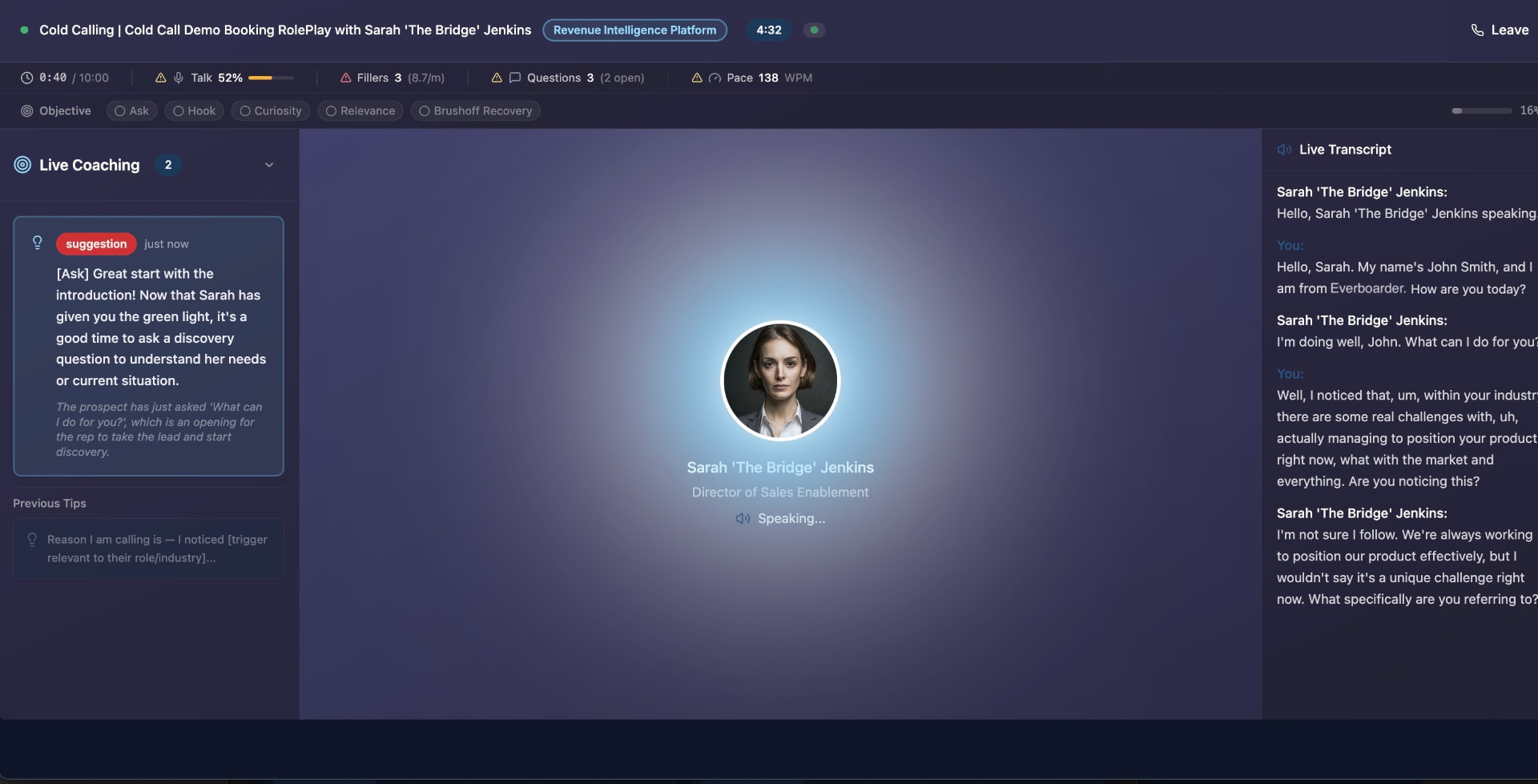
Assess
The candidate runs a real call — voice or text, live scored.
Not sell-me-this-pen. Your buyer, your product, your objections. Meters run in real time so the recording you review is a call they actually made, not a call they described in a panel.
- AI buyer built from your ICP, your competitive landscape and your CRM context.
- Live pace, filler and talk-ratio meters — you see the call they made, not the call they think they made.
- Async — every candidate takes it on their own time, no interviewer hours burned.
What changes
What changes when you screen this way
Fewer false positives
The polished interviewer who can't sell is the single most expensive person in your hiring funnel, and a conversational interview is designed to select for exactly that person. Watching a candidate work a real buyer removes the disguise. You stop paying twice — once to hire, once to fire and rehire.
You find the candidates who can learn
The flip side, and the one most teams never capture: a candidate who opens mid-pack but improves sharply on the retest is often a better hire than the polished one who doesn't move. Those candidates get rejected on the first score everywhere else. Measuring the delta means you can hire them on purpose — usually at a lower comp band, from a wider pool.
Faster ramp, and a gap map on day one
Every hire arrives having already practiced your motion against your buyer. Their manager starts with a scored breakdown of exactly where the gaps are, instead of spending the first six weeks finding out. Onboarding starts on week one instead of week seven.
One standard across the whole team
The same digital twin, methodology and scoring rubric that screens the candidate is what your existing reps practice against. Screening isn't a separate tool you buy for hiring season — it's the front door to the readiness system the team already runs on.
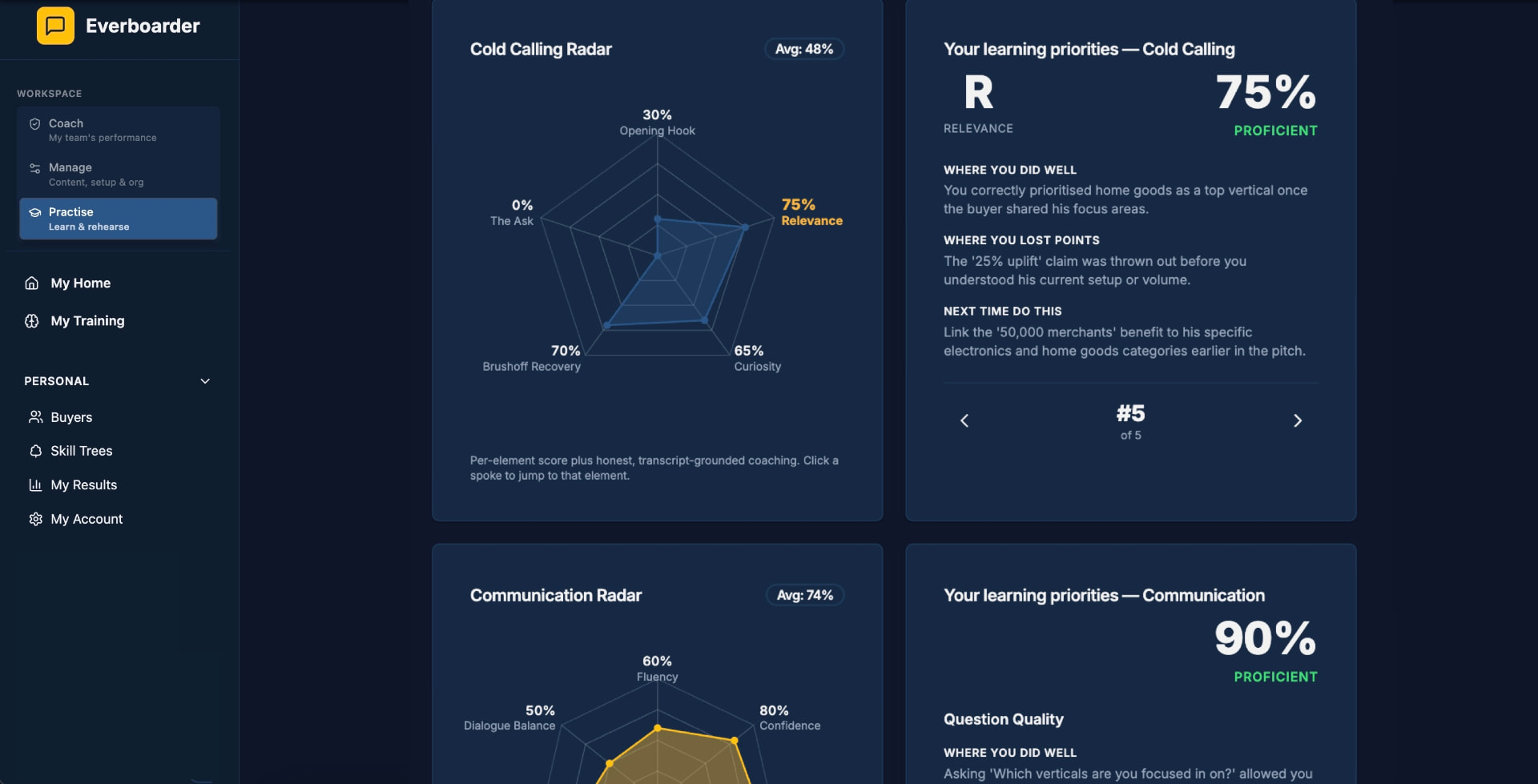
Score & retest
Same rubric, every candidate — coaching on the way out.
Structured beats subjective. Improvement beats the score. Every candidate is scored on the same criteria, gets specific coaching on what to fix, and the retake gives you the delta — a direct read on how fast this hire will ramp.
- Per-element scoring mapped to MEDDIC, SPICED, Challenger or whatever you run.
- Coaching notes anchored to the moment they happened, not a rejection email.
- Retest gap between run 1 and run 2 is the coachability signal you never had before.
Where it fits
It doesn't replace your process. It replaces the guessing.
Everboarder screening sits after the resume screen and before the panel. Sourcing, comp, references and the final hiring decision stay yours — every one of them.
What changes is that by the time a candidate reaches your panel, you already know they can run the call. So the panel stops being an audition and becomes what it should be: a conversation about motivation, judgment and whether this person is going to be good to work with.
| How candidates get assessed | Resume screen | Panel interview | "Sell me this pen" | Everboarder |
|---|---|---|---|---|
| Tests actual selling | No | No | Partly | Yes |
| Same bar for every candidate | Partly | No | No | Yes |
| Uses your buyer and methodology | No | Partly | No | Yes |
| Measures coachability | No | No | No | Yes |
| Scales past ~10 candidates | Yes | No | No | Yes |
| Gives the candidate something back | No | No | No | Yes |
After the offer
The screen is the first day of onboarding
The candidate's scored screening record doesn't get thrown away when they sign. It becomes their baseline. Their 30-60-90 day plan is built against the gaps the screen already found, they keep practicing against the same digital twin, and their manager can see improvement as a curve rather than a hunch.
That's the difference between hiring and onboarding: you're not selecting a finished rep, you're selecting the rep with the steepest curve and then giving them the reps to climb it. Once they're in, the same digital twin drives training and continued readiness — hiring, onboarding and training run as one system.
Objections answered
The four things you're probably thinking
"AI roleplay is a gimmick." It is, when the buyer is generic. The entire value here sits in the digital twin: the objections your reps actually hear, the competitor your buyer is also talking to, the pricing pushback specific to your deal shape. A candidate who can handle a generic AI buyer has proved nothing. A candidate who can handle yours has proved the thing you're hiring for.
"Good candidates won't do it." The ones who can sell will. What loses candidates is a screen that feels like unpaid work with nothing back — so every candidate gets a scored breakdown and real coaching on their own performance, whether or not you hire them. That is a better candidate experience than a rejection email after three rounds.
"Our process is already too long." This replaces a stage rather than adding one — usually the first-round screen, which is the stage least predictive of anything. It runs asynchronously, so it costs your team zero interview hours and typically shortens the calendar rather than extending it.
"Our hiring managers won't trust a score." They shouldn't trust it alone, and the product doesn't ask them to. The score is evidence for a human decision, alongside the recording of the call itself. Most managers stop arguing with the number once they watch the candidate run the conversation.
Who it's for
Built for the person carrying the number
See it live
See it run against your own ICP.
Book a 30-minute walkthrough. We'll build a digital twin of one of your buyer personas and screen a candidate profile against it, live, on the call.