

Framework
MEDDPICC
MEDDIC plus Paper Process and Competition — the enterprise sales qualification framework for deals above $100K with formal procurement. Free MEDDPICC checklist template and AI practice.
Free to start. No credit card.
Or create your account — free to start, no credit card, and your first roleplay is waiting inside.
The framework
What is MEDDPICC?
MEDDPICC is the enterprise sales qualification framework that extends the original MEDDIC checklist with two additional letters: P for Paper Process and a second C for Competition. The full eight letters — Metrics, Economic Buyer, Decision Criteria, Decision Process, Paper Process, Identify Pain, Champion, Competition — give reps a structured way to qualify complex, multi-stakeholder deals above $100K ARR where formal procurement, legal review, and competitive evaluation genuinely shape the outcome.
MEDDIC was developed at PTC in the early 1990s, where it is credited with helping grow the company from roughly $300M to $1B in revenue. MEDDPICC emerged later as enterprise SaaS sales cycles lengthened and procurement became more sophisticated. According to MEDDIC Academy, 73% of SaaS companies selling above $100K ARR now run MEDDIC or a variant — and at enterprise scale, the variant is usually MEDDPICC.
The framework is methodology-flexible but rigour-strict. Each letter is a gate the deal has to pass before it advances. Skip a letter and the deal slips — usually at week 11, when the unsurfaced Paper Process or the unmapped status-quo competitor finally surfaces and quietly kills the forecast.
Economic Buyer, tagged
Every letter starts on the model — not in the CRM field.
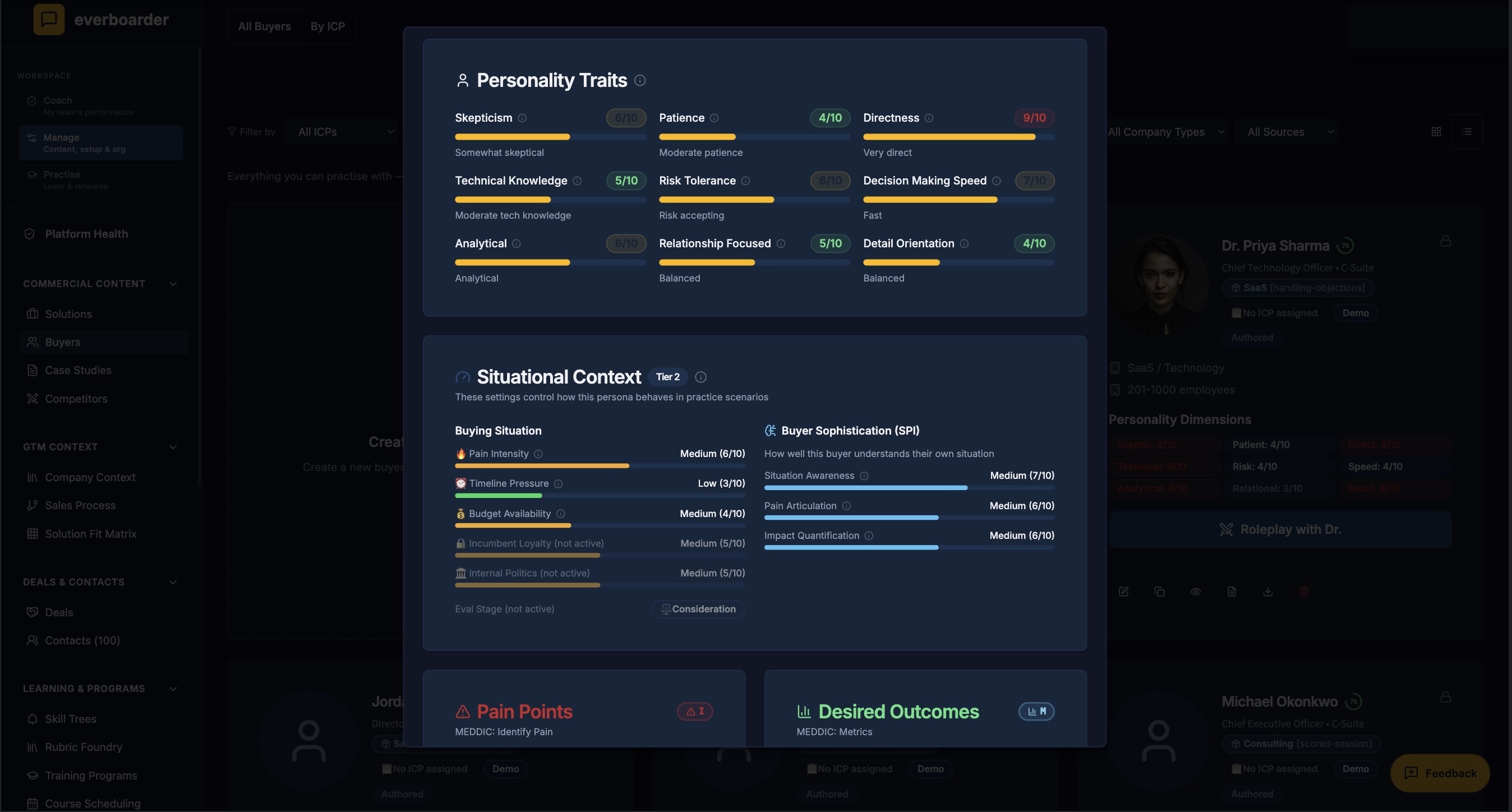
Pain Points and Desired Outcomes carry methodology tags on the buyer's dials, so the Economic Buyer, Decision Criteria, and Identify Pain letters have a place to live before the qualifying call starts. Paper Process authority becomes a dial the rep can see, not a note they'll write after the deal slips.
- MEDDIC tags on Pain Points and Desired Outcomes — the shape of the qualification is on the model.
- Buyers who defer the Economic Buyer question the way a real Champion would.
- Same dials drive the framework-aware scorecard — the pain the rep didn't surface shows up as a red row.
Letter by letter
MEDDPICC letter by letter
Each letter is a qualification gate. Below: what it means, a concrete example, and the most common way reps get it wrong.
Metrics
The quantified business outcome the prospect expects from solving this problem. Dollars saved, hours reclaimed, conversion lifted — a number, not a sentiment.
"Cut reconciliation time from 14 days to 5" or "reduce ramp time from 9 months to 4." Metrics anchor the ROI story you'll need at procurement.
Reps accept "improve efficiency" or "modernise the stack" as a metric. Those are themes, not metrics. Without a number, there's nothing to defend at the budget conversation.
Economic Buyer
The single person with the discretionary authority and budget to say yes — independent of consensus, committee, or executive sponsor sign-off.
At a 200-person SaaS company, the EB for a $80K tool is usually the VP of the business unit. At enterprise, it may be a divisional CFO. The EB is rarely the person you've been talking to.
Reps confirm the Champion as the Economic Buyer and skip the meeting. The deal then dies in week 11 because the actual EB sees the proposal for the first time and has different priorities.
Decision Criteria
The explicit list of features, capabilities, integrations, and constraints the prospect will evaluate vendors against — in writing where possible.
"Must integrate with Salesforce, SSO via Okta, SOC 2 Type II, sub-200ms latency, audit log retention 7 years." The criteria are the scorecard you'll be measured against.
Reps assume criteria from a demo conversation. Real criteria are set by the technical buyer and procurement, often after the demo, and frequently include items the rep never heard about.
Decision Process
The sequence of steps, approvals, and gates the deal must clear — from technical evaluation through legal review to signature — with names and dates against each step.
"Tech eval (2 weeks, lead by Priya) → security review (1 week, InfoSec) → procurement (3 weeks) → CFO sign-off (1 week) → DocuSign." Seven weeks minimum, with named owners.
Reps get "we'll get back to you next week" and write it down as the Decision Process. The real process has 5–8 steps the rep hasn't surfaced; the deal slips because no one mapped them in advance.
Paper Process
The procurement, legal, security, and signature mechanics — the operational path the contract takes from "yes" to countersigned PDF. The first of two MEDDPICC additions to MEDDIC.
Vendor onboarding form, MSA redlines (cycle 1: 8 days, cycle 2: 5 days), DPA, security questionnaire (typically 200+ questions at enterprise), InfoSec review, procurement negotiation, DocuSign.
Surfaced at week 7 instead of week 2. The verbal yes is in; the paper process then extends the deal by 30–90 days while the rep insists in the forecast that it's closing this quarter. It isn't.
MEDDPICC addition. Paper Process is where the deal you've won goes to die quietly. Surface it on the first qualification call, not after the verbal yes.
Identify Pain
The specific, named, quantified pain that motivates the prospect to act now rather than next year. Not "efficiency," not "growth" — a sharp problem with a cost.
"Reconciliation takes the finance team 14 days a month, blocking the monthly close and forcing 6 weekends of overtime per analyst per year. Audit flagged it last cycle." Named, quantified, with a deadline.
Reps accept generic pain ("we want to be more efficient") and lose to status quo. Without an identified, costed pain, there's no urgency — and "do nothing" beats "buy yours" by a wide margin.
Champion
An internal advocate with influence over the Economic Buyer, who actively sells your solution on your behalf when you're not in the room. Tested by asking them to do something difficult.
The Champion organises the demo with the EB, shares your one-pager in the leadership team meeting, and tells you which competitor's pricing came in lower. They have skin in your game.
Reps mistake an enthusiastic user for a Champion. A user who likes the demo is a Coach, not a Champion. Champions take political risk; coaches don't. The test: "will they introduce me to the EB this week?"
Competition
The full set of alternatives the prospect is evaluating — including direct competitors, build-in-house, adjacent tools, and the status quo. The second MEDDPICC addition to MEDDIC.
Direct: Outreach, SalesLoft. Indirect: "we'll just build it on top of Salesforce." Status quo: "we'll keep using spreadsheets and live with the pain for another year." All three are real competitors and the status quo wins more deals than the named ones.
Reps assume the competition is the named alternative on the RFP. The real competition is usually status quo (do nothing) or build-in-house, both of which require zero budget approval and zero procurement.
MEDDPICC addition. Three competition types — direct, indirect (build-in-house, adjacent tools), status quo — must all be mapped. Status quo is the competitor that wins most often.
Reading the letters is not the same as running them. Practise MEDDPICC against an AI buyer with a framework-specific scorecard.
Practise MEDDPICC with AIWorked example
Worked example: a Series-B SaaS deal, qualified end-to-end
The deal. Acme, a Series-B SaaS company selling a finance-ops product, has an $80K ARR opportunity at FinanceCo — a 5,000-employee financial services firm. The rep, Priya, is on her fourth call with the prospect. The deal closes 87 days after first contact.
Metrics. The Director of Finance Operations names the metric on call two: reduce month-end reconciliation from 14 days to 5, saving the finance team 6 weekends per analyst per year. Quantified, named, owned.
Economic Buyer. Priya confirms on call three that the EB is the CFO, not the Director of Finance Ops she has been talking to. She asks for and gets a 20-minute meeting with the CFO in week 5.
Decision Criteria. In writing, from the technical buyer: Salesforce integration, SSO via Okta, SOC 2 Type II, sub-200ms latency, 7-year audit log retention. Priya gets the list, confirms Acme meets each criterion, and documents it.
Decision Process. Mapped in week 3: tech eval (2 weeks, led by Priya at FinanceCo) → security review (1 week, InfoSec) → procurement (3 weeks) → CFO sign-off (1 week) → DocuSign. Seven weeks minimum, with named owners.
Paper Process — surfaced in week 7. This is where the MEDDPICC rigour earned its keep. FinanceCo's procurement team requires a 220-question security questionnaire, two cycles of MSA redlines (the first cycle alone takes eight days), and a separate DPA. Priya surfaced it on the third qualification call by asking "walk me through how a contract like this gets signed at FinanceCo." Had she waited until the verbal yes, the Paper Process would have extended the deal by another 30–90 days. Instead, it ran in parallel with the security review and added only 11 days to the cycle.
Identify Pain. The audit cycle had flagged reconciliation lag as a control weakness. The CFO had a quarterly board commitment to close it. Doing nothing was the most expensive option — which meant status quo could not win.
Champion. The Director of Finance Ops introduced Priya to the CFO, shared the Acme one-pager in her leadership team meeting, and warned Priya that a competitor's pricing had come in 12% lower. She took political risk. She was the Champion, not just an enthusiastic user.
Competition — three types mapped. Direct: a named competitor that came in 12% cheaper on price but failed two of the technical criteria. Indirect: "we could build a reconciliation workflow on top of Salesforce" — killed by the engineering team's roadmap, which had no capacity. Status quo: "we could live with the 14-day cycle for another year" — killed by the audit finding. With all three competitors mapped, Priya knew exactly which objections to pre-empt at the CFO meeting.
Outcome. Deal closed in 87 days. Roughly the cycle length the team forecast at qualification, because every letter had been surfaced before week 4. The deals that slip are the ones where Paper Process and Competition come in late.
Pitfalls
Five common MEDDPICC mistakes
Treating MEDDPICC as a CRM compliance exercise
Reps fill the eight fields after the call to keep the forecast clean, not before the call to actually qualify. The framework only works as a conversation guide. When MEDDPICC is a data-entry chore, the qualifying questions never get asked and the deal slips at week 11.
Surfacing Paper Process too late
Paper Process belongs on the first qualification call, not after the verbal yes. Asking "walk me through how a contract like this gets signed at your company" in week 2 surfaces a procurement queue, a security review, and an MSA cycle the rep would otherwise discover in week 7 — by which point the forecast is already wrong.
Confirming the Champion without testing them
An enthusiastic user is a Coach, not a Champion. The test is whether they'll take political risk on your behalf — introduce you to the Economic Buyer, share your one-pager in their leadership team, tell you their CFO's actual objection. If they won't do something difficult for you, they aren't your Champion.
Missing the status-quo competitor
Reps map the named competitors on the RFP and ignore the option that wins most deals: doing nothing. "Build it in-house on Salesforce" and "keep using the spreadsheet for another year" are real competitors with zero procurement friction. If the Identified Pain isn't sharp enough, status quo wins by default.
Using MEDDPICC when MEDDIC is enough
The extra two letters add overhead. In mid-market deals under $50K with a single decision-maker and no formal procurement, MEDDPICC's Paper Process and Competition rigour is unnecessary friction. Use MEDDIC for those motions and reserve MEDDPICC for enterprise deals above $100K where procurement and competition genuinely shape the outcome.
Coaching in MEDDPICC's language
"Champion tested. Paper Process surfaced. EB meeting booked."
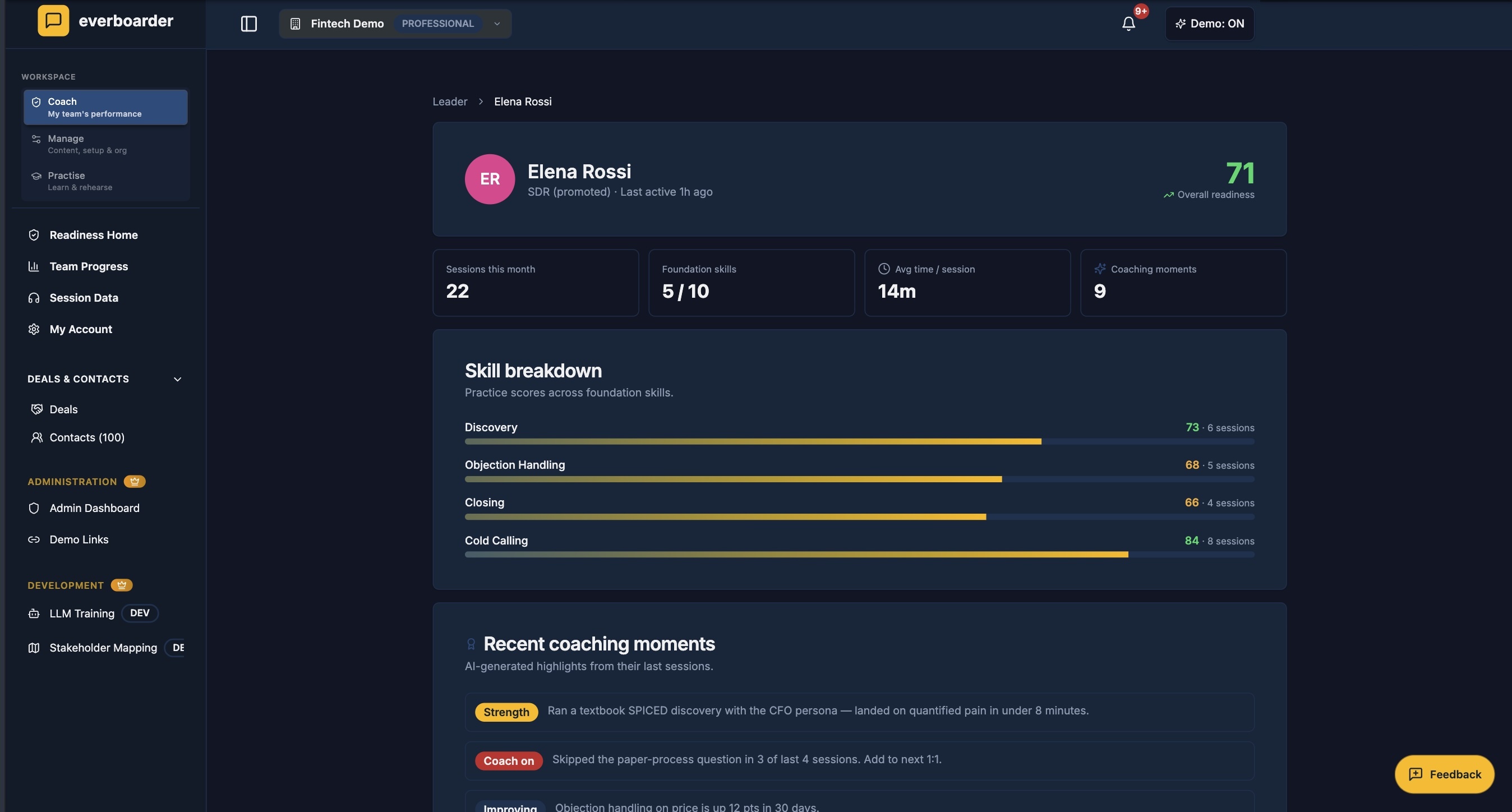
Coaching that references the eight letters, not "good call." The rep sees exactly which letter they landed and which they skipped before the next dial — Champion tested versus assumed, Paper Process surfaced versus deferred, Competition mapped versus ignored.
- Per-letter coaching moments tagged strength, coach-on, improving.
- Rep-level readiness curve rolls week over week to managers.
- Feedback vocabulary matches the eight letters — no CRM-field babble.

“I'm personally supportive, but the CFO will want to see the numbers.”
Practise live
Practise MEDDPICC live with AI
MEDDPICC adoption fails for the same reason every methodology rollout fails: there is no practice gap between the training workshop and the live call. Reps learn the eight letters in a Tuesday session and never rehearse them before Wednesday's qualification call. The framework stays in slides; the behaviour never changes.
Everboarder closes that gap with short, repeated practice against an AI buyer tuned to enterprise qualification. Resist the Economic Buyer probe the way a real CFO would. Withhold Decision Criteria until pressed. Surface Paper Process slowly. The methodology-specific scorecard scores each letter against the conversation — not against CRM field completion — and real-time coaching flags missed letters the moment the rep moves past them, while the muscle memory is still forming.
For teams, manager dashboards roll up methodology adoption — book a demo to see it.
Practise MEDDPICC, don't just read about it
Reading the eight letters is not the same as running them on call 14 of the week. Practise against an AI buyer; get the checklist; ship the framework into your motion.
Free to start. No credit card.
When to use it
When to use MEDDPICC vs alternative frameworks
Match the framework to the deal shape. MEDDPICC earns its keep in enterprise; smaller motions are better served by something lighter.
| Framework | Use it when |
|---|---|
| MEDDIC | Mid-market complex deals, $25K–$100K ARR, 3–5 stakeholders, 60–90 day cycles, no formal procurement. |
| MEDDPICC | Enterprise deals above $100K ARR, 5+ stakeholders, 90+ day cycles, formal procurement, security review, legal redlines, competitive evaluation. |
| BANT | Transactional B2B, inbound triage, short cycles where speed matters more than rigour. Budget / Authority / Need / Timeline as a quick gate. |
| SPIN Selling | Discovery-heavy sales where the prospect doesn't yet know they have the problem. Pairs well with MEDDPICC as a discovery-stage overlay. |
| SPICED | Subscription motions where deal-cycle compression and net expansion drive the economics. Winning by Design's framework, tighter than MEDDPICC for SaaS. |
| Solution Selling | Pain-chain frameworks for consultative motions — diagnose before prescribing. Strong in services-led sales; weaker when procurement is the bottleneck. |
Frequently asked questions
Run MEDDPICC for real
The eight letters are easy to read and hard to run. Get the practice and the checklist that turn methodology into behaviour.
Free to start. No credit card.