

Get them in
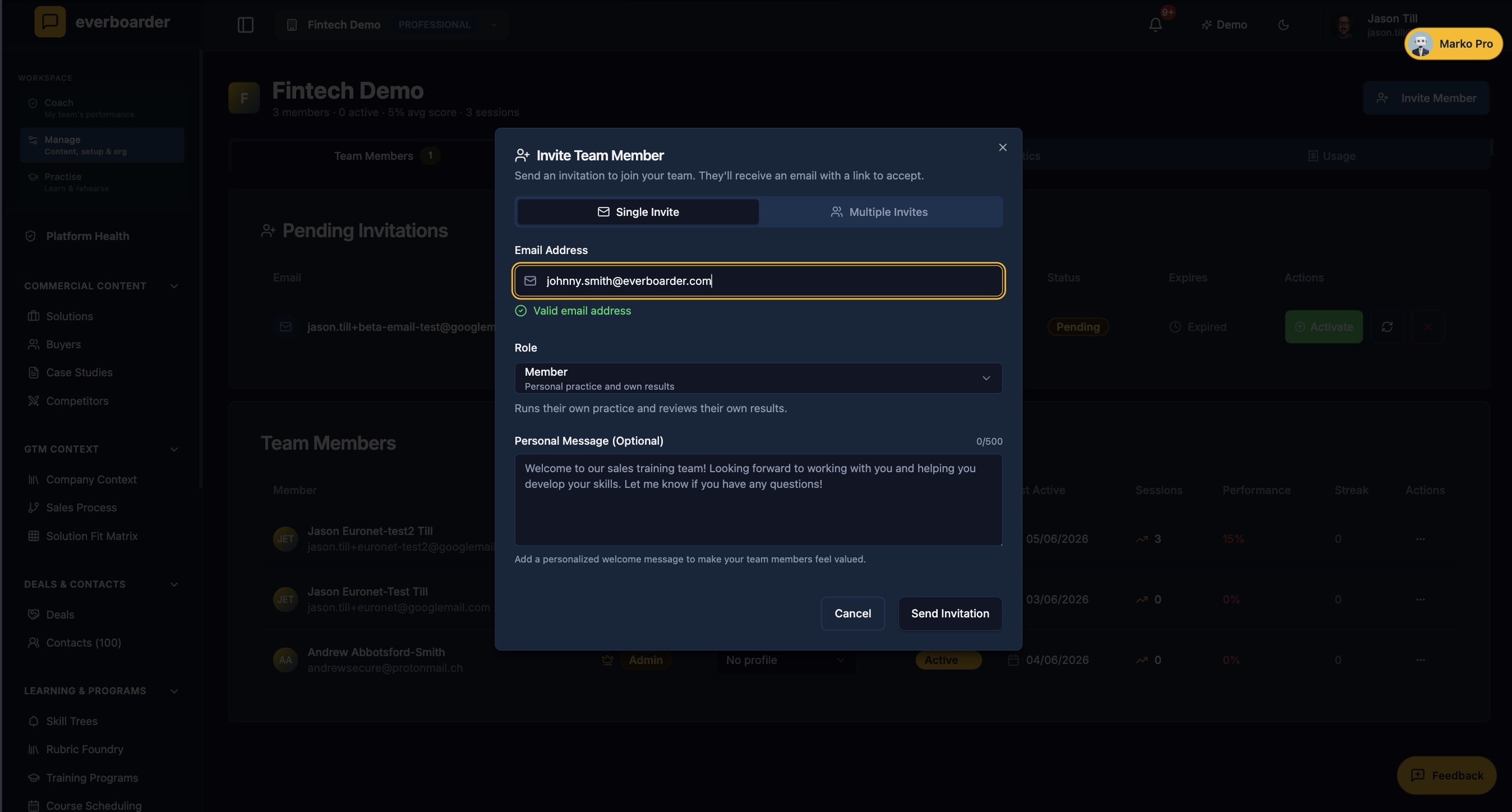
Roster and invitations
Onboarding starts with getting people in. One frame covers the mechanics — invites, roles, and the seat assignment that puts each new hire on the right ramp path.

Sales pillar
Cut sales onboarding from months to weeks. Structured curriculum, AI-driven certification, manager-amplifying coaching — built on practice-based skill transfer.
Free to start. No credit card.
Or create your account — free to start, no credit card, and your first roleplay is waiting inside.
The failure mode
Onboarding decks, methodology certifications, product wikis, competitive one-pagers — the content library gets deeper every quarter, and reps arrive at week 4 having read most of it and practiced none of it. Skill transfer needs reps against a realistic buyer, not reading time. The content is the floor, not the ceiling.
A rep who scores 100% on the MEDDIC quiz on Tuesday can still miss the Economic Buyer on Wednesday's discovery call. Certification-by-quiz measures memorisation, not behaviour. Real certification is a scored practice call against an AI buyer — the same rubric the manager scores live calls against.
Most teams have a 30/60/90 template shared in the enablement folder, filled in once during onboarding, and never opened again. The rep and the manager both stop looking at it by week 5. Without practice targets, certification gates, and evidence at each phase boundary, the plan becomes a formality — the ramp happens (or doesn't) somewhere else.
Most onboarding programmes assume the rep will "pick it up" through 3–5 shadowed calls plus a workshop. That's an order of magnitude short of what skill acquisition actually requires. The gap between what the programme provides and what the rep needs is where the manager's month-3 frustration comes from.
Even reps who ramp cleanly lose skill without ongoing practice — the opener that landed in month 3 sounds mechanical in month 9, the methodology that was second-nature at certification is quietly missing letters six months later. Onboarding that ends at day 90 leaves reps performing at a plateau they'll slowly slide off. Continued practice is not remedial — it's what maintains the skill floor.
Practice live
Reading the methodology isn't running it. Everboarder's AI buyers let new hires practice specific skills between manager sessions — pitch delivery, objection sequences, discovery-call rhythm, methodology-qualification depth — in 5–10 minute sessions with real-time coaching on the scorecard the manager uses.
Contextual Realism (SPCM) tunes the AI buyer to match the shape of the rep's real calls: same persona, same channel, same source. Certification at each phase gate is evidence, not opinion — the manager sees the practice data plus the rubric score, not just the rep's self-report.
The curriculum
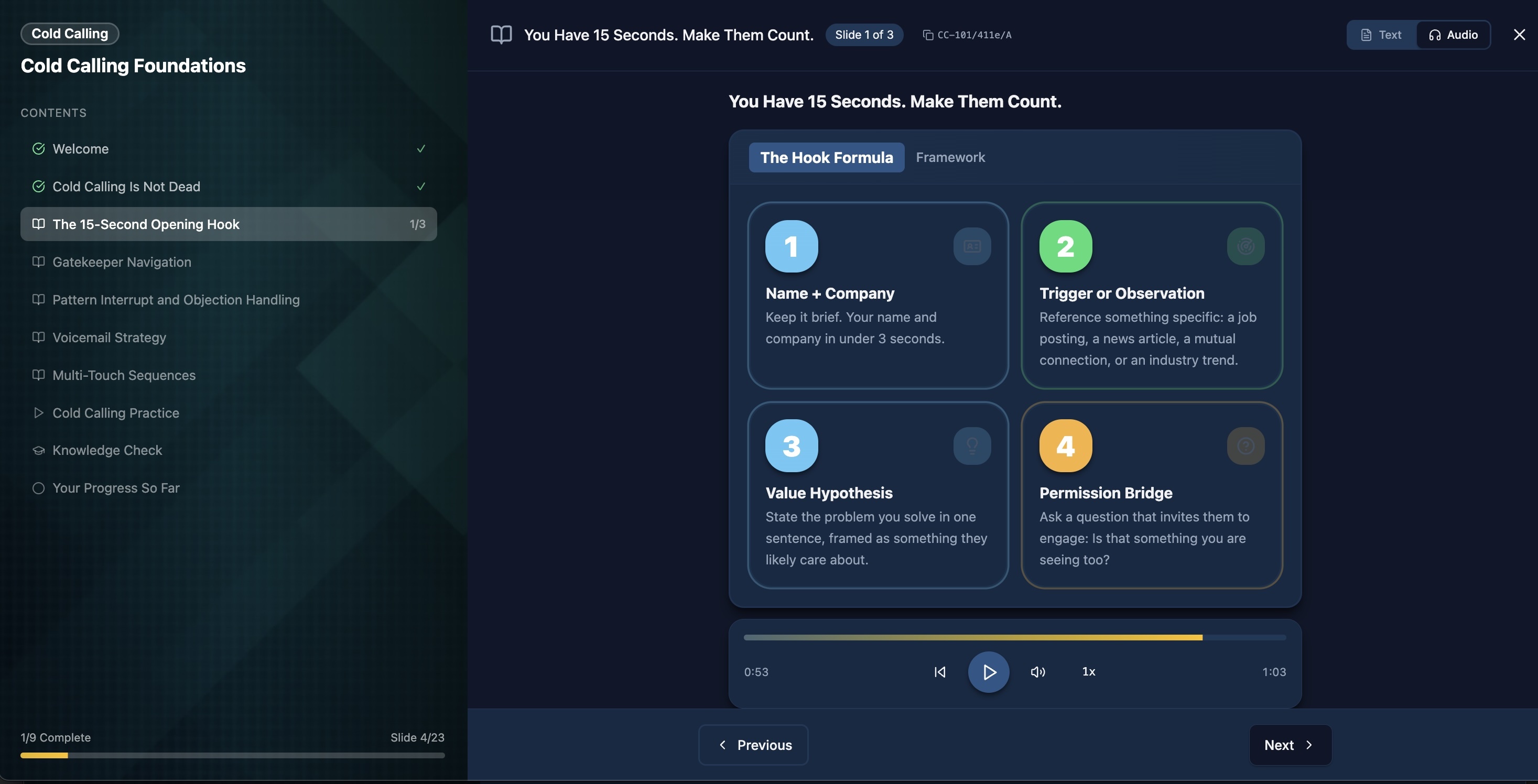
A course player with a completion-tracked contents rail. "Ramp reps to first meeting in weeks" needs a real programme with structured lessons behind it — not a link to a chatbot on day one.
How everboarder helps
Every phase of the onboarding programme pairs content with practice. Read the methodology, then run 10 reps against a methodology-tuned AI buyer. Watch the objection-handling module, then drill the LAER sequences with real-time coaching. Skill acquisition happens on the practice rep, not on reading.
AI buyers vary by source, channel, and persona — a skeptical CFO from a cold LinkedIn message doesn't behave like the same CFO from a warm referral. Practice matches the shape of the rep's real calls, so what transfers from practice to live is behaviour, not just vocabulary.
MEDDIC, MEDDPICC, BANT, SPIN, SPICED, Challenger, Solution Selling — certification gates and coaching scorecards adapt to the methodology your team actually runs. New hires certify against your framework's letters, not a generic rubric they'll never use in a live deal.
Feedback arrives during the practice call, not three days later in a 1:1. When the rep skips Implication or pitches before Need-Payoff, coaching flags it in the moment while the muscle memory is still forming — instead of repeating the bad habit 40 times before the next manager review.
Automates scoring, drill assignment, certification tracking, and ramp-plan progress — so the manager's onboarding time is spent on coaching conversations, not on running roleplay sessions and hand-scoring rubrics. One manager can ramp a full cohort at the same bar as one-to-one attention.
Reps can start practicing on their own before day one — most do. Teams add manager dashboards, role-specific paths, methodology customisation, CRM integration, and certification rollups when they're ready to run the programme at scale.
Per-rep ramp
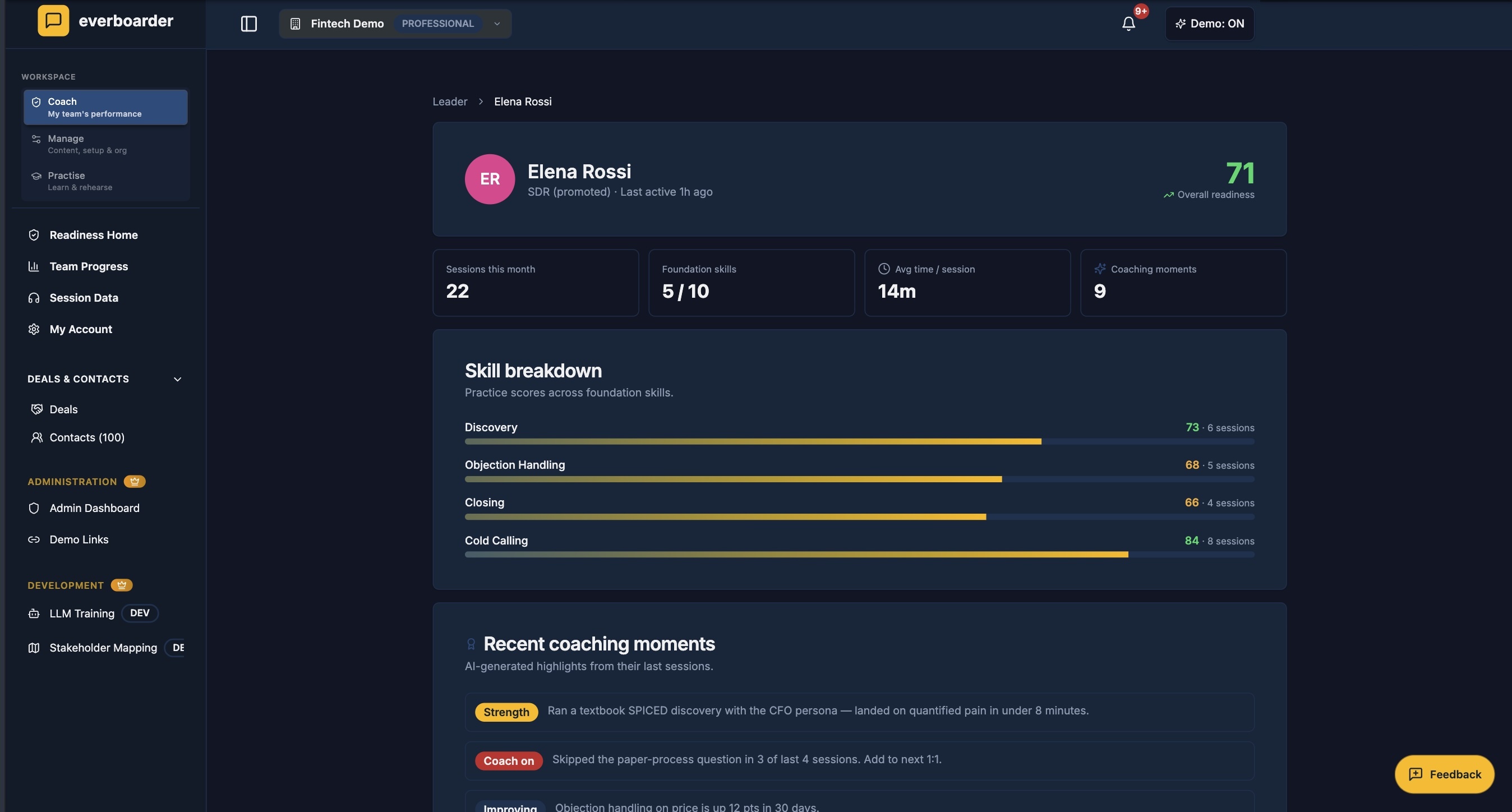
Per-rep skill progression across the certification skills, week by week. This is the picture managers ask for at month three — the specific reps who are on-track, the ones stalling, and the drill each one needs next.
Key features for you
Every template pairs with an AI buyer to practice the skill it describes. Coming-soon items ship over the following weeks of Phase 2.
The rep-side ramp plan — Learn / Contribute / Lead phases with certification milestones at each 30-day boundary tied to AI practice.
The manager-side onboarding programme — role definitions, competency framework, week-by-week schedule, manager checkpoints.
The weekly 1:1 coaching template that continues after ramp — agenda, scorecard, action items, evidence at the next session.
Modular playbook covering personas, plays, objection responses, and methodology overlay — the operating manual reps work against post-ramp.











At team scale
Onboarding scales when the mechanics — get people in, measure where they are — stop being manual work. Two frames that cover the operational half of the programme.
Onboarding starts with getting people in. One frame covers the mechanics — invites, roles, and the seat assignment that puts each new hire on the right ramp path.
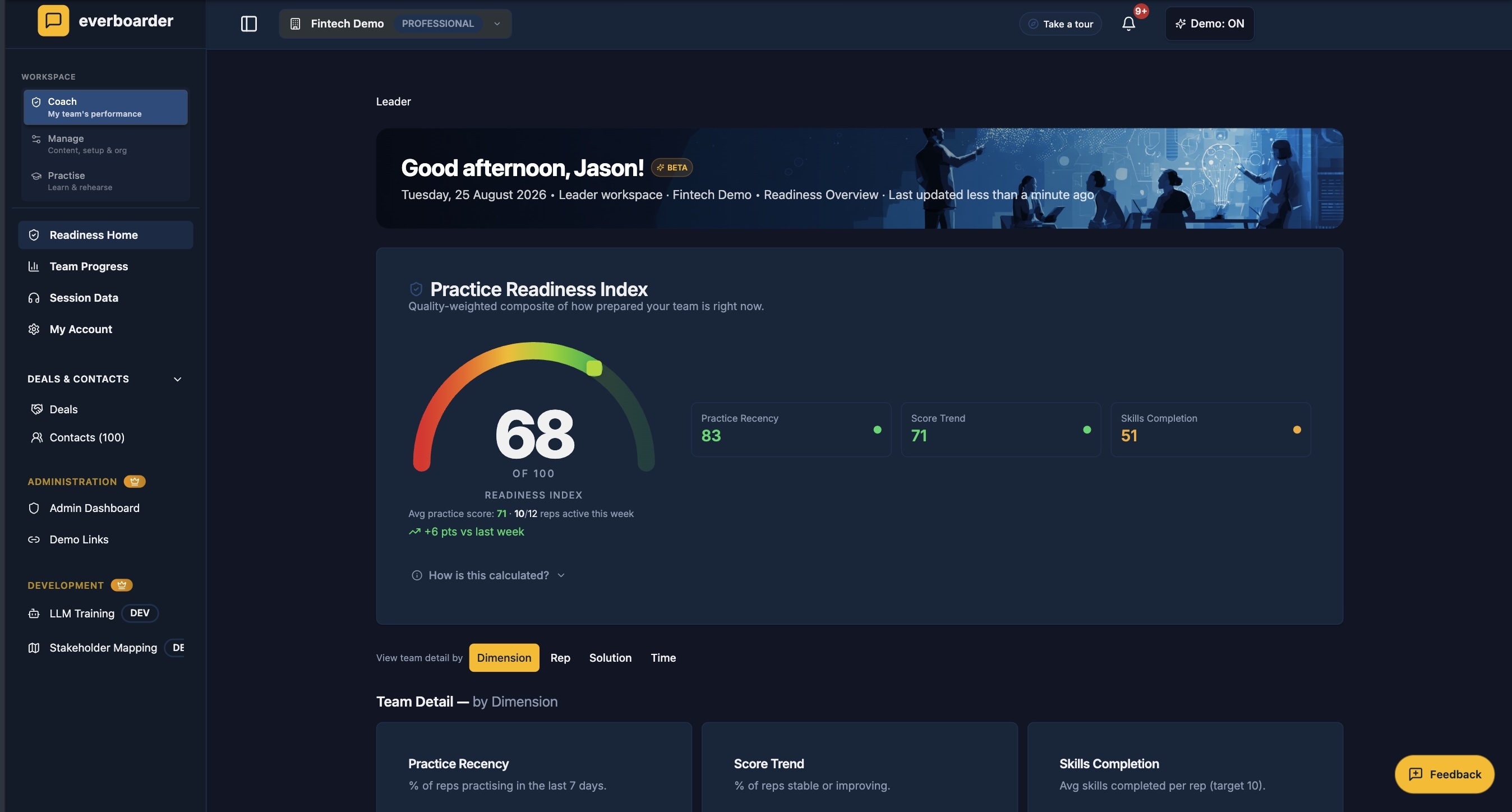
Onboarding progress as a measurable state, not a checklist that got ticked. The number leadership actually buys — the one that survives the QBR — in one screen at team level.
Methodology fit
Certification gates and coaching scorecards mirror the methodology's letters — the rep certifies on the same framework they'll use in live discovery, not a generic rubric that gets replaced on day 91.
Your stack
Integrations with your LMS, CRM, conversation intelligence platform, sales engagement, and SSO providers are on the roadmap. We'll list specific vendors here as each integration ships — we don't claim integrations we haven't built.
A 15-minute team demo covers manager dashboards, role-specific paths, certification rollups, and the practice library new hires drill against between phases.
Free to start. No credit card.
Practice-based certification, methodology-aligned rubrics, manager-amplifying dashboards. Free to start for individuals; team plans scale the programme.
Free to start. No credit card.