







everboarder
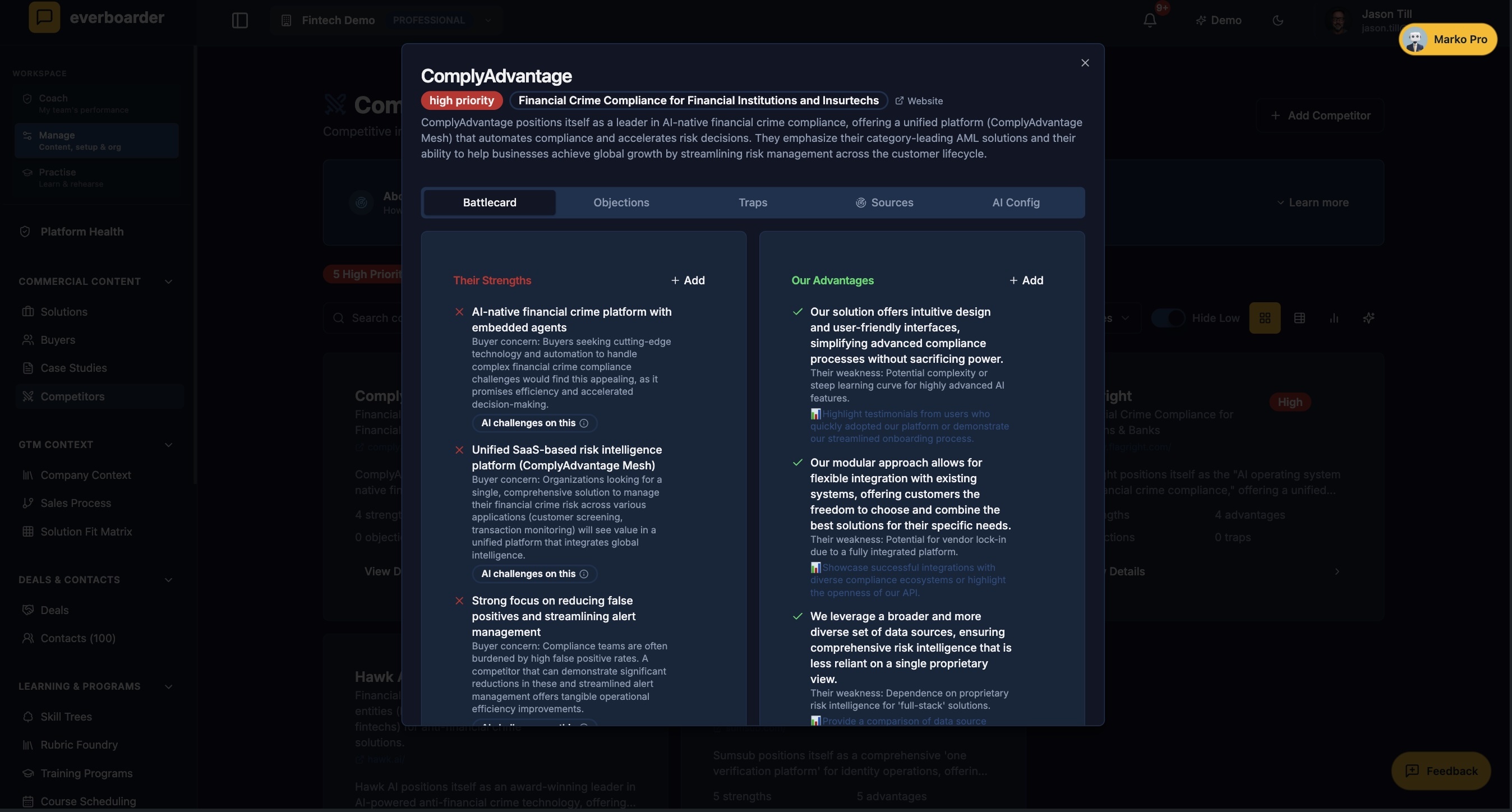
A competitor battlecard inside Everboarder alongside a live AI buyer practice session.

Enablement template

Sales battle card template

A battle card template that pairs with an AI buyer. Populate the competitor, the positioning, the expected objections — then practise against a buyer who throws exactly those objections back at you. Because the value of a battle card is what the rep does with it on the call, not what the enablement team ships to Notion.

Free forever. No credit card. Battle card unlocks after your first practice session.

Or create your account — free to start, no credit card, and your first roleplay is waiting inside.

What you get

What you get

  • Six-section battle card structure — Competitor snapshot, positioning statement, our wins vs. their wins, expected objections (with LAER responses), landmines & traps, discovery questions to disqualify their fit.
  • Practice mode — an AI buyer configured with the competitor's positioning drills your rep on every objection listed.
  • Objection variety — no two practice sessions identical; buyer randomises which of the expected objections gets thrown first.
  • Real-time coaching tips during practice — flags when the rep trashes the competitor, over-promises, or misses a discovery beat.
  • Manager view — see which reps have completed practice against which competitor cards.
  • Method-agnostic — works with MEDDIC, MEDDPICC, BANT, SPIN, SPICED workflows.
  • Editable in Everboarder and exportable to your CRM, Notion, or enablement wiki.

Sales teams at these companies practise with Everboarder

McKinsey & CompanyDentsuOmnicom GroupCiscoDatabricksHubSpotPalantir
CapgeminiCognismRevolut BusinessStafflineSageMonetate
Live example
HubSpotversusSalesforceBattlecard

You win on time-to-value and rep adoption. They win on deep enterprise customisation.

Where HubSpot wins
  • Live in weeks, not a two-quarter implementation
  • Reps actually use it — no admin layer between them and the CRM
  • Pricing that a VP can approve without a steering committee
Where Salesforce wins
  • Deeply bespoke workflows across large, matrixed orgs
  • Existing enterprise agreements and procurement inertia
Questions that plant doubt
  • Ask what their last implementation cost — in months and headcount
  • Ask how many admins it takes to change a single field
  • Ask what percentage of seats are logged into weekly
Objection handling
“We need enterprise-grade customisation.”Agreed — for the 10% of workflows that are genuinely bespoke. What did the other 90% cost you in admin time last year?
“We already own Salesforce licences.”Understood. What is the annual cost of the seats nobody logs into? That is usually where this pays for itself.
“Migration is too risky.”Most teams run parallel for one quarter. Who would need to see that plan for it to feel safe?
Faster to first value
88%
Weekly active seats
−31%
Admin overhead

AI buyer persona challenging a rep with a competitor price comparison
Can you respond to this well?
Your competitor quoted us 30% less for the same scope.
ObjectionCompetitor pricePractise this objection

Practice live

Drill the battle card with your team instantly

Run the card against an AI buyer configured with the competitor's positioning. The buyer throws the expected objections back at your rep in a randomised order — no two sessions identical.

Set up your team on Everboarder

Why it fails

Why most battle cards fail

Every good sales team has a folder of battle cards. Almost nobody uses them on a live call. The battle card gets built, filed in Notion, and the enablement team reports on "battle cards shipped" instead of "battle cards used". Three failure modes.

They live where reps don't look.

Enablement teams ship battle cards to a wiki. Reps live in their CRM, their inbox, and their next meeting. The card that would have saved the deal was three clicks away and got skipped.

They're outdated by the time the rep needs them.

Competitive intel changes faster than the update cycle. A competitor's pricing changed six weeks ago; the battle card still shows the old number; the rep quotes the old number; the deal is dead.

They're read once, forgotten before Friday.

Reading a battle card isn't the same as being able to deliver its positioning under pressure from a real prospect. Battle cards are enablement content. Battle-card-shaped skill is enablement outcome. The gap between them is where deals get lost — and no amount of "please read the battle card" from the enablement Slack channel closes it.

Everboarder pairs the battle card with an AI buyer that plays the competitor's positioning back at you. The rep doesn't just read what the competitor will say — they hear it, respond, get scored, iterate. The battle card becomes battle-card-shaped skill.

Six sections

The six sections in detail

Each section carries a single job. Together they cover the competitive deal end-to-end — from qualification through objection handling.

1

Competitor snapshot

One-paragraph summary of who they are and where they win. Include category and positioning, typical ICP overlap with yours, funding stage, notable customers, and the most recent product move in the last 90 days.

2

Positioning statement

The one-line version of 'why us, not them' the rep can say in their sleep. Structured as [Buyer situation] + [our unique value] + [their limitation] = why we win.

3

Our wins vs. their wins

A two-column matrix. When do we win against this competitor (list 5–7 buyer signals) and when do they win against us (list 3–5). The second column is what lets reps disqualify losable deals before they eat the pipeline.

4

Expected objections + LAER responses

The four objections this competitor's positioning will produce, each with a Listen / Acknowledge / Explore / Respond script. Includes a 'what NOT to say' callout — half the losses to this competitor come from reps trash-talking them into the deal.

5

Landmines & traps

The two or three moves this competitor uses mid-cycle that reps walk into. Named — the free-pilot trap, the CIO reference call, the 'we're a platform' claim. For each: what to watch for and what to preempt.

6

Discovery questions to disqualify their fit

Six questions the rep can ask on the first discovery call that surface whether this is a 'we win here' or 'they win here' opportunity — so you know before proposal stage.

Get in the reps

Practise the card before the competitive deal.

Run the battle card against an AI buyer who's already been calibrated on the competitor's positioning. Five minutes today beats one lost competitive deal this quarter.

Set up your team on Everboarder

How Everboarder differs

How Everboarder differs

Most enablement platforms let you distribute battle cards. Ours lets you drill against them. That's the difference between an enablement outcome and an enablement activity.

Contextual Realism (SPCM) means the AI buyer's positioning changes with the segment, persona, and stage of deal. A CFO at a Series-B SaaS company evaluating you against Hyperbound behaves differently than a VP of Sales at an Enterprise fintech evaluating you against Second Nature. The card handles the positioning; the practice handles the delivery.

The bar is not "reps read the battle card." The bar is "reps close the deal against the competitor the card was written for." That's why the editable card unlocks after practice, not before.

FAQ

Battle cards — direct answers

The questions enablement leaders and sales managers ask before standardising battle cards across the team.

Battlecards that get used

The competitor section becomes a drill, not a laminated card.

Every enablement team has battlecards nobody reads. The battlecard view carries a live "AI challenges on this" button — the rep loads the competitor into a scored practice session and finds out whether the differentiation actually holds up when a buyer pushes back on it.

  • One-click load into a live practice against the competitor.
  • Reps drill the framing, not just read it.
  • The battlecard evolves as the reps' wins and losses come back in.
Competitor battlecard
A competitor battlecard inside Everboarder — differentiation notes with a one-click "AI challenges on this" drill.

Get started

Ship the card. Drill the delivery.

The next competitive deal is either backed by a rep who has drilled the card — or by one who read it once.

Free forever for individuals. Team plans add manager dashboards, competitor scenario libraries, and CRM integration.