







everboarder
An enablement lead assembling a solution card alongside an AI buyer pitch session.

Enablement template

Solution cards template

A solution card template that pairs with an AI buyer. Populate the pain your product solves, the ROI, the decision criteria you win on — then practise pitching it against a buyer who'll challenge every claim. Because a solution card is worth what the rep can defend under pressure, not what product marketing wrote on the slide.

Free forever. No credit card. Solution card unlocks after your first practice session.

Or create your account — free to start, no credit card, and your first roleplay is waiting inside.

What you get

What you get

  • Five-section solution card structure — Buyer pain solved, differentiated value, quantified ROI, decision-criteria alignment, common objections & responses.
  • Practice mode — pitch the card against an AI buyer calibrated to the buyer persona the card was built for.
  • Coaching on delivery — flags when the rep pitches features instead of pain, over-quantifies without proof, or skips discovery for a canned pitch.
  • Multiple cards per product line — build one card per buyer persona, per ICP segment, per stage of the sales cycle.
  • Manager view — see which reps can defend which solution cards, ready-vs-not per rep per card.
  • Method-agnostic — plugs into SPIN discovery, MEDDIC Metrics, SPICED Impact, Solution Selling Vision.
  • Editable in Everboarder, exportable to your enablement wiki or CRM.

Sales teams at these companies practise with Everboarder

McKinsey & CompanyDentsuOmnicom GroupCiscoDatabricksHubSpotPalantir
CapgeminiCognismRevolut BusinessStafflineSageMonetate
Live exampleClick a card to focus it
AnalyticsSolution card

Revenue Intelligence

Sells to CRO · VP Revenue Operations

Pains it removes
  • Forecast is a spreadsheet opinion, not a signal
  • Nobody can say which deals are actually slipping
  • Board asks “why” and the answer takes a week
How it wins
One number, defensible
Pipeline health that survives a board question.
Slip detection
Flags at-risk deals from real activity, not sentiment.
Rep-level coaching signal
Shows who needs which conversation, not just who is behind.
Discovery questions
  1. 1How do you build the forecast today, and who challenges it?
  2. 2When a deal slips, how long until you know why?
  3. 3What would you change if you trusted the number completely?
92%Forecast accuracy at quarter close

DataSolution card

Customer Data Platform

Sells to CMO · Head of Growth

Pains it removes
  • Customer data lives in six systems that disagree
  • Segments take a data-team ticket and two weeks
  • Personalisation stops at the first name
How it wins
One resolved profile
Identity stitched across every touchpoint.
Self-serve segments
Marketers build audiences without a ticket.
Activation anywhere
Push the same segment to ads, email and product.
Discovery questions
  1. 1How many systems hold a version of the customer today?
  2. 2What happens when marketing needs a new segment?
  3. 3Which campaign would you run if data were not the blocker?
6 → 1Systems of record consolidated
SupportSolution card

Service Automation

Sells to VP Customer Support · COO

Pains it removes
  • Ticket volume grows faster than headcount
  • Agents answer the same question forty times a day
  • CSAT drops the moment the queue backs up
How it wins
Deflection that works
Resolves repeat questions before an agent sees them.
Agents on the hard cases
Routes complexity to the people who can handle it.
Consistent answers
One source of truth, every channel.
Discovery questions
  1. 1What share of tickets are genuinely novel?
  2. 2Where does an agent lose the most time in a shift?
  3. 3What would you do with 30% of your queue back?
−42%First-touch resolution time
AI buyer persona challenging a rep on differentiation vs competitors
Can you defend the card under pressure?
Your competitors said the same thing. What makes you different?

Practice live

Drill the solution card with your team instantly

Run the solution card against an AI buyer calibrated to the persona the card was built for. Practise the pitch, hear it back, iterate before the real demo.

Set up your team on Everboarder

Battle cards vs solution cards

Battle cards vs solution cards — what's the difference

Battle cards face outward at the competition. Solution cards face inward at the product. Battle cards answer "how do we win against [competitor]?". Solution cards answer "how do we sell [our own value]?".

You need both. A rep with strong battle cards but weak solution cards can defuse the competitor but can't articulate why the buyer should pick anyone. A rep with strong solution cards but weak battle cards can pitch the product but can't handle "why not [competitor]?". Together they cover competitive selling end-to-end.

Why it fails

Why most solution cards fail

Same failure mode as battle cards, at scale. Product marketing ships them, enablement distributes them, sales reads them, nobody practises them. Then a Series-B AE walks into a Thursday-afternoon demo with the CFO and their pitch is 40% of what the solution card said it should be, because 40% is the retention rate of read-once information under pressure.

Also common: solution cards written from product's point of view, not buyer's. The card lists features and internal terminology. The rep translates on-the-fly. Half the buyer conversation is the rep translating instead of positioning. The fix is a card structured around buyer pain and outcome, not around feature name and specification — which is what this template enforces.

Card meets buyer

The persona the card was written for shows up as an actual buyer.

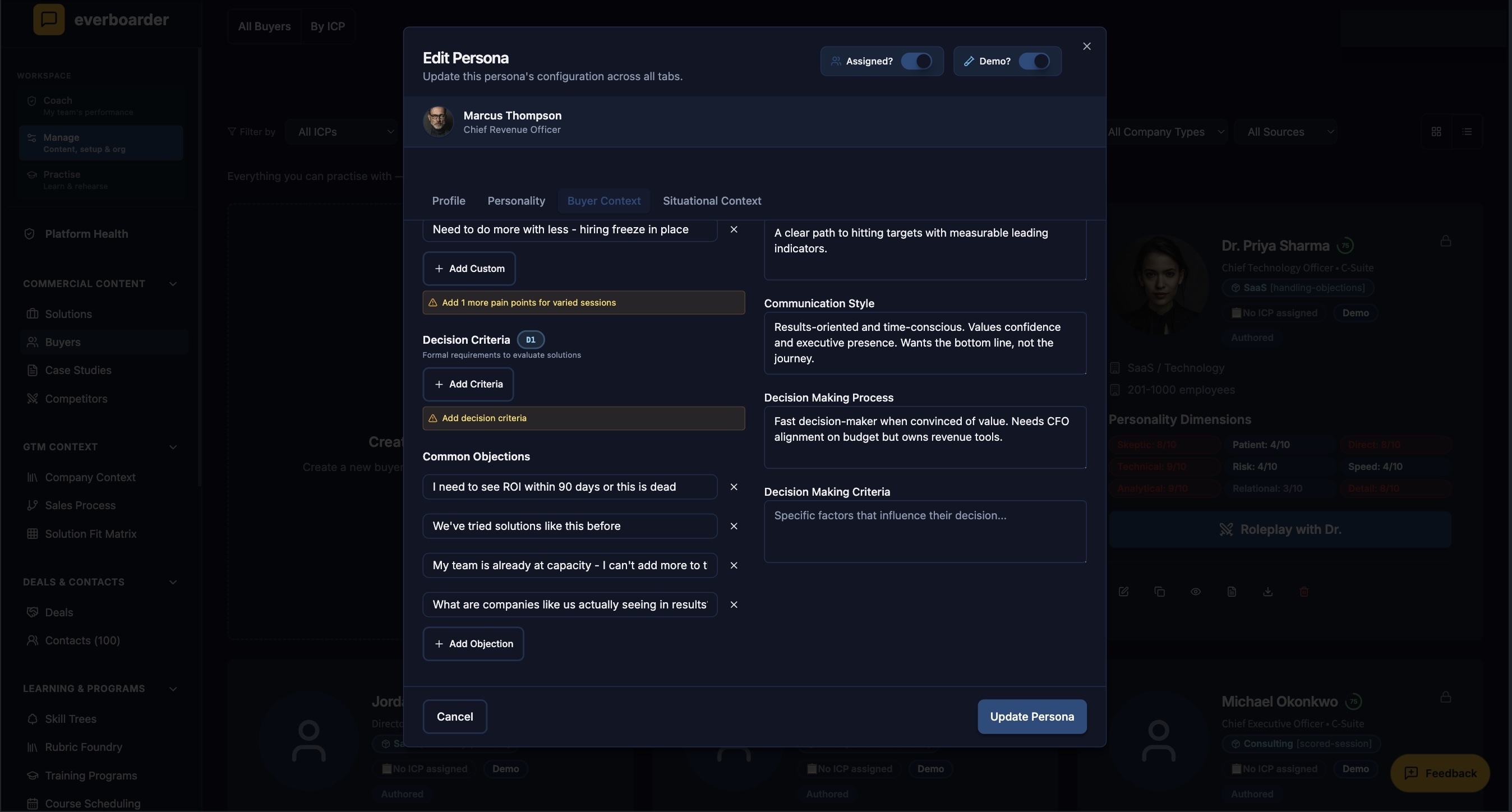
Populate the pain, outcomes, and decision criteria in the persona builder and the solution card has a live counterpart to be pitched against. Not a generic AI partner — the exact buyer the card was written for, ready to challenge every line on it.

  • Buyer pain, outcomes, and objections tied to the card's ICP.
  • Completeness prompts flag missing sections before practice starts.
  • One card, one buyer — pitch it, hear it back, iterate.
Persona builder
The persona builder inside Everboarder — assembling the buyer persona a solution card will be pitched against.

Five sections

The five sections in detail

Each section carries a specific job in the pitch. Miss one and the card leaves the rep short a beat.

1

Buyer pain solved

The specific pain the buyer feels, in their language, not yours. Structured: [Buyer role] at [ICP segment] typically struggles with [specific friction], which shows up as [observable symptom], costing [quantified impact] per [time period].

2

Differentiated value

What your product does that solves that pain, framed against the two alternatives the buyer will consider (competitor and do-nothing). Not 'what we do' — 'what we do that the alternatives don't'.

3

Quantified ROI

The metric that moves when the buyer picks you. Includes: the metric, the range of impact from customer data, the timeline to impact, and one proof-point customer at their ICP segment.

4

Decision-criteria alignment

For each of the top three decision criteria this buyer typically uses, one line on how your product satisfies it. This is where reps go weakest in practice — they know the product but not the buyer's decision framework, so the pitch lands wrong.

5

Common objections & responses

The three objections you consistently hear about this solution, each with a Listen / Acknowledge / Explore / Respond script and a 'what NOT to say'.

Roll it out

Give the card to your team, drill it, ship it.

Set up your team on Everboarder, upload the card, and every rep practises the pitch against the persona the card was built for before the real demo.

Set up your team on Everboarder

The buyer that stress-tests the card

One card, three different pressure tests by ICP.

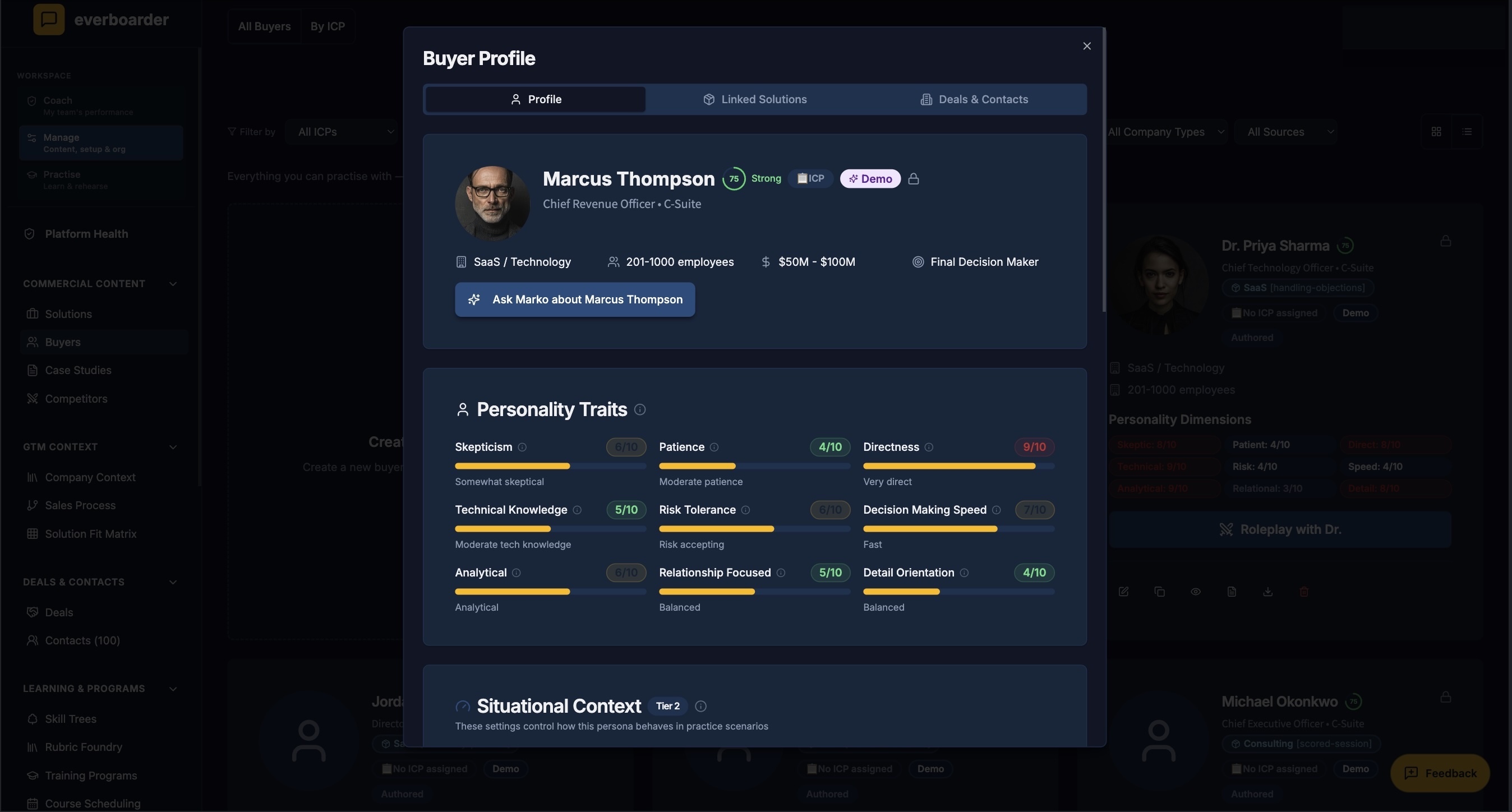
A CFO at a Series-B SaaS challenges ROI mathematics. A VP of Sales at a mid-market fintech challenges implementation risk. A CTO at an enterprise services firm challenges integration path. Same solution card, three different buyer profiles — the rep who's practised all three is the rep who wins across ICPs.

  • Buyer profile view shows pain, outcomes, and posture per ICP.
  • One card, multiple buyers — each configured to pressure-test differently.
  • Reps drill the card against the ICP they're actually pitching this week.
Buyer profile
A buyer profile read view inside Everboarder — the persona the solution card is being drilled against.

How Everboarder differs

How Everboarder differs

Solution cards are enablement's single highest-effort content asset per unit of adoption. Weeks of PMM input, days of enablement formatting, and reps who read them once. The economics only work when the card produces skill, not just knowledge — and skill comes from practice.

Contextual Realism means the AI buyer challenges the card differently by ICP. A CFO at a Series-B SaaS challenges ROI mathematics. A VP of Sales at a mid-market fintech challenges implementation risk. A CTO at an enterprise services firm challenges integration path. Same solution card, three different pressure tests. The rep who's practised all three is the rep who wins across ICPs.

FAQ

Solution cards — direct answers

The questions enablement leads, PMMs, and sales leadership ask before rolling out a solution-card library across the team.

Get started

Ship the card. Then drill it.

A solution card is worth what the rep can defend under pressure — not what product marketing wrote on the slide.

Free forever for individuals. Team plans add manager dashboards, custom scenario libraries, and CRM integration.