
MEDDPICC checklist template + AI practice
The eight-dimension MEDDPICC qualification checklist for enterprise deals above $100K — Paper Process and Competition included. Free template and AI practice.
Free to start. No credit card.
Or create your account — free to start, no credit card, and your first roleplay is waiting inside.
What you get
What you get
- →All eight MEDDPICC dimensions — Metrics, Economic Buyer, Decision Criteria, Decision Process, Paper Process, Identify Pain, Champion, Competition.
- →0–3 scoring on every dimension; total scorecard out of 24 with a single forecast-health number.
- →Stage-gating logic — deal cannot advance to Proposal until Paper Process is mapped and scored ≥2.
- →Discovery questions for the two enterprise-specific dimensions (Paper Process and Competition) other templates skip.
- →Practise the full eight-dimension scorecard against an AI buyer who hides the economic buyer and slips procurement.
- →Method-agnostic on the inside — drops into Salesforce, HubSpot or any opportunity record without re-platforming.
FAQ
MEDDPICC — direct answers
The seven questions enterprise reps actually search for, answered the way you'd answer them on a real call.
Why it fails
Why most enterprise qualification fails
The first failure is treating MEDDPICC as paperwork. Reps fill the eight letters in after the deal is already in Proposal, working backwards from a forecast they've already committed to. The point of the framework is to challenge the forecast before it's made, not to justify it after.
The second failure is skipping Paper Process because it feels like procurement's problem. It isn't. Enterprise deals routinely take six to twelve weeks in the administrative layer alone — security review, MSA, DPA, vendor onboarding — and a deal that is qualified on pain and metrics still slips a quarter when a new procurement contact surfaces in week eight.
The third — and most expensive — failure is treating the status quo as a non-event. Roughly forty per cent of forecasted enterprise deals are lost to no decision, not to a competitor. The second C in MEDDPICC exists specifically to force that conversation into the deal review, where it can be defended.

“Can you put together something I can share internally? I can't present vendor slides.”
Practice live
Practise the scorecard before you score the deal
Run the eight dimensions against an AI buyer who hides the economic buyer and slips procurement. Five minutes today beats a slipped quarter next month.
Practise this MEDDPICC template with AIFree to start. No credit card.
Template preview
Preview the template
The first four dimensions (M, E, D, D) are free. Practise with the AI buyer to unlock Paper Process, Identify Pain, Champion and Competition.
Stage-gating rule
The stage-gating rule
Deals cannot advance from Discovery to Proposal until Paper Process is mapped.
Concretely: Paper Process must score ≥2, meaning every administrative step from verbal yes to signed contract has a named owner and a rough timeline. The cost of pausing one extra discovery call to map Paper Process is two days. The cost of skipping it is a slipped quarter when procurement surfaces in week eight. The math is obvious once the rule is enforced.
Eight dimensions
The eight dimensions, scored 0–24
Each dimension scores 0 (unknown) to 3 (validated by the economic buyer or champion in their own words). Healthy forecasted deals score above 18 total with no individual dimension below 2.
Metrics
Quantified KPIs the buyer's CFO would recognise — dollar impact, ramp time, cost-to-serve. Score 0–3 based on whether the number is specific, sourced and economic-buyer-aligned.
Economic Buyer
The person who can unilaterally release budget and stop the deal. Score 0 if unknown, 3 if you have met them and they have validated the metrics in their own words.
Decision Criteria
The explicit criteria the buyer will use to choose — technical, business, and political. Score reflects whether you helped shape them or are responding to a competitor's list.
Decision Process
Every step from the current stage to a signed contract — including procurement, legal, security review and final approval. Score 3 when every step has an owner and a date.
Paper Process
The administrative path from verbal agreement to signature: MSA, DPA, security review, vendor onboarding, finance setup. Score 0 if unmapped, 3 if every step has an owner and a timeline. The deal cannot advance from Discovery to Proposal until this is scored ≥2.
Identify Pain
The quantified business pain that the economic buyer has acknowledged in their own words. Score 3 only when the pain is named, sized in dollars, and tied to a deadline.
Champion
An internal advocate with influence, personal stake in the outcome, and the willingness to sell on your behalf when you are not in the room. Tested, not assumed.
Competition
Three categories mapped — direct competitors, indirect alternatives (build in-house, adjacent tool), and the status quo (do nothing). Score 3 only when the champion has been briefed on all three.
Tune the buyer
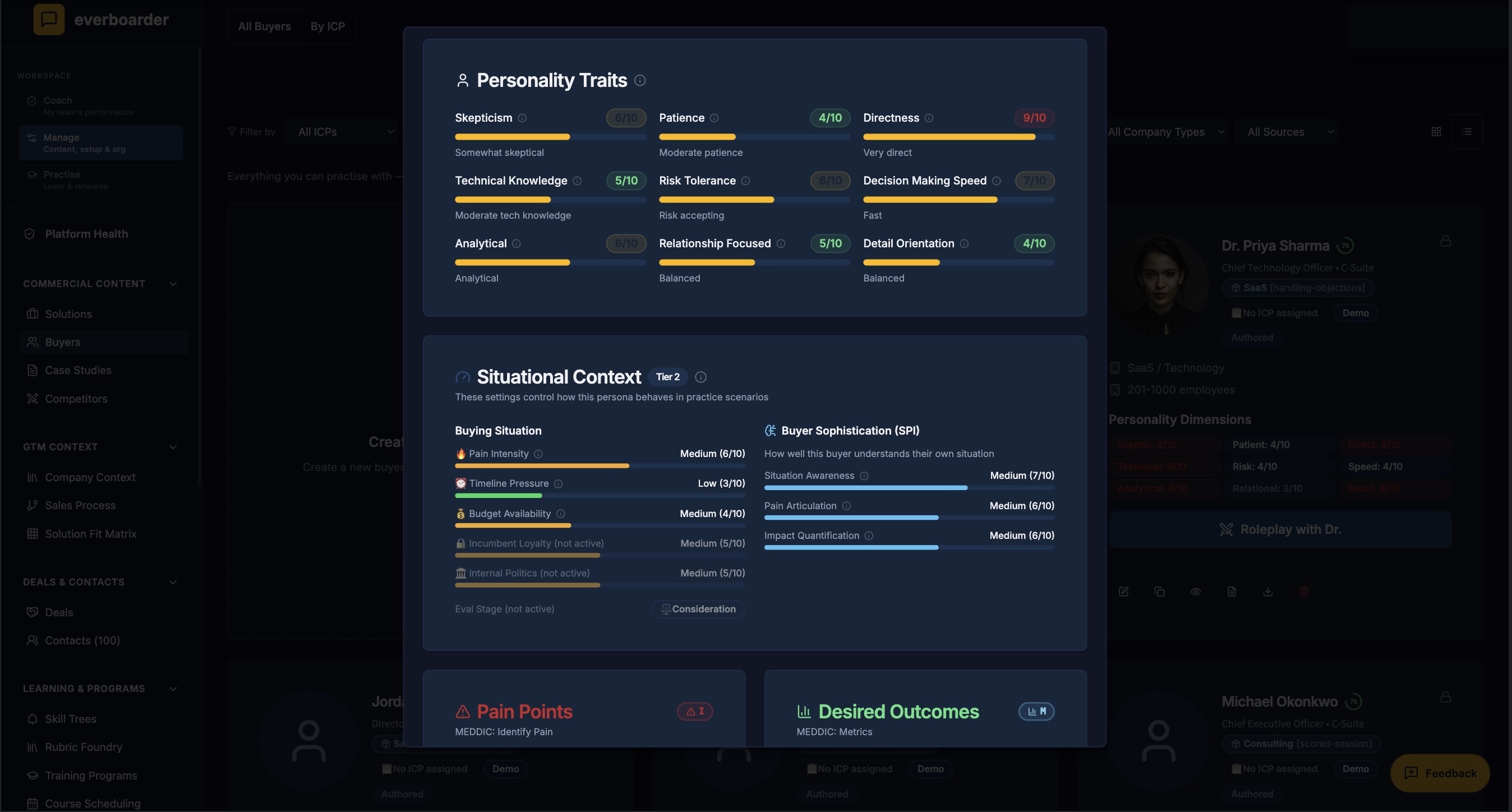
MEDDIC tags live inside the buyer's dials — including Paper Process traps.
Practice qualification only works when the buyer under the microscope has real dimensions to surface. The buyer's Pain Points, Desired Outcomes, and stakeholder posture carry MEDDIC/MEDDPICC tags, and reps have to actually run discovery to uncover them — the champion won't hand you Paper Process unless the ask earns it.
- MEDDIC and MEDDPICC tags on Pain, Outcomes, and stakeholder access.
- Champion posture models the "can't present vendor slides" behaviour real champions have.
- Same taxonomy as the scorecard — one language, learn-side to do-side.
How everboarder helps
How Everboarder differs
Most roleplay tools give you a generic AI partner that is too helpful — names the economic buyer when asked, walks you through procurement, never lets the status quo win. Our practice is built on Contextual Realism: the buyer holds a pre-set scorecard across all eight MEDDPICC dimensions, hides the dimensions a real prospect would hide, and disengages when you skip Paper Process.
The bar is not "useful practice partner." The bar is "felt like the qualification call I had last Thursday." That's why the editable checklist unlocks after practice, not before — the scorecard is only worth anything if you can actually fill it under pressure. Free to start. No credit card.
Track the scorecard
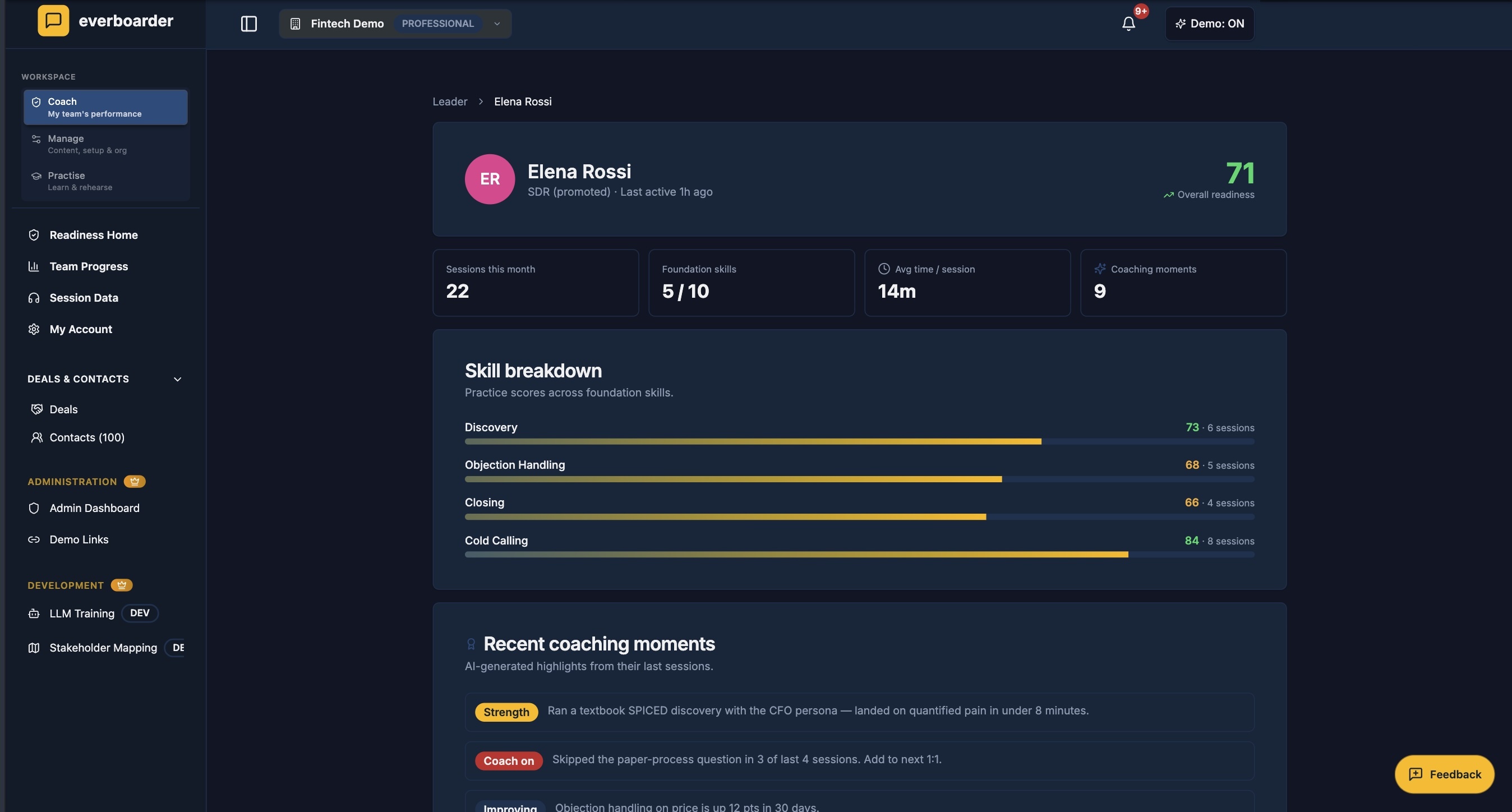
Every practice session tags where the rep skipped a dimension.
MEDDPICC only works if reps improve on the dimensions they habitually skip — usually Paper Process and Competition. The rep readiness profile carries per-dimension coaching moments tagged Strength, Coach on, Improving, so it's obvious across a week of sessions where the pattern is.
- Per-dimension coaching moments across sessions.
- Strength / Coach on / Improving tags — not a vanity chart.
- Manager sees the pattern without watching every replay.
Methodology fit
Which methodology does this align with?
MEDDPICC is the framework; the other three sit alongside it for different deal shapes. MEDDIC is the right framework for mid-market velocity. BANT is the right framework for shorter, inbound cycles. SPIN handles the discovery conversation that surfaces the Identify Pain dimension — MEDDPICC tells you what to validate, SPIN gives you the questions to validate it.
Related templates
Related templates
The six-dimension base framework — Metrics, Economic Buyer, Decision Criteria, Decision Process, Identify Pain, Champion. Right for mid-market velocity deals.
Budget, Authority, Need, Timing — the classic IBM framework. Lightweight qualification for shorter sales cycles and inbound velocity teams.
The forty questions that surface every MEDDPICC dimension in a single sixty-minute discovery call, organised by the order a real call follows.
Customer outcome
Get started
Score the deal before you forecast it
The next deal you commit to is either an 18+ scorecard you've actually validated — or it isn't. Choose the path.
Free to start. No credit card.