
The common sales objections library — 30+ objections and how to answer them
The definitive library of the objections every B2B rep hears — grouped by category, with a LAER-based response pattern for each. Plus the templates and practice paths that turn the framework into behaviour.
Six categories cover the vast majority of B2B sales objections: price, timing, authority, need, competitor, and status-quo. Every rep hears all six regularly. The differentiator between average and top reps is not knowing the objections exist — it's knowing which of the six is really being raised in any given moment, because they're rarely literal.
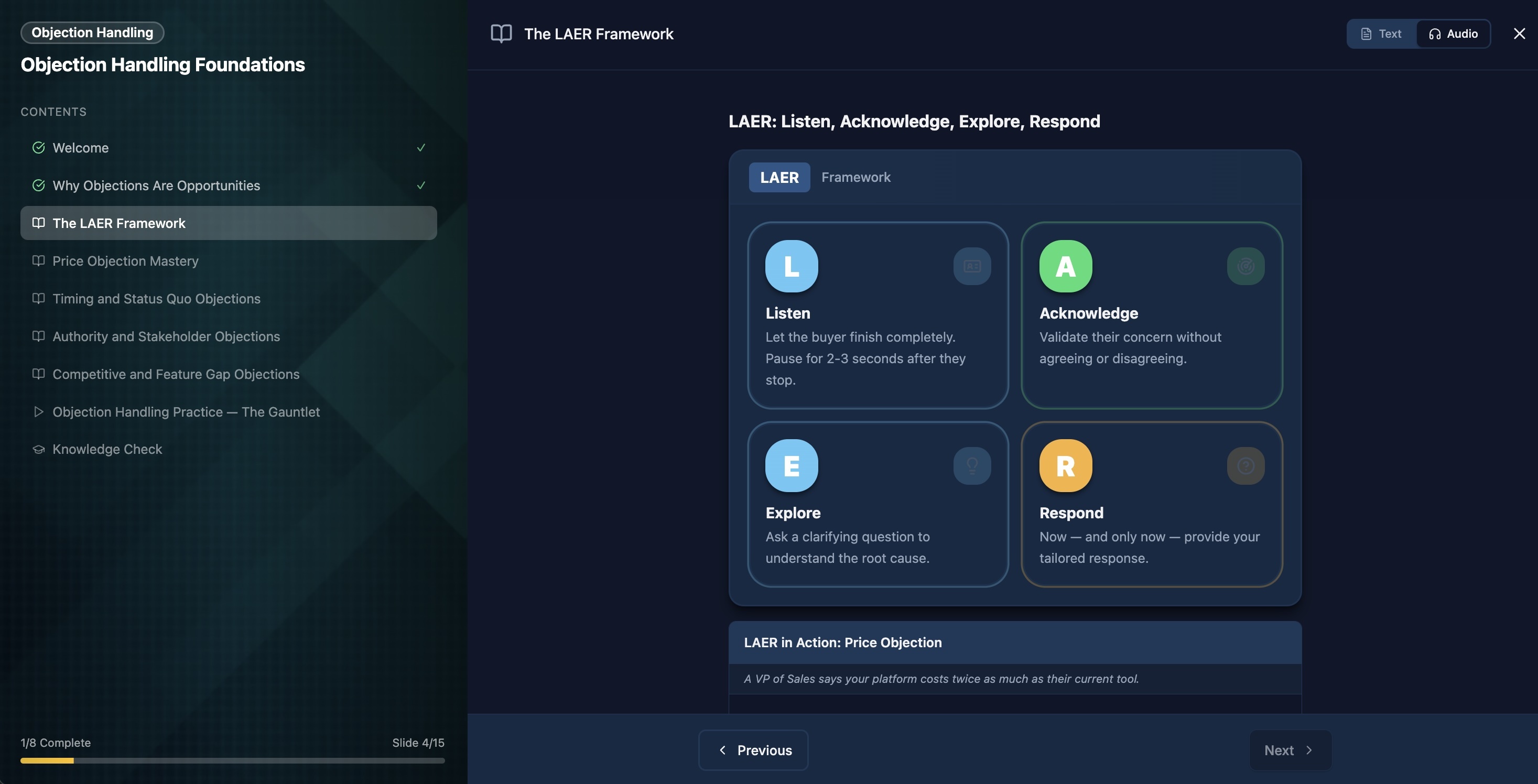
Underneath each objection category, the response pattern is the same: Listen, Acknowledge, Explore, Respond (LAER). Reading the framework is easy. Running it under live pushback — silence when your instinct is to defend, one exploration question when your instinct is to reframe — is the muscle memory that separates certification from behaviour.
For each category below: the common versions of the objection, the LAER response pattern, and the template or framework page to go deeper.
The framework, taught
LAER, taught the way it actually gets used on a call.
Listen, Acknowledge, Explore, Respond. The framework sits inside a proper lesson — with worked segment-specific examples and the line-level moves reps miss most — so the library isn't just a list of objections, it's a model reps have been taught to run.
- The four LAER beats, named and paced.
- Worked examples in reps' segment, not generic B2B.
- Loads straight into a live objection drill on the same page.
Price objections
The most common objection group and the one most reps fumble by defending the number instead of reframing the value. Price objections are almost never really about price — they're about the buyer's ROI defensibility inside their own organisation.
Common versions
- →"Your price is too high."
- →"We don't have budget this quarter."
- →"Your competitor came in 20% cheaper."
- →"We were expecting something in the $X range."
- →"Can you do better on the price?"
LAER response pattern
Listen
Let the buyer name the number they were expecting and the reference point behind it. Silence works here — most reps talk over their own discovery.
Acknowledge
"Yeah — I hear that. Cost is one of the questions I get most." No defence, no immediate reframe. Just landing the acknowledgement.
Explore
"What's the alternative you're comparing against?" or "How is your team measuring ROI on this kind of investment?" — surface the frame the buyer is using.
Respond
Reframe against value. Reference the Metrics from your MEDDIC discovery. Never negotiate the number until Value has been co-quantified.
Go deeper: Price objection script template — 5 fully scripted responses →
Timing objections
Timing objections are stall tactics disguised as scheduling problems. "Not this quarter" usually means "the Champion doesn't have air cover from the Economic Buyer yet." Real timing objections have a specific date attached.
Common versions
- →"Now isn't a good time."
- →"We're revisiting this in Q4."
- →"Call me back in three months."
- →"We're in the middle of a bigger project."
- →"Let's talk after the reorg settles."
LAER response pattern
Listen
The distinction to catch: is there a specific date, or is this a vague push?
Acknowledge
"That makes sense — the reorg is where most of your team's attention is right now."
Explore
"What has to be true in Q4 for this to be a real project? What's driving the timing?" — force specificity or expose the stall.
Respond
If the timing is real, schedule the specific follow-up now. If it's a stall, the exploration usually surfaces the actual objection (budget, authority, unclear ROI) — which you can then handle directly.
Go deeper: Objection Handling — full skill hub →
Authority objections
Authority objections are the load-bearing MEDDIC gap in disguise. "I need to check with my boss" almost always means the seller has been selling to a Coach, not to Power. Handle these badly and the deal dies in the executive review.
Common versions
- →"I need to check with my boss."
- →"This will need approval from the exec team."
- →"Legal / procurement / IT will have to review this."
- →"I don't have sign-off authority above $X."
- →"We'd need to run this by the board."
LAER response pattern
Listen
Hear whether the buyer is naming a specific person, a committee, or vague hand-waving. Vague is a red flag.
Acknowledge
"Totally makes sense — a decision this size needs the right sponsorship."
Explore
"Who else needs to be comfortable with this? What has each of them typically wanted to see before signing off?" — map the Consensus.
Respond
Ask for an introduction. "Would it help if I met with them together to answer questions directly?" A real Champion says yes; a Coach hedges.
Go deeper: MEDDIC — Economic Buyer and Champion identification →
Need objections
Need objections mean the discovery didn't fully surface pain — or the buyer never internalised the pain as costly enough to act on. The fix is upstream: better Implication questions, quantified cost of doing nothing.
Common versions
- →"We're not really looking for this right now."
- →"Our current setup is working fine."
- →"We handle this manually and it's OK."
- →"We don't have this problem."
- →"This isn't a priority."
LAER response pattern
Listen
Notice which version of "we're fine" you're hearing — is the buyer actually fine, or protecting an approach they built and now can't easily replace?
Acknowledge
"Fair enough — most teams don't feel the pain until it's costing something specific."
Explore
"When you look at the time your team spends on this manually, or the errors that creep in during month-end — what's that costing?" Quantified Implication questions.
Respond
Reflect the cost back. If the exploration surfaces real cost, the objection collapses. If it doesn't, the buyer genuinely isn't feeling pain — walk away or park the deal.
Go deeper: SPIN Selling — Implication questions that surface real pain →
Competitor objections
Competitor objections are the buyer signalling that the seller hasn't differentiated on Vision or Value. The wrong move is trashing the competitor; the right move is helping the buyer articulate what "solved" actually looks like for them.
Common versions
- →"We're already using [competitor]."
- →"[Competitor] does the same thing for less."
- →"We're evaluating you against three other vendors."
- →"How are you different from [category leader]?"
- →"Our team is happy with what we have."
LAER response pattern
Listen
Which version of "we're using X" is it? Genuine happiness, mild frustration, or actively looking?
Acknowledge
"That's a great tool — plenty of teams use it well. What's working for you? What's frustrating?"
Explore
Get the buyer to articulate the frustration with the incumbent. Use their language, not yours.
Respond
Reframe against the frustration. Do NOT trash the competitor. "That's exactly the reason our customers switched" — and cite a specific outcome.
Go deeper: Objection Handling Master Library — 25+ scripted responses →
Status-quo objections
The single biggest competitor in every B2B deal is doing nothing. Status-quo objections are the buyer's way of saying "the effort of change isn't worth the outcome." The response is always to raise the cost of inaction, not lower the cost of the purchase.
Common versions
- →"We'll figure something out internally."
- →"Let's revisit this next year."
- →"We can live with the current setup."
- →"Change is disruptive — we'd rather wait."
- →"We tried something like this before and it didn't stick."
LAER response pattern
Listen
Status-quo objections usually surface late in the cycle. Note what the buyer isn't saying — that's usually where the real risk is.
Acknowledge
"Change is real work. Every team we've helped had this same conversation internally."
Explore
"What's the cost of NOT doing anything for another year? What happens to [named pain] over that time?"
Respond
Quantify the cost of inaction against the cost of change. Reference the Critical Event if you have one. If you don't have one, this is why the deal is stalling — go back to discovery.
Go deeper: SPICED — Critical Event and Impact quantification →
Drill at volume
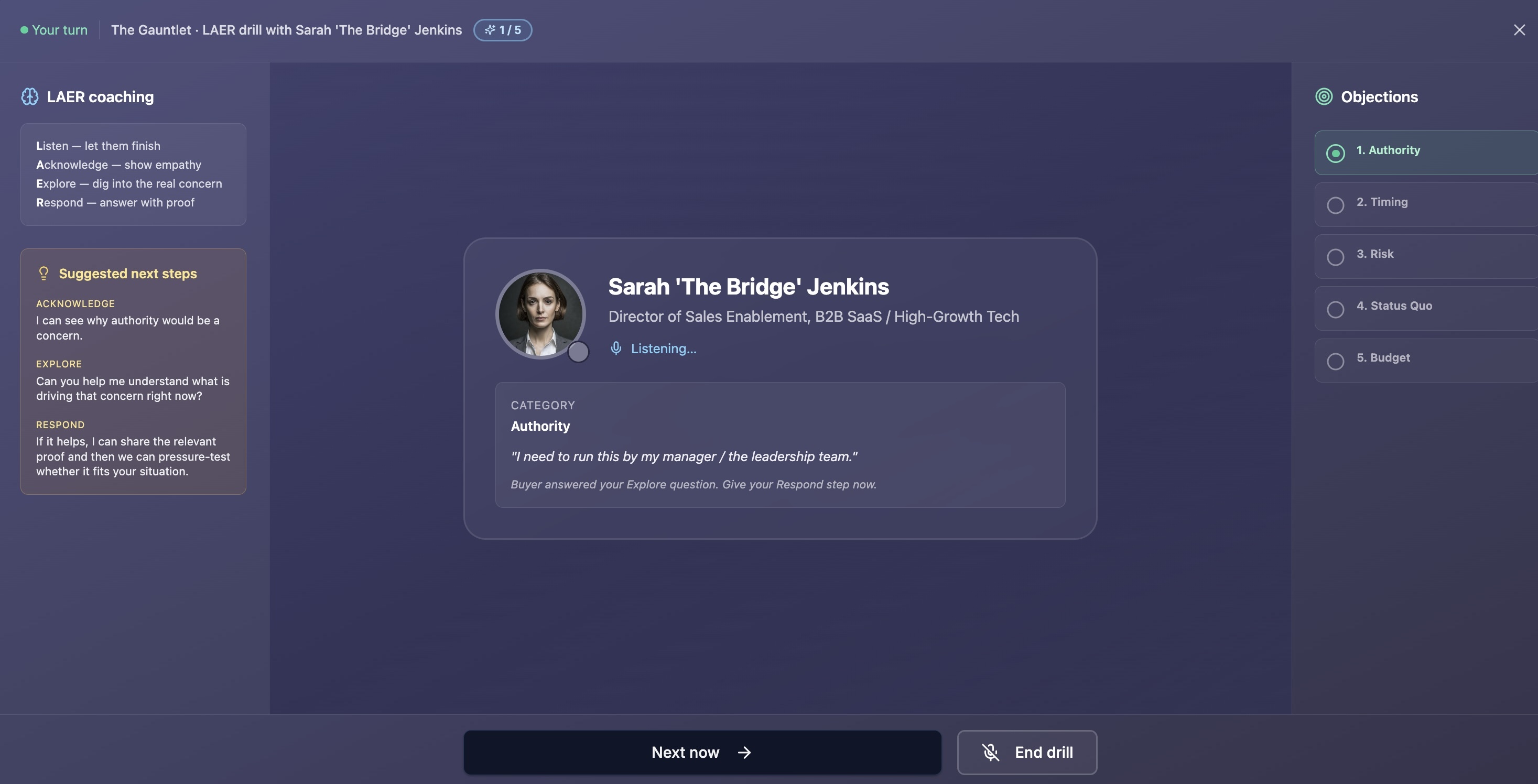
Then run the Gauntlet — five objections queued back-to-back.
The library is 30+ objections; the Gauntlet is five of them queued in sequence, drawn across the six categories, so the drill covers price, timing, authority, need, competitor and status-quo in one ten-minute session. No rep gets a clean run on day one — that's the point.
- Five objections queued — categories rotated across the run.
- Scored against LAER — the Explore beat is where reps drop most points.
- Ten-minute session covers a quarter's worth of live-call learning.
Selling into a specific industry? See the objections buyers raise in cyber security, cloud infrastructure and more.
Practice these against an AI buyer
Reading the LAER framework is not the same as running it when a real buyer pushes back mid-call. Drill each objection type against an AI buyer that resists the way real prospects do — until the response is automatic.
Free to start. No credit card.