

How to handle price objections — script template + AI practice
A battle-tested how-to-handle-price-objections template you can use today — plus an AI buyer you can practise it against in 60 seconds. Most templates give you words on a page. Everboarder gives you the words and the conversation.
Free to start. No credit card.
Or create your account — free to start, no credit card, and your first roleplay is waiting inside.
WHAT YOU GET
What you get
- →Five proven price-objection responses, each in plain conversational language.
- →Mapped to the LAER framework — Listen, Acknowledge, Explore, Respond.
- →Covers the four highest-frequency variants: "too expensive," "we have no budget," "send me a quote," "your competitor is cheaper."
- →Practise each response against an AI buyer who pushes back the way real prospects do.
- →Real-time coaching tips during practice — flags when you concede too quickly.
- →Method-agnostic — works with whatever methodology your team runs.
FAQ
Price objections — direct answers
The eight questions reps actually search for, answered the way you'd answer them on a real call.
WHY IT FAILS
Why most objection handling fails
The rehearsal gap is the first failure. Reps download an objection library, skim it once, and the next time they hear “too expensive” on a live call, they revert to instinct. Reading a doc is not the same as having the words ready under pressure — and pressure is when the objection always arrives.
The second failure is defend-mode. Without rehearsed responses, reps justify the price, list the features, or argue the comparison. None of it converts. The response that works is conversational and curious, not defensive.
The third — and most expensive — failure is missing the objection behind the objection. “We don't have budget” is rarely about budget. It's about priority, authority, or trust. Reps who haven't practised exploration questions take the surface objection at face value and lose the deal to a competitor who asked one more question.

“Can you do it for half that price? We're a small team.”
PRACTICE LIVE
Practise the response before you hear the objection
Run each response against an AI buyer who throws the price objection back the way a real prospect would. Five minutes today beats forty lost deals this quarter.
Practise this price objection script template with AIFree to start. No credit card.
TEMPLATE PREVIEW
Preview the template
The LAER framework and the first response are free. Practise with the AI buyer to unlock all five price-objection responses.
Customer outcome
Drill the price beat
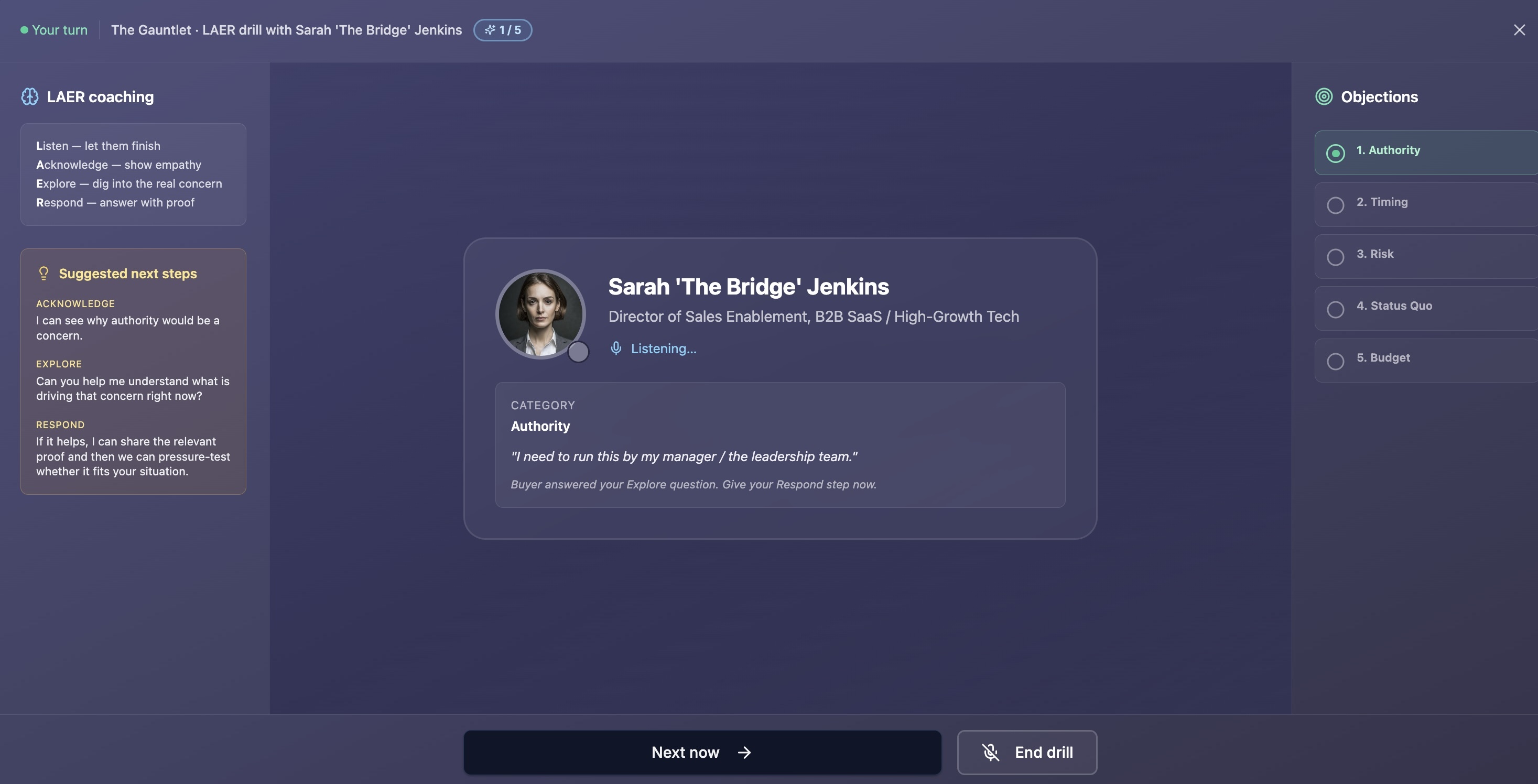
Run the five price objections back-to-back in the Gauntlet.
The Gauntlet queues five objections in sequence — with the five price forms drawn across the run — so the rep meets "too expensive," "send me a quote," and the discount ask under real time-pressure. Concede too early and the buyer disengages; skip the explore step and it shows up on the scorecard.
- Five objections queued — the price forms rotated with authority and stalling variants.
- Scored against LAER — the Explore beat is where most reps drop points.
- Ten-minute session covers a quarter's worth of live-call learning.
TEMPLATE SECTIONS
Five price-objection responses, each on LAER
Same four-step structure, five different objections. Use the response that matches what the prospect actually said — and practise it before you hear it live.
"Too expensive"
How do I respond when a prospect says we're too expensive?
- ListenHear the full sentence. "Too expensive" almost always has a comparison hiding behind it — wait for it.
- Acknowledge"That's fair — price is the easiest thing to push back on." Disarms the negotiation reflex without conceding.
- Explore"What are you comparing it to?" Then stop talking. The answer tells you whether you are competing with a tool, an internal build, or doing nothing.
- RespondAnchor on the cost of the alternative they just named. Around seventy per cent of "too expensive" objections evaporate once the comparison shifts from your price to the cost of the status quo.
What NOT to say
"Let me see what I can do on price." That trains the prospect to push every time and tells them the number was never real.
"We have no budget"
What do I say when a prospect tells me they don't have budget?
- ListenDistinguish 'no budget allocated' from 'this is not a priority.' The two need different responses and reps confuse them constantly.
- Acknowledge"Makes sense — most teams we work with weren't budgeted for this when we first talked."
- Explore"If we got there — if the ROI was clear and the timing was right — what would have to be true for budget to appear?" That question separates real no-budget from no-priority.
- RespondReframe to an adjacent budget line: "Most teams fund this from the enablement budget because the ROI shows up in ramp time, not in tooling spend." Then qualify the priority question that surfaces.
What NOT to say
"When does the new budget cycle start?" That parks the deal in six months and gives the prospect a polite way to ghost you.
"Send me a quote"
How do I handle 'send me a quote and I'll think about it'?
- ListenThis is almost never a real quote request. It is a polite exit — but it is also a chance to turn deflection into qualification.
- Acknowledge"Happy to send something over." Do not push back on the request itself — push back on the vagueness.
- Explore"So I send the right thing — what's the one number you'd need to see to decide it's worth a deeper conversation?" That question forces a real criterion.
- RespondIf they name a criterion, you have a qualified deal and a reason for a follow-up call. If they cannot name one, you have a polite no — and the time you would have spent building a quote goes back into pipeline that can actually close.
What NOT to say
"Sure, I'll have that over by end of day." You just committed to unpaid work for a prospect who has not committed to anything.
"Competitor is cheaper"
What's my response to 'your competitor is cheaper'?
- ListenGet the competitor's name. "Cheaper than what" is the first piece of information you need — and reps forget to ask.
- Acknowledge"They are. We chose not to compete on price." Said calmly, that line resets the whole conversation.
- Explore"What's the cost to your team if the solution you pick doesn't actually move the metric you care about?" Now you are comparing outcomes, not invoices.
- RespondDifferentiate on cost-of-status-quo and cost-of-getting-it-wrong, never on feature checklists. The buyer rarely picks the cheapest option in B2B — they pick the option they are most confident will work.
What NOT to say
"We're actually better than them because…" Trashing the competitor reads as insecure and is the fastest way to lose the deal you were about to win.
"Can you discount?"
What do I say when asked for a discount?
- ListenHear whether it is a real ask or a reflex. Procurement reflexes sound different from CFO asks — both deserve a different response.
- Acknowledge"I get the ask — every CFO asks the same question." Normalises the request without conceding the answer.
- Explore"Help me understand what would make the current number work — is it the absolute amount, the payment terms, or the scope?" The answer tells you what to actually negotiate.
- RespondStand firm without ego: "We don't discount, because we'd need to take something out — which part of the solution would you want to leave out?" That keeps the conversation on value, not on margin.
What NOT to say
"Let me check with my manager." Translation: 'I will be back with a discount.' You have already lost the price conversation.
HOW EVERBOARDER HELPS
How Everboarder differs
Most roleplay tools give you a generic AI partner that is too helpful — soft price objections, accepts the first reframe, never pushes back twice. Our practice is built on Contextual Realism: the buyer has a pre-set pain, budget, authority and timeline; the price objection varies by persona and segment; and the buyer disengages when you concede too quickly or skip the explore step.
The bar is not “useful practice partner.” The bar is “felt like the CFO conversation I had last Thursday.” That's why the editable script unlocks after practice, not before — the response is only worth anything if you can actually deliver it under pressure. Free to start. No credit card.
METHODOLOGY FIT
Which methodology does this align with?
Price objections reveal missing dimensions in your qualification — uncovered Economic buyer in MEDDIC, missing Paper Process in MEDDPICC, soft Budget in BANT, an unquantified Implication in SPIN. The LAER explore step is often the moment you discover which dimension you missed earlier in the deal.
RELATED TEMPLATES
Related templates
The pillar page for the whole cluster — frameworks, use-cases, methodology integration, and every objection template in one place.
The full objection map — price, authority, timing, competitor, stalling — with rehearsed responses for every category.
Most price objections start on the cold call. The Hook → Bridge → Value → Soft Ask structure handles the early ones before they harden.
Customer outcome
GET STARTED
Stop losing deals on price
The next price objection you hear is one you've already practised — or it isn't. Choose the path.
Free to start. No credit card.