
How to cold call — a step-by-step guide
The complete guide to making a sales call — research, list, opener, gatekeeper, bridge, first objection, closing for the meeting, follow-up. Seven steps with the tactical version of each, plus the templates and practice paths that turn the guide into muscle memory.
Cold calling is a repeatable skill, not a personality trait. Top SDRs aren't smoother than everyone else — they've drilled the seven steps below more times. Each step is a specific moment: research (before), opener (first 15 seconds), gatekeeper (if there is one), bridge (next 30 seconds), first objection (almost always in the first 90 seconds), meeting close, follow-up.
Reading the guide is easy. Running each step under live pushback is the muscle memory that separates certification from behaviour. The sections below cover the tactical version; the templates and simulator links let you drill each one.
Research and build the list
The single biggest predictor of a cold-call meeting isn't the opener — it's the list. A sharp 50-account list with real triggers beats a 500-account blast every time. If your dial-to-meeting rate is broken, look at the list first.
Start with your Ideal Customer Profile (ICP) — the segment where you have real proof, not the segment where you hope to sell. If your top 10 customers are all Series-B SaaS with 50–200 employees, that's the ICP. Not "any tech company."
Layer in real triggers: recent funding, new leadership hires, product launches, competitive moves, hiring pushes for the relevant role. Triggers are the reason for the call — they turn "I'm reaching out" into "I'm reaching out because I saw [thing]."
Use LinkedIn Sales Navigator, Apollo, ZoomInfo, or your CRM's segmentation to build the list. Aim for 30–50 named accounts per week, not 500 uncategorised leads. Depth beats breadth on cold outbound.
Prioritise ruthlessly. Score each account by ICP fit + trigger strength + reachability. Call the top 20 first. Come back to the tail only after the top has been worked twice.
Go deeper: Cold Calling — full skill hub →
Prepare the opener
The first 15 seconds decide the next 45. Reps who show up without a specific opener default to "how are you?" and lose the buyer in three seconds. Pick a hook type that fits the prospect and drill it until the delivery is automatic.
Pick one of four hook types based on what you know about the prospect: pattern-interrupt (busy skeptic — "I'll be honest, this is a cold call, do you want to hang up or give me 30 seconds?"), permission-based (guard up but not hostile — "can I borrow 27 seconds?"), referral or trigger-event (you have a specific signal — "I saw [thing]"), or problem-led (segment insight — "most [role]s I speak to are wrestling with [pain]").
Keep the opener to 10–15 seconds. Longer triggers the pitch alarm and burns the interrupt opportunity. Slow the pace — reps rush the opener because they're nervous, and fast delivery reads as scripted.
Practice the opener out loud before the first dial of the block. Three reps, no audience. Muscle memory doesn't develop reading the words silently in your head.
Go deeper: Cold Call Opening Lines — 25+ openers by hook type →
Learn
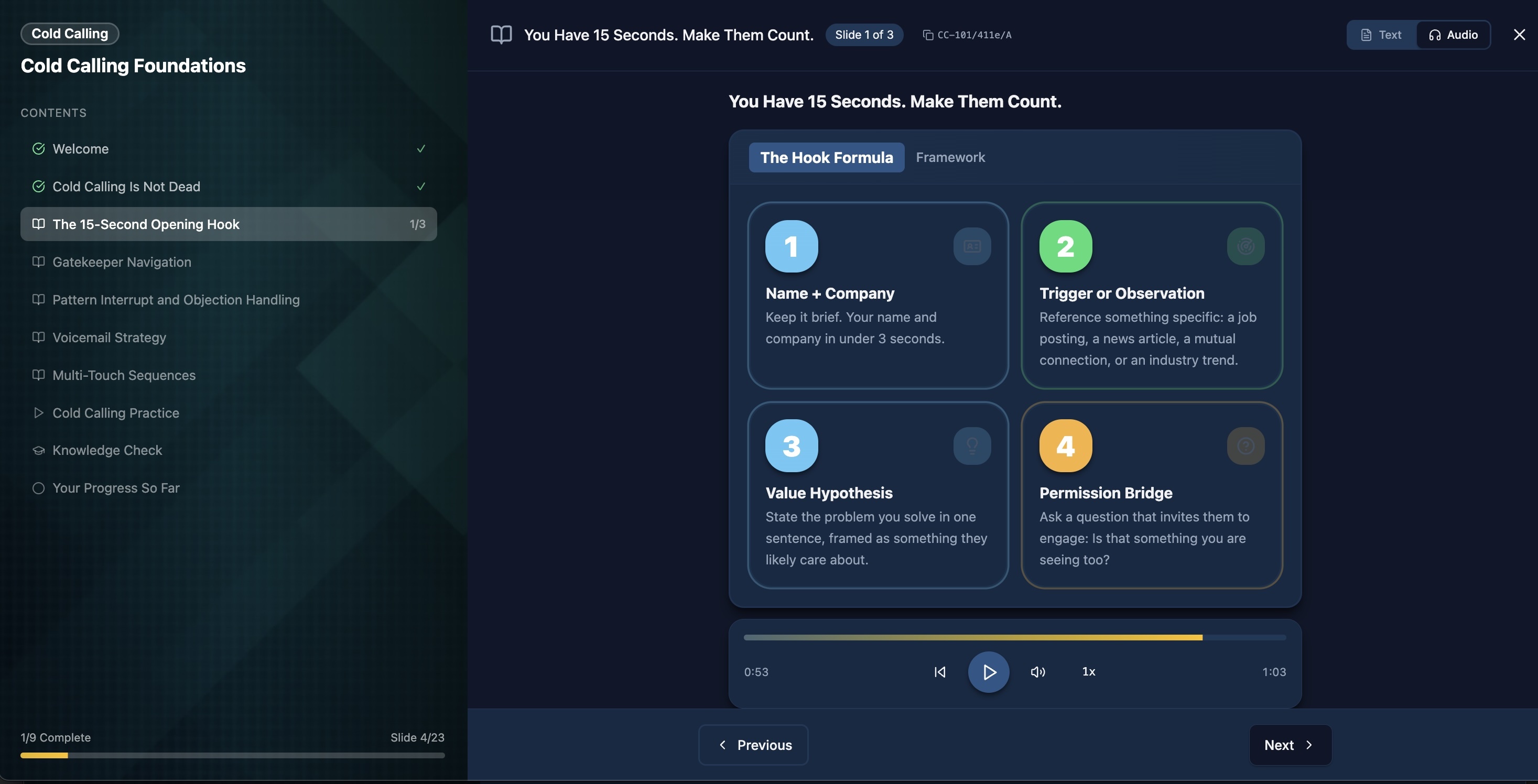
The 15-second opening hook, broken into four beats.
Name and Company. Trigger. Value Hypothesis. Permission Bridge. Reps learn the shape of an opener the way it actually gets used on a call — not as a script to read, but as a structure to internalise, with worked examples in the segment they sell into.
- The four opener beats, named and paced.
- Worked examples in reps' segment, not generic B2B.
- Loads straight into a live practice on the same page.
Get past the gatekeeper
Gatekeepers are professionals — they screen for sales calls all day. Beating them is not about tricks; it's about treating them like a person and asking directly for what you need.
Use the prospect's first name confidently. "Is [name] around?" — direct, no explanation. Sounds like a peer, not a pitch.
If you're screened, ask when the best time to call back is. Gatekeepers who won't put you through will often tell you when the prospect is usually free. That intel is worth 10x the failed attempt.
Try adjacent times — 8am, 5pm, lunch hour. Gatekeepers work standard hours; prospects often don't. A dial at 8:07am or 5:23pm goes direct more often than a 10am dial.
Never lie about who you are or why you're calling. "Just a quick question about a project" said in a certain tone burns your credibility at that company permanently.
Go deeper: Cold Call Script Template — 60-second script with 5 opener variants →
Run the bridge — earn the next 30 seconds
After the opener, the buyer's thinking "why is this call worth my time?" The bridge answers that in one sentence — connecting a specific problem in the buyer's world to what you do. This is where SPIN's Situation and Problem questions live.
One sentence. Specific to the buyer's segment, not your product category. "Most [role]s at [segment] are wrestling with [specific pain]" — reference the trigger you found in step 1.
Then ask ONE question. Not three. "Is that landing for you, or is it a non-issue?" gives the buyer permission to redirect or engage. Reps who fire three questions after the bridge sound interrogative and lose the room.
Use silence. Ask the question and wait. Reps who fill the silence after a question undo their own discovery. The buyer needs 2–3 seconds to formulate the honest answer.
Go deeper: SPIN Selling — Situation and Problem questions →
Practice this step: Drill the bridge + first-question sequence 10–15 times against an AI buyer before your next live block. Try the cold call simulator →
Handle the first objection cleanly
On a cold call, the first objection is almost never a real objection — it's a defensive reflex. "Send me some info," "I'm not interested," "we already use X." LAER them; don't fight them.
Listen. Silence works — let the buyer land the objection fully before responding. Two seconds of pause feels like an hour but keeps the conversation open.
Acknowledge without agreeing or defending. "Fair enough — I caught you cold." That's it. No reframe, no counter-argument.
Explore with ONE question. "What's the alternative you're comparing against?" or "When you say 'not interested' — is that 'not right now' or 'not ever'?" — one specific question that surfaces the real concern.
Respond to the real concern the exploration revealed, not the surface objection. If the exploration exposed that the objection was a mask (usually authority or timing), handle the real one.
Go deeper: Common Sales Objections Library — LAER for all six categories →
Do
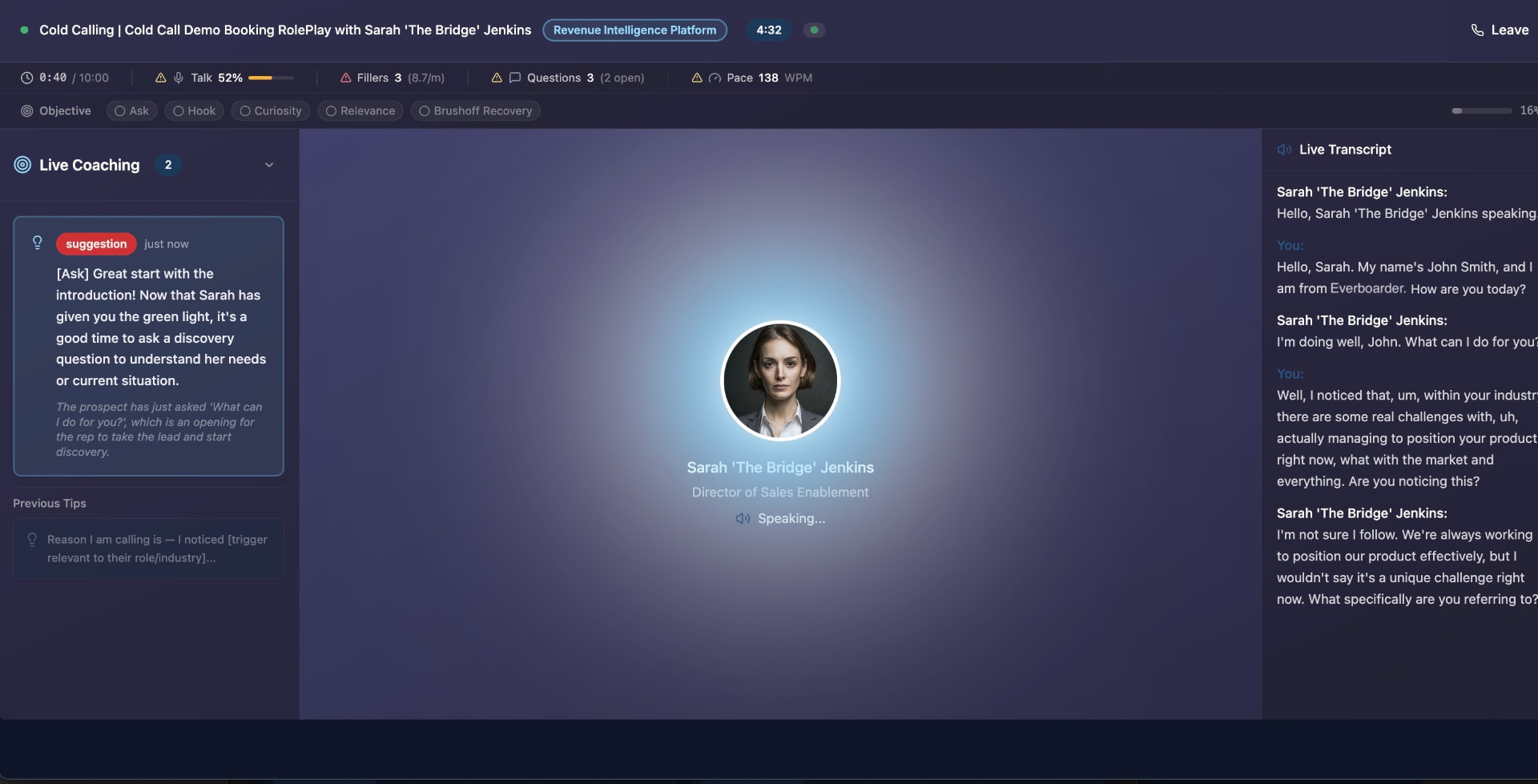
Then run it live — with the objection landing at 40 seconds in.
Reading the LAER walkthrough is not the same as running it under a real reflex-objection. The AI buyer picks up and delivers the first-objection push exactly the way a live prospect would — with pace, filler, and talk-ratio meters running so the rep can see the call they're actually making.
- Live pace, filler, and talk-ratio meters mid-call.
- Buyers who withhold — polished answer first, real pain only if the follow-up earns it.
- Five-minute sessions. Twenty reps in a week, no manager needed.
Ask for the meeting explicitly
The goal of a cold call is a booked meeting — not a demo, not a close, not "getting to know each other." Reps who ask for the meeting explicitly book more than reps who hint at it.
Ask for a specific window. "Does 15 minutes Thursday at 2 or Friday at 10 work better?" Two specific options force a decision. "Can we book a meeting sometime?" gets deferred forever.
Suggest 15 minutes, not 30. Buyers say yes to 15 more than 30 — the friction is lower and they know they can escape. 15 minutes almost always runs to 30 anyway.
Book while you're on the call. Send the calendar invite before you hang up. "Can I lock that in now?" Show rate drops from ~80% to ~60% when the invite goes 24 hours later.
Go deeper: Practice closing for the meeting on an AI buyer →
Follow up in the 90 seconds after the call
The 90 seconds after the call decide whether the meeting actually happens. Fast, specific follow-up separates reps who book from reps who chase.
Send the invite from the call itself — not "in the next hour." Type it while the buyer is talking; confirm it while you're still on the line.
Two-line follow-up email. Reference one specific thing from the call, restate the next step, stop. Long follow-up emails read as desperation.
Add the prospect on LinkedIn with a personal note. "Great to speak — looking forward to Thursday at 2." Ten seconds, higher show rate. The connection signals the meeting is real.
Log the call outcome in the CRM before the next dial. Fresh detail is the only kind that survives.
Review
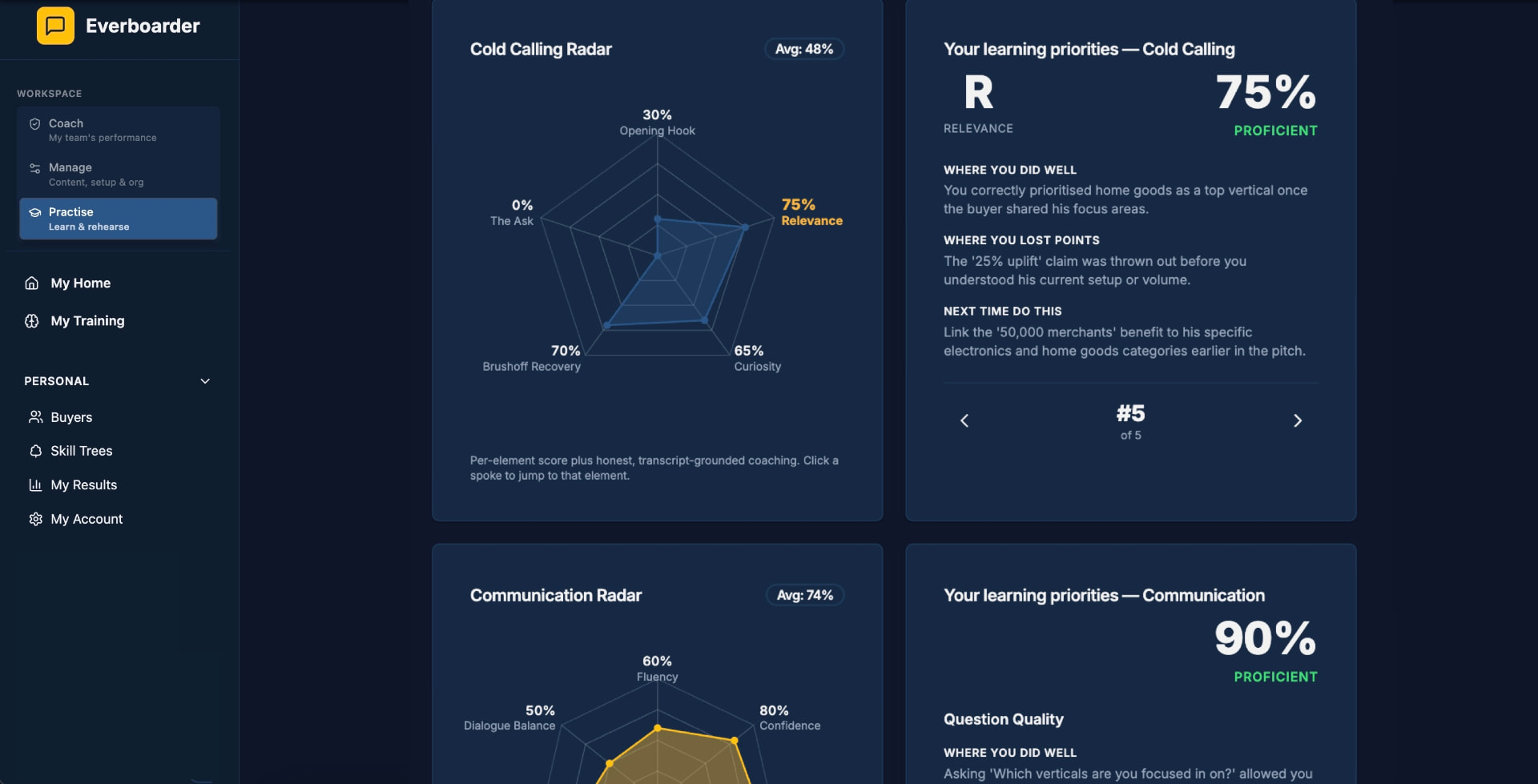
Then score it against the five elements the guide just taught.
Every practice session ends with a scorecard: hook, relevance, curiosity, brush-off recovery, and the ask. The same five things this guide teaches — scored against a transcript, with the specific line-level moments the rep did well, lost points on, and should try next time.
- Radar scored on the five elements the guide names.
- "Where you did well / lost points / next time" — grounded in the transcript.
- The article and the product use the same vocabulary.
Run the whole flow against an AI buyer
Reading the seven steps is not the same as running them back-to-back under live pushback. Practice a full cold call — opener through meeting close — against an AI buyer until the sequence is automatic.
Free to start. No credit card.