
27 cold calling tips that actually work
Practical tactics from top SDRs, grouped by call stage — pre-call research, opener, gatekeeper, objections, closing for the meeting, and follow-up. Plus the templates and practice paths that turn the tips into muscle memory.
Cold calling is a skill, not a personality trait. Top SDRs aren't smoother than everyone else — they've drilled the specific moments (the opener, the gatekeeper ask, the first-objection response) more times. Each tip below is one of those moments, with the tactical version of the fix.
Reading the tips is easy. Running them under live pushback is where the meeting is won or lost. The soft CTA at the end links to the practice bot for drilling.
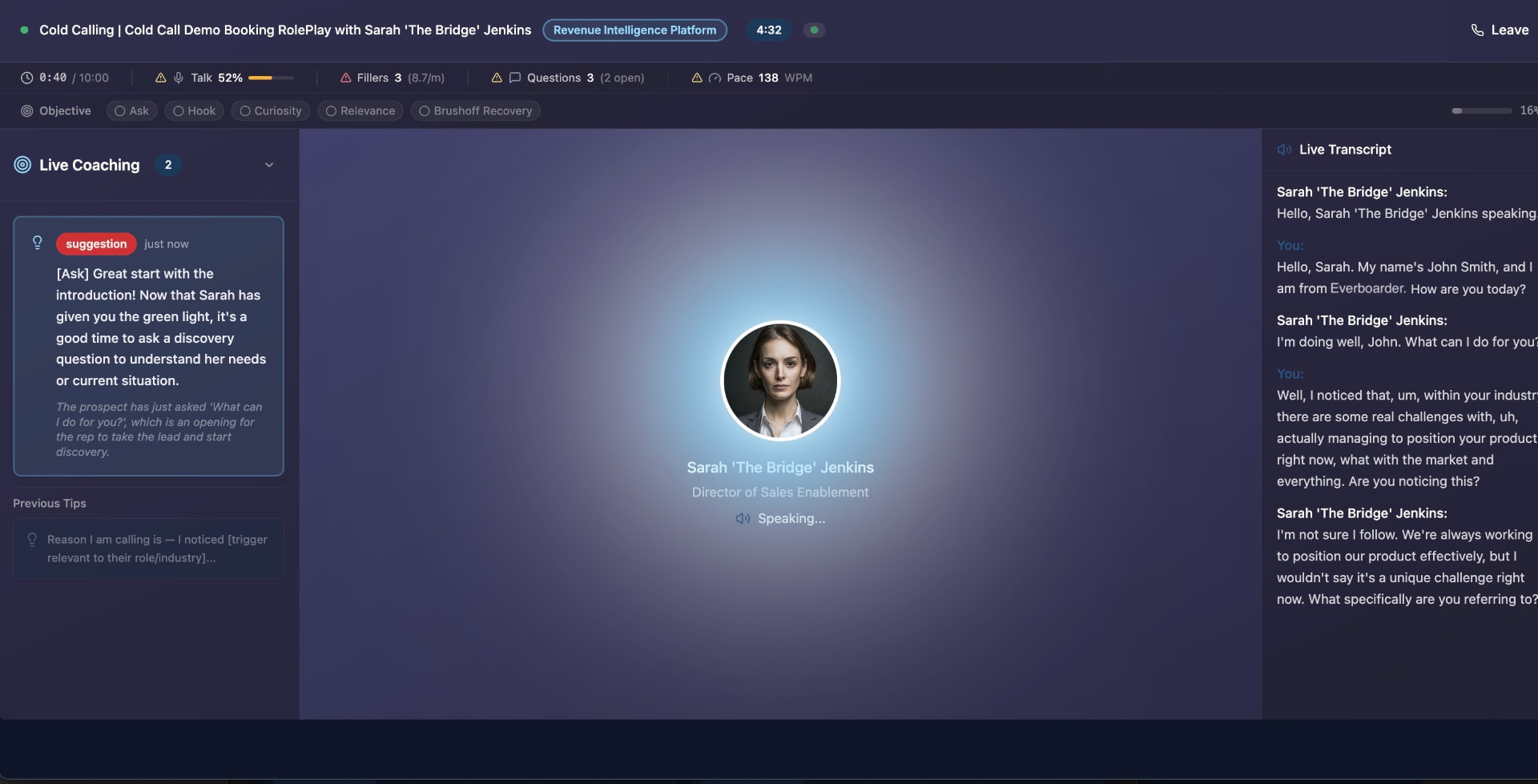
What drilling looks like
The tips only matter if you've said them out loud under pushback.
Reading a list of cold-call tactics is easy; running them at 40 seconds into a live call with a skeptical buyer is not. The AI buyer picks up, delivers the same brush-offs a real prospect would, and the pace, filler, and talk-ratio meters run in real time so the rep can see the call they're actually making.
- Live pace, filler, and talk-ratio meters mid-call.
- Buyers who withhold — polished answer first, real pain only if the follow-up earns it.
- Five-minute sessions. Twenty reps in a week, no manager needed.
Before the call
The single biggest predictor of a cold call landing is what happened in the 60 seconds before the dial. Research, list quality, and mental prep separate the reps who book meetings from the reps who play voicemail bingo.
Research the trigger, not the org chart
Two minutes on LinkedIn looking for a specific trigger — funding, hire, product launch, competitive move — beats 20 minutes memorising the corporate structure. The trigger is the reason for the call.
Time-block your dial sessions
Cold calling is a state, not a task. Fifteen dials in a focused 45-minute block outperforms 40 dials scattered across the day. The state cost of switching in and out is what kills the connect rate.
Practice the opener out loud before dialling
Reading the opener silently in your head is not the same as saying it. Say it three times before the first dial — the delivery only sounds like the rep after the vocal muscle memory is warm.
Have the follow-up email ready before you dial
If the buyer says "send me some info," you want the email drafted in ten seconds, not written from scratch after the call. Momentum matters.
Go deeper: Cold Calling — full skill hub →
The opener
The first 15 seconds decide whether you get the next 45. Reps who default to "how are you?" burn the pattern-interrupt opportunity in three seconds. Reps who pick a hook that fits the prospect earn the meeting.
Never open with "how are you?"
It signals "sales call" in three seconds and triggers the hang-up reflex. Use a pattern-interrupt, a permission ask, or a specific trigger reference instead.
State that it's a cold call
"I'll be honest — this is a cold call. Do you want to hang up, or give me 30 seconds?" The pattern-interrupt version. Acknowledging the awkwardness disarms it.
Ask for a specific window of time
"Can I borrow 27 seconds?" — permission-based openers work when the buyer's guard is up but not hostile. Odd numbers land better than round ones.
Reference a real trigger, not a generic industry pain
"I saw [thing] — that usually means [pain]. Is that landing on your desk?" — trigger openers work when you have a specific signal to reference.
Keep the opener to 15 seconds
Longer than that triggers the pitch alarm. The opener's only job is to earn the next 45 seconds of attention, not to close the meeting.
Slow down the pace
Reps rush the opener because they're nervous. Slow delivery signals confidence and lets the buyer track what you're saying. Fast delivery signals script-reader.
Go deeper: Cold Call Opening Lines — 25+ openers by hook type →
The gatekeeper
Gatekeepers are professionals — they screen sales calls all day. Beating the gatekeeper is not about tricks; it's about treating them like a person and asking for the specific thing you need without the sales-y hedging.
Get the gatekeeper's name and use it
"Hi, this is [name] from [company] — is [prospect] around?" Direct, first-name, no explanation. Sounds like a peer, not a pitch.
Ask when the prospect is usually free
If the gatekeeper won't put you through, ask when the best time to call back is. They'll often give you a specific window — which is worth 10x the current attempt.
Don't lie about who you are or why you're calling
"Just a quick question about a project" said in a certain tone burns your credibility permanently at that company. Be honest — you're a sales rep, and you have a specific reason to reach the prospect.
Try adjacent times — 8am, 5pm, lunch
Gatekeepers work standard hours. Prospects often don't. A dial at 8:07am or 5:23pm goes direct more often than a 10am dial does.
Go deeper: Cold Call Script Template — full 60-second script →
Handling objections on the call
Cold-call objections are almost always defensive reflexes, not real objections. "Send me some info," "I'm not interested," "we already use X" — the buyer hasn't heard enough to have a real objection yet. LAER them, don't fight them.
Match the buyer's energy, then bring it up
If the buyer is curt, don't be chirpy. Match the tone, then gently lift it once you've earned the next 30 seconds. Buyers tune out mismatched energy in the first three words.
Never argue with an objection
The moment you defend, the buyer hangs up. Acknowledge, explore, then respond — in that order. LAER works on cold calls because the buyer has no context for you yet.
Ask one specific exploration question, not three
"What's the alternative you're comparing against?" is one question. Reps who fire three questions after an objection sound interrogative and lose the room. One question, then silence.
"Send me some info" is not a yes
It's almost always a polite hang-up. Either qualify further ("happy to — what specifically would be most useful?") or exit cleanly. Sending generic info to buyers who aren't leaning in is how you burn 3-hour email cycles for zero meetings.
The Champion test works on cold calls too
"Would it be useful to see how [specific person at similar company] handled this?" — a small ask that filters real interest from politeness.
Go deeper: Common Sales Objections Library — LAER for all six objection types →
Closing for the meeting
The goal of a cold call is a booked meeting, not a demo, not a close, not "getting to know each other." Reps who ask for the meeting explicitly book more than reps who hint at it.
Ask for a specific time, not "a meeting"
"Does 15 minutes Thursday at 2 or Friday at 10 work better?" Two specific options force a decision. "Can we book a meeting sometime?" gets deferred forever.
Suggest 15 minutes, not 30
Buyers say yes to 15 more than they say yes to 30 — the friction is lower and they know they can escape if they need to. 15 minutes almost always runs to 30 anyway.
Book while you're on the call
Send the calendar invite before you hang up. "Can I lock that in now?" — momentum matters. A meeting booked 24 hours later drops from 80% show rate to 60%.
Send the invite from the call, not "in the next hour"
Type the invite while the buyer is talking. Confirm it while you're still on the line. "I've just sent the invite — you should see it. Anything else you need before the call?"
Go deeper: Practice cold-call meeting closes against an AI buyer →
After the call
The 90 seconds after a cold call decide whether the meeting actually happens. Fast, specific follow-up separates reps who book from reps who chase.
Log the call outcome in the CRM before the next dial
Two minutes now beats 20 minutes at the end of the day trying to reconstruct what happened. Fresh detail is the only kind that survives.
Follow up with a two-line email — not a novel
Reference one specific thing from the call, restate the next step, and stop. Long follow-up emails read as desperation.
Add the prospect on LinkedIn with a personal note
"Great to speak — looking forward to Thursday at 2" — 10 seconds, higher show rate. The connection signals the meeting is real.
Practice the moments you struggled with
The five seconds where you fumbled — the opener that didn't land, the objection you overcorrected on — that's next week's practice focus. Feedback in the moment, not three days later.
Go deeper: Cold Call Simulator — drill the moments you fumbled →
The moment you fumbled
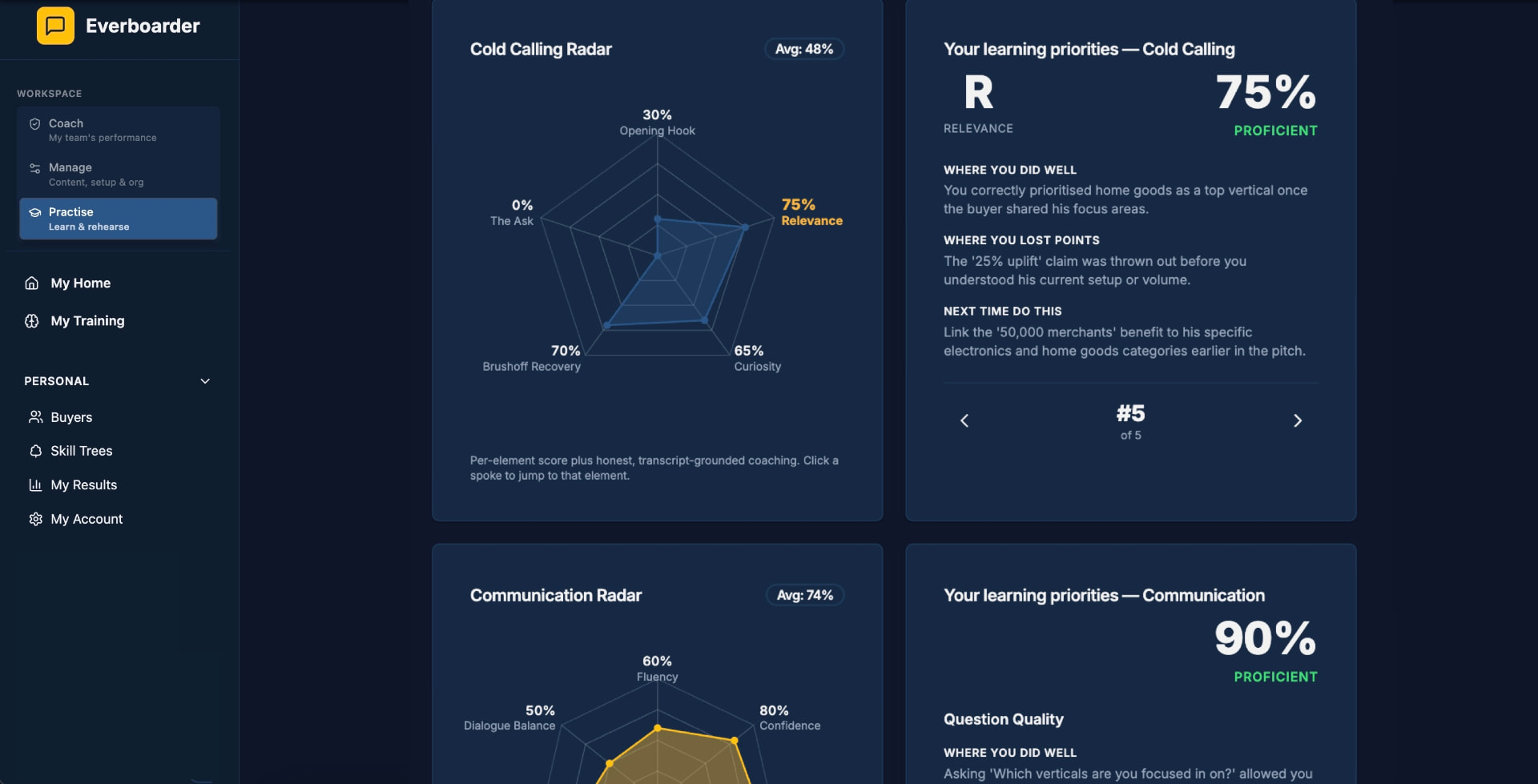
Every session ends with a scorecard on the five things that matter.
Hook. Relevance. Curiosity. Brush-off recovery. The ask. The scorecard is transcript-grounded — the exact line where the opener didn't land shows up as a moment on the coaching card, so tip #27 ("practice the moments you struggled with") stops being a slogan and becomes a queue.
- Radar scored on the five elements the tips are organised around.
- "Where you did well / lost points / next time" — grounded in the transcript.
- The fumble moments become tomorrow's practice focus.
Practice these on an AI buyer
Reading tactics is not the same as running them under live pushback. Drill the opener, the gatekeeper ask, and the first-objection response against an AI buyer until each one is automatic.
Free to start. No credit card.